




What Is D-Mannose and How Does It Work
-
By Chris Jones
Written by Chris Jones | Last updated June 2026 | Social Media Manager at Nutrivity (7+ years in the UK supplement industry)
What Is D-Mannose and How Does It Work?
D-Mannose has become one of the most popular urinary health supplements in the UK, yet many people who buy it have only a vague idea of what it actually is. This article explains D-Mannose from the ground up — what it is chemically, where it comes from, how it works in the body, and why people take it as a supplement.
This is part of our complete D-Mannose guide. For the full topic hub, see: D-Mannose Supplements: The Complete Guide.
Quick Answer on What is D-mannose and how does it work?
-
Natural Isomer of Glucose: D-Mannose is a naturally occurring simple sugar that differs structurally from glucose, meaning it is poorly metabolised for energy and passes largely intact through the kidneys directly into the urine.
-
Anti-Adhesion Mechanism: It targets E. coli bacteria—the cause of 80–90% of uncomplicated UTIs—by flooding the urinary tract with free-floating sugars that bind to the bacteria’s surface appendages, allowing them to be flushed out during urination.
-
Preventative Supplement, Not Medicine: Because it does not possess antibiotic properties, it will not disrupt the gut microbiome, making it an excellent daily preventative habit rather than an acute treatment for active infections.
What Is D-Mannose?
D-Mannose is a monosaccharide — a simple, single-unit sugar — that occurs naturally in the human body and in a range of fruits and vegetables. It is found in small amounts in apples, peaches, oranges, cranberries, green beans, and broccoli. Structurally, D-Mannose is an isomer of glucose, meaning it has the same chemical formula (C₆H₁₂O₆) but a different three-dimensional arrangement of atoms. This difference in structure is significant because it means the body processes D-Mannose differently to glucose.
When you consume glucose, the body uses it as a primary energy source through metabolism. D-Mannose follows a different path. The small amount found naturally in food is partially absorbed in the small intestine, but it is not efficiently metabolised for energy. Instead, much of it passes into the bloodstream and is filtered by the kidneys, entering the urine in relatively high concentration compared to other sugars. This is the property that makes D-Mannose useful as a urinary health supplement — it reaches the urinary tract in meaningful amounts.
Where Does D-Mannose Come From?
D-Mannose in supplement form is not extracted directly from fruit. Concentrations in whole food sources are far too low to produce a supplement dose practically or economically. Instead, D-Mannose used in supplements is typically produced through one of two main processes.
Birch wood extraction
One well-established method involves extracting D-Mannose from birch wood. The wood is processed to isolate mannose without the use of harsh chemical solvents. Some brands — most notably SC Nutra, formerly Sweet Cures — specifically highlight birch sourcing as a mark of purity and natural origin. Birch-sourced D-Mannose contains both alpha and beta forms of the molecule, which some suppliers consider advantageous.
Glucose epimerization
The other main production method is glucose epimerization, a chemical process in which glucose is converted to D-Mannose by changing the arrangement of atoms at one specific carbon position. The end product is chemically identical D-Mannose. This process is commonly used in large-scale supplement manufacturing and is considered safe and effective. Corn-derived glucose is often the starting material.
The end product from both methods is the same molecule. Whether the source matters to the buyer is a question of personal preference and transparency expectations rather than a meaningful difference in the supplement’s function.
OUR TOP RECOMMENDED
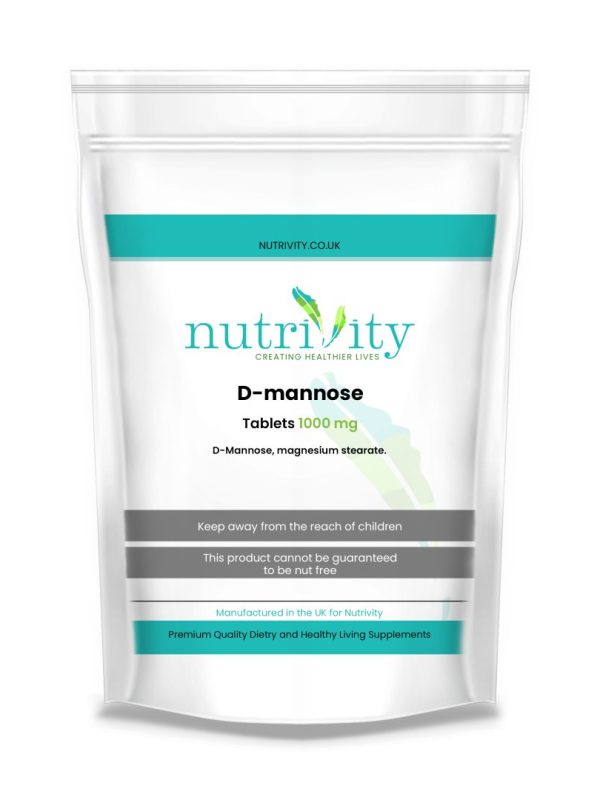
D-Mannose 1000mg Vegan Tablets – High Strength | Women’s Health
Price range: £13.99 through £58.99
How Does D-Mannose Work in the Body?
Understanding how D-Mannose works requires a brief look at how the most common type of urinary tract infection develops. Urinary tract infections in otherwise healthy adults are caused by bacteria — in roughly 80 to 90 percent of cases, this is Escherichia coli (E. coli). E. coli lives harmlessly in the gut but becomes problematic when it enters the urinary tract, which can happen relatively easily given the anatomy of the perineal region in women.
How E. coli causes UTIs
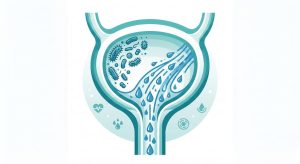
E. coli is equipped with fine, hair-like appendages called fimbriae. The tips of these fimbriae contain a protein called FimH, which acts as a molecular lock that binds specifically to mannose receptors on the cells lining the urinary tract — particularly the bladder epithelium. When E. coli attaches via this mechanism, it can resist being flushed out during urination and begins to multiply, causing the inflammation and discomfort associated with a UTI.
How D-Mannose interferes with this process
D-Mannose works by providing an alternative binding target for the FimH protein. When D-Mannose is present in the urine, the bacteria preferentially bind to the free-floating mannose molecules instead of the cells lining the urinary tract. Because these D-Mannose molecules are not attached to anything, the bacteria are flushed out of the urinary tract during normal urination, rather than remaining attached to the bladder wall.
This mechanism is elegant in its specificity. D-Mannose does not kill bacteria — it does not have antibiotic properties. It does not disrupt the gut microbiome. It works purely by making the bacteria bind to something that gets eliminated from the body rather than something they can colonise.
Why Is D-Mannose a Supplement Rather Than a Food?
The amounts of D-Mannose found in food are far too small to generate meaningful urinary concentrations through diet alone. A 1000mg supplement tablet provides a dose that would be impossible to achieve through eating fruit. This is why supplementation is necessary for anyone seeking to use D-Mannose as part of a urinary health routine — you simply cannot get a therapeutic-range dose from food.
D-Mannose and the Gut Microbiome
One of the most frequently discussed differences between D-Mannose and antibiotics is the impact on gut bacteria. Antibiotics — particularly broad-spectrum ones — eliminate a broad range of bacteria in the gut alongside the target pathogen, which can cause digestive side effects and alter the gut microbiome in ways that take time to recover from. This disruption has been linked to increased susceptibility to other infections including Clostridium difficile.
Because D-Mannose does not have antibiotic activity, it does not affect gut bacteria. It is not absorbed in large amounts in the gut and does not create conditions that harm beneficial bacteria. For people who have experienced gut side effects from repeated antibiotic courses, this is a meaningful practical difference.
Is D-Mannose Only Effective Against E. coli?
The FimH adhesin mechanism that D-Mannose targets is found most prominently in E. coli. Because E. coli causes the majority of uncomplicated UTIs in healthy adults, D-Mannose is relevant for the largest single category of urinary tract infections. However, UTIs can be caused by other bacteria — including Klebsiella pneumoniae, Staphylococcus saprophyticus, Enterococcus faecalis, and Proteus mirabilis — and D-Mannose has a less clear mechanism of action against these organisms.
This is why D-Mannose is most applicable as a preventative supplement for people with a history of E. coli-driven recurrent UTIs, and why medical assessment remains important to identify the causative organism if an infection is suspected.
D-Mannose vs Other Urinary Health Approaches
| Approach | Mechanism | Targets E. coli specifically | Affects gut bacteria |
|---|---|---|---|
| D-Mannose | Competitive bacterial adhesion inhibition | Yes | No |
| Cranberry (PACs) | Type A PAC anti-adhesion activity | Partially | No |
| Antibiotics | Bactericidal or bacteriostatic | Broad spectrum | Yes |
| Hydration | Mechanical flushing | Non-specific | No |
D-Mannose as a Supplement — What to Expect
D-Mannose is a food supplement, not a medicine. It is not licensed for the treatment or cure of any condition. It cannot diagnose, treat, cure, or prevent urinary tract infections. These are legal and regulatory realities that all UK supplement brands must operate within, and they apply to D-Mannose regardless of what the research suggests about its mechanism.
What this means practically is that if you have an active suspected infection — with symptoms including burning urination, frequent urge to urinate, cloudy or strong-smelling urine, or lower abdominal pain — you should seek medical assessment. D-Mannose may be used as a daily preventative supplement by people with a history of recurrent UTIs, but it is not a self-treatment for an acute infection.
For a full guide to D-Mannose dosage for daily use, see: D-Mannose Dosage: How Much Should You Take Per Day?
For information on safety and side effects: Is D-Mannose Safe? Side Effects and What to Know
To see how D-Mannose compares to cranberry: D-Mannose vs Cranberry: Which Is Better?
Nutrivity D-Mannose 1000mg Vegan Tablets
Nutrivity D-Mannose provides 1000mg per tablet in a single daily dose. It is vegan friendly and halal friendly, manufactured in the UK under GMP standards. Available in five pack sizes from 30 to 365 tablets, from 16p per day on the year supply.
View Nutrivity D-Mannose 1000mg Vegan Tablets
D-Mannose in Context: The Broader Urinary Health Picture
D-Mannose does not operate in isolation. For anyone managing urinary tract health — whether proactively or in response to a history of recurrent infections — it sits within a broader toolkit that includes hydration, hygiene practices, dietary choices, and in some cases medical intervention.
Hydration is consistently cited as one of the most important lifestyle factors for urinary tract health. Adequate fluid intake — at minimum 1.5 litres of water per day for most adults — helps physically flush bacteria from the urinary tract before they can establish. D-Mannose is most effective when taken with a full glass of water, and maintaining good hydration throughout the day supports its mechanism by ensuring regular urination that carries bacteria out of the body.
Post-intercourse urination is commonly recommended by healthcare professionals for women prone to UTIs, as sexual activity is a recognised risk factor for bacterial entry into the urethra. Avoiding irritants such as heavily scented personal care products in the perineal area is also frequently mentioned in urological guidance.
D-Mannose supplements fit into this picture as a daily habit for those who want additional support for urinary tract health. It is not a standalone solution, and it works best as part of a broader approach that includes adequate hydration and sensible lifestyle practices.
For more on the research supporting D-Mannose use, see: D-Mannose for UTIs: What the Research Actually Says
For long-term daily use guidance, see: Can You Take D-Mannose Every Day?
Frequently Asked Questions About D-Mannose
Is D-Mannose the same as mannose?
D-Mannose and mannose refer to the same compound. The “D” prefix refers to the stereochemical configuration of the molecule — the orientation of the hydroxyl groups around the carbon chain. The D-form is the biologically active configuration that occurs naturally in the body and in food. When you see “D-Mannose” on a supplement label, it simply specifies this naturally occurring form.
Can D-Mannose be found in food?
Yes, D-Mannose is found naturally in a range of foods including apples, peaches, oranges, cranberries, and certain vegetables. However, the concentrations in food are far too small to generate the urinary levels achieved through supplementation. A 1000mg supplement tablet provides a dose that would be extremely difficult or impossible to achieve through dietary intake alone, which is why supplementation is used.
How is D-Mannose different from glucose?
D-Mannose and glucose have identical chemical formulas but different three-dimensional structures — they are stereoisomers. This structural difference means they behave differently in the body. Glucose is efficiently metabolised for energy. D-Mannose is poorly metabolised and passes largely intact into the urine, which is the property that makes it useful as a urinary health supplement.
Does D-Mannose affect blood sugar?
D-Mannose is a sugar but is not metabolised in the same way as glucose or sucrose. At supplement doses used by most people, it is not thought to significantly affect blood glucose levels in healthy adults. However, people with diabetes, impaired glucose metabolism, or any condition affecting sugar processing should consult their doctor before taking D-Mannose, as with any sugar-based supplement.
Is D-Mannose suitable for vegans?
D-Mannose as an active ingredient is plant-derived and suitable for vegans. Whether a specific supplement product is vegan depends on the excipients — particularly the capsule or tablet shell. Nutrivity D-Mannose is in tablet form with plant-based excipients and is explicitly vegan friendly. Always check the specific product you are purchasing rather than assuming all D-Mannose products are vegan.
Is D-Mannose halal?
D-Mannose as an active ingredient is plant-derived and has no animal involvement. Nutrivity D-Mannose is explicitly confirmed as halal friendly with no gelatine or animal derivatives. Of the major UK D-Mannose brands, Nutrivity is the only one that explicitly states halal suitability on its product listing. If halal dietary compliance is important to you, always confirm with the specific brand before purchasing.
Can children take D-Mannose?
Most D-Mannose supplement products are not recommended for children without medical supervision. Natures Aid states their product is suitable from 12 years of age. If a child is experiencing urinary symptoms, seek medical assessment rather than using supplements as a first response.
Does D-Mannose work for all types of UTI?
D-Mannose works specifically through the FimH adhesin mechanism used by E. coli, which causes the majority of uncomplicated UTIs in healthy adults. It has a less established mechanism of action against other bacteria that can cause UTIs, including Klebsiella, Staphylococcus saprophyticus, and Proteus mirabilis. Medical assessment is important for identifying the causative organism, particularly in recurrent or complicated cases.
Food supplements must not replace a varied and balanced diet and a healthy lifestyle. Consult your doctor or pharmacist before use if you are under medical supervision or are taking prescribed medication. Made in a site that may handle nuts.