




Is D-Mannose Safe? Side Effects and What to Know Before Taking It
-
By Chris Jones
Written by Chris Jones | Last Updated June 2026 | Social Media Manager at Nutrivity (7+ years in the UK supplement industry)
Is D-Mannose Safe? Side Effects and What to Know Before Taking It
D-Mannose is generally considered well tolerated and safe for most healthy adults at supplement doses. But “generally safe” is not the same as “safe for everyone in all circumstances,” and this article gives you an honest, complete picture of what the safety evidence shows, who should exercise caution, and what side effects have been reported.
This is part of our complete D-Mannose guide: D-Mannose Supplements: The Complete Guide
Quick answer for is D-mannose safe?
-
Highly Safe for Most: D-Mannose (1000mg to 2000mg daily) is clinically safe and well-tolerated by healthy adults, offering a gentler long-term alternative to preventative antibiotics without disrupting the gut microbiome.
-
Mild, Dose-Dependent Side Effects: The most common side effects are mild gastrointestinal issues (like loose stools, bloating, or nausea), which typically resolve on their own or can be managed by taking the supplement with food or lowering the dose.
-
Caution for Specific Groups: People with diabetes (as it is a sugar), kidney disease, or rare metabolic disorders, as well as pregnant or breastfeeding women, should consult a doctor before use, and it should never be used to delay medical treatment for an active infection.
The Safety Profile of D-Mannose
D-Mannose is a naturally occurring simple sugar that the human body already produces and encounters in food. At the doses used in supplements — typically 1000mg to 2000mg per day — it is not metabolised in significant amounts for energy, passing largely intact into the urine. This means it does not interfere with normal energy metabolism in the way that glucose or sucrose would at equivalent amounts.
The clinical trials that have examined D-Mannose — including the Kranjčec 2014 trial and the MERIT trial — have reported a favourable safety profile. In the Kranjčec trial, participants in the D-Mannose group reported fewer side effects than those in the nitrofurantoin (antibiotic) group, and no serious adverse events were attributed to D-Mannose supplementation in either trial.
Reported Side Effects
The most commonly reported side effect of D-Mannose supplementation is mild gastrointestinal discomfort, particularly at higher doses. This includes:
Loose stools or diarrhoea — D-Mannose, like other poorly absorbed sugars, can draw water into the intestines at higher doses, causing looser stools. This is the most frequently reported adverse effect and is dose-dependent — more common at 2g per day or above than at 1g per day.
Bloating — Some users report mild bloating, particularly when starting supplementation. This typically resolves within a few days as the body adjusts.
Nausea — Occasional nausea has been reported, particularly when D-Mannose is taken on an empty stomach. Taking it with food can help if this is a concern.
These side effects are mild and generally self-limiting. They do not typically require stopping supplementation. Reducing the dose temporarily and increasing gradually is a sensible approach if gastrointestinal discomfort is experienced.
Who Should Exercise Caution or Avoid D-Mannose
People with diabetes or impaired glucose metabolism
D-Mannose is a sugar. While it is poorly metabolised compared to glucose and is not thought to significantly affect blood glucose in healthy adults at supplement doses, people with diabetes, pre-diabetes, or any condition affecting glucose or carbohydrate metabolism should consult their doctor before taking D-Mannose. The sugar content of a 1000mg tablet is small — 1g of D-Mannose — but regular daily intake over months should be accounted for in the context of a metabolic condition.
People with Type 1 or Type 2 diabetes who are interested in D-Mannose should monitor their blood glucose carefully if they choose to use it and discuss it explicitly with their diabetes care team.
People with kidney disease
D-Mannose reaches the urinary tract because it is filtered by the kidneys. People with significantly impaired kidney function have reduced ability to filter and excrete substances from the blood, which can affect how D-Mannose is processed. If you have diagnosed kidney disease, chronic kidney disease, or significantly reduced kidney function, consult your doctor before taking D-Mannose or any supplement that reaches the kidneys in meaningful amounts.
Pregnant and breastfeeding women
There is insufficient clinical evidence on the safety of D-Mannose supplementation during pregnancy or breastfeeding. UTIs are more common during pregnancy and carry risks, but management should always be supervised by a midwife or doctor. Do not take D-Mannose during pregnancy or breastfeeding without explicit medical guidance.
Children
D-Mannose supplements are generally not recommended for children without medical supervision. Most product labels note that they are intended for adults. If a child is experiencing urinary symptoms, seek medical assessment — do not use supplements as a first-line response.
People with phenylketonuria or galactosaemia
These rare metabolic conditions affect how specific sugars are processed. Anyone with a diagnosed disorder of carbohydrate metabolism should discuss any new supplement with their metabolic specialist before starting.
OUR TOP RECOMMENDED
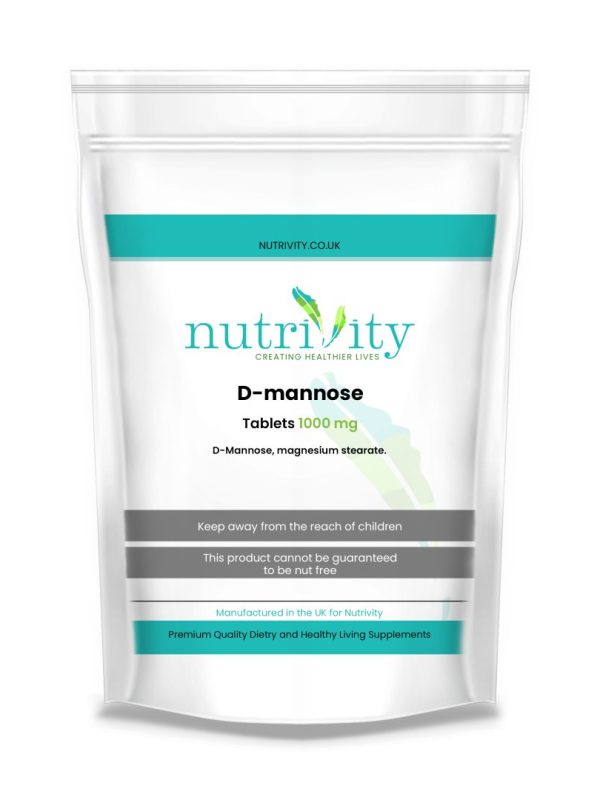
D-Mannose 1000mg Vegan Tablets – High Strength | Women’s Health
Price range: £13.99 through £58.99
Interactions With Medications
There are no well-documented drug interactions with D-Mannose at supplement doses. It does not share metabolic pathways with common medications and does not affect the enzymes responsible for drug metabolism. However, as with any supplement:
If you are taking medication for diabetes — Discuss with your prescriber, as any dietary sugar — however small — may need to be accounted for in your management plan.
If you are taking antibiotics — There is no known interaction between D-Mannose and antibiotics. Some people take both simultaneously — D-Mannose during and after an antibiotic course as a preventative measure. This is not problematic from a safety perspective.
If you are taking blood thinners, immunosuppressants, or complex medication regimens — As a general principle, always inform your doctor or pharmacist of any supplements you are taking, as individual circumstances vary.
Long-Term Safety
The longest clinical trials examining D-Mannose have followed participants for six months. Long-term safety data beyond this period is not established by controlled clinical trial evidence, though D-Mannose is a naturally occurring compound and the mechanism of action does not suggest a reason for accumulating harm over time in healthy adults.
People who have been taking D-Mannose daily for years report no significant adverse effects in anecdotal accounts, but this is observational rather than controlled evidence. For otherwise healthy adults taking 1000mg to 2000mg daily, current evidence does not suggest a safety concern with ongoing use.
For a full daily use guide: Can You Take D-Mannose Every Day?
D-Mannose vs Antibiotics: A Safety Comparison
One of the reasons D-Mannose is discussed as an alternative to long-term antibiotic prophylaxis is the comparative safety profile. Antibiotics used for recurrent UTI prophylaxis — particularly nitrofurantoin — carry specific risks with prolonged use including pulmonary toxicity, peripheral neuropathy, and liver effects, requiring monitoring. Antibiotic use also contributes to resistance and disrupts the gut microbiome.
D-Mannose does not carry these specific risks. Its main safety consideration for healthy adults is the mild gastrointestinal effects at higher doses. For people who are able to take it safely, this represents a meaningfully better long-term safety profile than continuous antibiotic use for the specific purpose of recurrent UTI prevention.
For more: D-Mannose vs Antibiotics for Urinary Tract Infections
View Nutrivity D-Mannose 1000mg Vegan Tablets | Best D-Mannose Supplements UK 2026
 Regulatory Status: D-Mannose in the UK
D-Mannose is regulated as a food supplement in the UK under the Food Supplements (England) Regulations 2003 and equivalent legislation in Scotland, Wales, and Northern Ireland. This means it is legal to sell, does not require a prescription, and is subject to food safety standards rather than the stricter medicinal licensing framework that applies to pharmaceuticals.
UK supplement manufacturers are required to comply with Good Manufacturing Practice (GMP) standards, which cover production quality, hygiene, batch consistency, and labelling accuracy. Nutrivity D-Mannose is manufactured in the UK under GMP standards, which provides assurance that what is stated on the label is what is in the tablet.
As a food supplement, D-Mannose is not licensed by the Medicines and Healthcare products Regulatory Agency (MHRA) for any therapeutic use. Supplement brands cannot make medicinal claims — statements that a supplement treats, cures, or prevents disease are not permitted under UK law. All claims made about D-Mannose on UK supplement labels and websites must comply with the food supplement regulations and the Advertising Standards Authority guidelines.
How to Take D-Mannose Safely
Following basic principles reduces any risk associated with D-Mannose supplementation:
Start at 1000mg per day — Beginning with the standard maintenance dose allows you to assess how your body responds before considering a higher dose. If you experience gastrointestinal discomfort, try taking it with food or reducing the dose temporarily.
Stay well hydrated — Taking D-Mannose with a full glass of water and maintaining good fluid intake throughout the day reduces the likelihood of gastrointestinal effects and supports the supplement’s mechanism of action.
Inform your GP — Always keep your healthcare team informed about supplements you take, particularly if you have any medical condition or are taking prescribed medication.
Do not use it to delay medical care — If you have significant UTI symptoms, seek medical assessment. D-Mannose is a preventative supplement, not a treatment for active infections. Using it to avoid medical care when symptoms are present carries the risk of an untreated infection progressing to involve the kidneys.
Follow the dosage guidance — Do not exceed the stated dose without medical guidance. There is no evidence that very high doses provide additional benefit, and higher doses increase the likelihood of gastrointestinal side effects.
For dosage guidance: D-Mannose Dosage: How Much Should You Take Per Day?
For the complete overview: D-Mannose Supplements: The Complete Guide
For long-term use: Can You Take D-Mannose Every Day?
D-Mannose Safety Summary
For otherwise healthy adults, D-Mannose at 1000mg to 2000mg per day is well tolerated and has a favourable safety profile based on available clinical evidence. The most common adverse effect is mild gastrointestinal discomfort at higher doses, which is self-limiting. Special caution is warranted for people with diabetes, kidney disease, or during pregnancy. There are no well-documented drug interactions at supplement doses. It does not contribute to antibiotic resistance, does not disrupt the gut microbiome, and does not require monitoring in healthy adults taking it for urinary health support.
Nutrivity D-Mannose is manufactured in the UK under GMP standards, vegan friendly and halal friendly, from 16p per day on the 365-tablet pack. View the product here.
Frequently Asked Questions About D-Mannose Safety
Can D-Mannose cause kidney damage?
There is no evidence that D-Mannose at supplement doses causes kidney damage in people with healthy kidney function. It is filtered by the kidneys and excreted in urine, which is how it reaches the urinary tract. People with pre-existing kidney disease should consult their doctor before use.
Is D-Mannose safe to take every day?
For otherwise healthy adults, daily D-Mannose supplementation at 1000mg to 2000mg per day has not been associated with significant adverse effects in clinical trials of up to six months duration. There is no established upper limit for daily intake in healthy adults. See the dedicated article: Can You Take D-Mannose Every Day?
Can D-Mannose raise blood sugar?
D-Mannose is a sugar but is poorly metabolised compared to glucose. At supplement doses of 1000mg to 2000mg daily, it is not thought to significantly affect blood glucose in healthy adults. People with diabetes should monitor their blood glucose and discuss with their care team before use.
Does D-Mannose affect the gut microbiome?
Unlike antibiotics, D-Mannose does not have antimicrobial activity and does not directly affect gut bacteria. It is one of its practical advantages over antibiotic prophylaxis for long-term recurrent UTI prevention.
Can I take D-Mannose if I am allergic to fruit?
D-Mannose in supplement form is not derived from fruit — it is typically produced from birch wood or by glucose epimerization. It does not contain fruit proteins that cause common fruit allergies. However, if you have a history of severe allergic reactions, consult a healthcare professional before trying any new supplement. Always check the full ingredients list of the specific product you are purchasing.
Food supplements must not replace a varied and balanced diet and a healthy lifestyle. This article does not constitute medical advice. If you are experiencing symptoms of a UTI or have concerns about a health condition, always consult a qualified healthcare professional.