




Agnus Castus vs Maca for Hormonal Balance: Which Is Right for You?
-
By Chris Jones
Last Updated May 2026 | Written by Chris Jones, Social Media Manager at Nutrivity with 7+ years in the supplement industry.
Agnus Castus vs Maca — Understanding the Difference
The conversation around hormonal balance supplements has grown enormously in recent years, with women increasingly seeking natural approaches to manage menstrual irregularity, PMS symptoms, perimenopause, and general hormonal wellness. Agnus castus and maca are two of the most frequently recommended options, but they are often presented as interchangeable when they are anything but.
Agnus castus — also known as vitex, chasteberry, or monk’s pepper — is a Mediterranean shrub whose dried berries have been used in traditional European herbal medicine for over 2,000 years. Its modern use is supported by a specific, well-characterised mechanism of action involving the dopaminergic system and pituitary gland function.
Maca is a cruciferous root vegetable native to the Peruvian Andes, where it has been cultivated for at least 3,000 years as both a food staple and a traditional medicine. It is classified as an adaptogen — a substance that is believed to help the body resist physical, chemical, and biological stressors — and is used for a wide range of purposes including energy, stamina, libido, and hormonal wellness.
These are two very different plants with different active compounds, different mechanisms, and different strengths. Understanding those differences is the key to choosing the right one — or deciding whether you need either at all.
Quick Answer
Agnus castus (Vitex agnus-castus) and maca (Lepidium meyenii) are both popular herbal supplements for hormonal health, but they work in fundamentally different ways. Agnus castus has a specific mechanism of action — it influences the pituitary gland to modulate prolactin levels, making it particularly relevant for menstrual cycle regularity and PMS-related symptoms. Maca is classified as an adaptogen with a broader, less targeted effect on energy, vitality, and general wellbeing, without directly altering hormone levels in the same way. If you are specifically looking for menstrual cycle support, agnus castus is the more evidence-based choice. If you want a general energy and vitality boost alongside hormonal wellness, maca offers a different kind of support.
How Agnus Castus Works
Agnus castus has one of the more clearly defined mechanisms of action among herbal supplements. Its primary active compounds — including diterpenes (such as rotundifuran) and iridoid glycosides (such as aucubin and agnuside) — interact with dopamine D2 receptors in the anterior pituitary gland.
This dopaminergic activity has a specific downstream effect: it suppresses the release of prolactin. Prolactin is a hormone primarily associated with lactation, but it also plays a role in menstrual cycle regulation. Elevated prolactin levels (a condition called hyperprolactinaemia, even when mild or subclinical) can disrupt the normal hormonal cascade that governs ovulation, progesterone production, and menstrual regularity.
By helping to normalise prolactin levels, agnus castus can support:
Menstrual cycle regularity — Women with irregular cycles, particularly those associated with corpus luteum insufficiency (where the body does not produce enough progesterone in the second half of the cycle), may benefit from agnus castus supplementation. Several clinical studies have reported improvements in cycle regularity and luteal phase length.
PMS symptom management — Premenstrual syndrome encompasses a range of physical and emotional symptoms that occur in the luteal phase of the menstrual cycle. Multiple randomised controlled trials have shown that agnus castus extract can reduce the severity of PMS symptoms including breast tenderness, irritability, mood changes, bloating, and headache. A systematic review published in the Journal of Women’s Health found consistent evidence supporting its use for PMS.
Premenstrual breast discomfort — Cyclical mastalgia (breast pain that follows the menstrual cycle pattern) is often linked to elevated prolactin. Agnus castus’s prolactin-lowering effect is directly relevant to this symptom. Agnus Castus Dosage and Forms
The most commonly studied dose of agnus castus is 20-40mg of dried berry extract per day, though higher-strength products are also available. Nutrivity’s Agnus Castus 1000mg provides a high-strength dose in vegan friendly capsules — manufactured in the UK to GMP standards and halal friendly. This high-strength formulation delivers a meaningful dose in a single daily capsule, making it straightforward to incorporate into a daily wellness routine.
Agnus castus is generally taken consistently over several menstrual cycles (typically 3-6 months) to allow its effects to build. It is not a fast-acting symptomatic remedy — it works by gradually influencing hormonal patterns, which requires time.
How Maca Works
Maca’s mechanism of action is less precisely defined than that of agnus castus. Unlike vitex, maca does not appear to directly interact with specific hormone receptors or modify the levels of hormones like prolactin, oestrogen, or progesterone in the bloodstream. Instead, it is believed to exert its effects through indirect mechanisms related to its nutritional density and adaptogenic properties.
Maca root is nutritionally rich, containing significant amounts of amino acids, fatty acids, vitamins (particularly B vitamins and vitamin C), minerals (iron, calcium, potassium, zinc), and bioactive compounds including macamides, macaenes, and glucosinolates.
Adaptogenic effects — As an adaptogen, maca is proposed to help modulate the hypothalamic-pituitary-adrenal (HPA) axis — the body’s central stress response system. By supporting a more balanced stress response, adaptogens are theorised to indirectly support hormonal equilibrium, since chronic stress can disrupt reproductive hormone production through cortisol-mediated pathways.
Energy and vitality — Multiple studies have reported improvements in energy levels, stamina, and general vitality with maca supplementation. These effects are not hormone-specific but may contribute to a general sense of wellbeing that makes hormonal symptoms more manageable.
Libido — Several clinical trials have shown that maca may support healthy libido in both men and women. Notably, these effects appear to occur without measurable changes in sex hormone levels, suggesting that the mechanism is not through direct hormonal modulation but possibly through effects on neurotransmitters, energy metabolism, or other pathways.
Menopausal support — Some preliminary research suggests that maca may help with certain menopausal symptoms, though the evidence is less robust than for agnus castus and PMS. Studies have shown modest improvements in mood and quality of life in perimenopausal and postmenopausal women taking maca, but larger trials are needed.
Maca Varieties
Maca comes in several colour varieties — yellow, red, and black — each with slightly different traditional uses and emerging research profiles. Yellow maca is the most common and widely studied. Red maca has been associated in some research with prostate health and bone density. Black maca has been linked to stamina and cognitive function. However, the differences between varieties are not as clearly established as marketing materials sometimes suggest, and much of the research is preclinical.
Head-to-Head Comparison
| Feature | Agnus Castus (Vitex) | Maca |
|---|---|---|
| Primary mechanism | Dopaminergic — modulates prolactin via pituitary gland | Adaptogenic — supports HPA axis and general vitality |
| Direct hormonal action | Yes — influences prolactin and indirectly progesterone | No — does not appear to directly alter hormone levels |
| Best evidence for | PMS, menstrual irregularity, cyclical breast discomfort | Energy, libido, general vitality, adaptogenic support |
| Research maturity | Well-established — multiple RCTs and systematic reviews | Growing — positive but less extensive |
| Onset of effects | Gradual — typically 1-3 menstrual cycles | Some effects noticed within 2-4 weeks |
| Suitable for men | Generally not — mechanism is female-cycle-specific | Yes — studied for libido and stamina in men |
| Pregnancy suitability | Not recommended — discontinue if pregnancy occurs | Insufficient safety data — consult GP |
| Interactions | May interact with hormonal medications, dopamine agonists | Few known interactions — generally well tolerated |
| Vegan friendly options | Yes — Nutrivity Agnus Castus 1000mg is vegan friendly | Typically yes — maca is a plant root |
OUR TOP RECOMMENDED
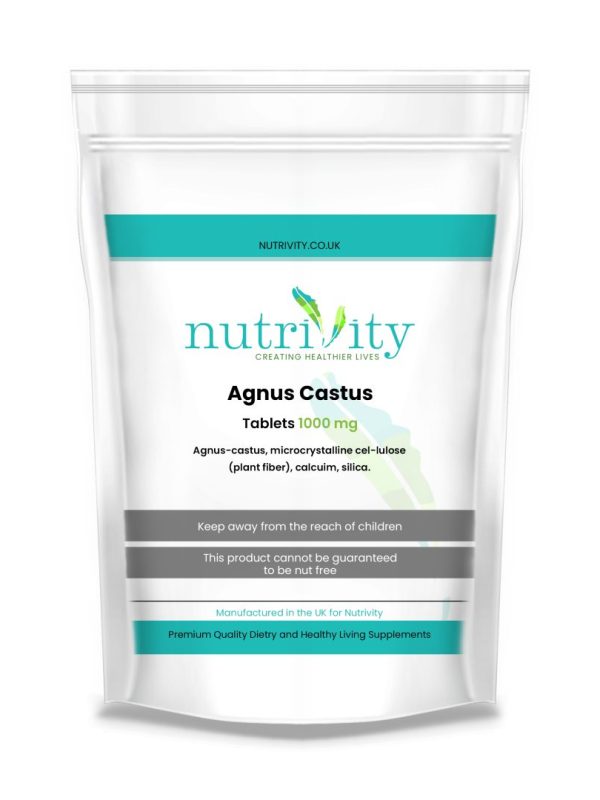
Agnus Castus 1000mg Vegan Tablets | 8 Months Supply (240 Tablets) | Women’s Health
Original price was: £28.99.£24.99Current price is: £24.99. 8 months supply – from just 10.4p per day!

Which Should You Choose?
The decision between agnus castus and maca should be guided by your specific symptoms and goals rather than general “hormonal balance” marketing.
Choose agnus castus if — You experience PMS symptoms (breast tenderness, mood changes, irritability, bloating), your menstrual cycles are irregular, you have been told you have mildly elevated prolactin, or your primary concern is menstrual cycle regulation. Agnus castus has the more targeted mechanism and the stronger evidence base for these specific issues.
Choose maca if — Your primary concerns are low energy, reduced libido, general vitality, or you want adaptogenic support to help manage the effects of stress on your overall wellbeing. Maca’s broader, non-hormone-specific effects make it a good choice for general wellness support, particularly if your hormonal concerns are mild or secondary to fatigue and stress.
Consider both (sequentially, not simultaneously without advice) if — You want to address both specific menstrual symptoms and general energy levels. However, combining herbal supplements that influence hormonal pathways should be discussed with a qualified healthcare practitioner, as the interaction profile is not fully characterised.
Important Safety Considerations
Herbal supplements are not without risks, and both agnus castus and maca have important safety considerations:
Hormonal medications — Agnus castus can interact with hormonal contraceptives, hormone replacement therapy, and dopamine-related medications. If you are taking any hormonal medication or treatment, consult your GP before starting agnus castus.
Hormone-sensitive conditions — Women with conditions that are influenced by oestrogen or progesterone levels — such as endometriosis, fibroids, or hormone-receptor-positive breast cancer — should exercise particular caution and seek medical advice before taking either supplement.
Pregnancy and breastfeeding — Agnus castus should be discontinued if pregnancy occurs or is suspected. There is insufficient safety data for maca during pregnancy. Always consult your GP or midwife.
Thyroid considerations — Maca contains glucosinolates, which are goitrogenic compounds found in cruciferous vegetables. In very high doses or in individuals with existing thyroid conditions, this could theoretically affect thyroid function. At normal supplementation doses, this is unlikely to be clinically significant, but individuals with thyroid conditions should be aware.
Complementary Supplements for Hormonal Wellness
Hormonal health does not exist in isolation. Several other nutrients and supplements can support the broader hormonal and general wellness picture:
Vitamin D — Contributes to the normal function of the immune system and the maintenance of normal muscle function. Vitamin D receptors are found in reproductive tissues, and adequate vitamin D status is associated with overall hormonal health. Nutrivity’s Vitamin D3 4000IU & K2 MK-7 provides a high-strength dose alongside vitamin K2 for calcium metabolism support.
Sea Buckthorn Oil — Rich in omega-7 fatty acids and antioxidants, sea buckthorn has traditional use in supporting skin and mucosal health — relevant during hormonal changes. Nutrivity’s Sea Buckthorn Oil 500mg provides this in a vegan friendly capsule.
Blackcurrant Seed Oil — A source of gamma-linolenic acid (GLA), which is involved in prostaglandin metabolism and has been traditionally used for PMS support. Nutrivity’s Blackcurrant Seed Oil 500mg provides GLA from a whole-food source.
The Bottom Line
Agnus castus and maca are both valuable herbal supplements, but they serve different purposes. Agnus castus is the more targeted, evidence-based choice for menstrual cycle regulation and PMS symptom management, working through a specific dopaminergic mechanism that modulates prolactin. Maca is a broader adaptogenic supplement best suited for energy, vitality, and general wellness support, without directly altering reproductive hormone levels. For menstrual and PMS concerns specifically, Nutrivity’s Agnus Castus 1000mg provides a high-strength, vegan friendly, halal friendly option manufactured in the UK to GMP standards. Key Takeaways
Different mechanisms entirely — Agnus castus works through dopamine receptors to modulate prolactin. Maca works as a broad adaptogen without directly altering hormone levels.
Agnus castus is better evidenced for PMS and menstrual irregularity — Multiple clinical trials and systematic reviews support its use for these specific conditions.
Maca excels for energy and vitality — If fatigue, low libido, or general low energy is your primary concern, maca has more relevant evidence.
Allow adequate time — Agnus castus typically requires 1-3 menstrual cycles for full effect. Do not expect overnight results from either supplement.
Consult your GP if on hormonal medication — Agnus castus in particular can interact with hormonal contraceptives and HRT.
Frequently Asked Questions
Can I take agnus castus and maca together?
While there is no strong evidence of a harmful interaction between agnus castus and maca, combining herbal supplements that influence hormonal pathways should be approached with caution. It is advisable to consult a qualified healthcare practitioner before combining them, and to introduce one at a time so you can assess each supplement’s individual contribution to your wellbeing.
How long does agnus castus take to work for PMS?
Most clinical studies evaluate agnus castus over periods of 1 to 3 menstrual cycles (roughly 1-3 months). Some women notice improvements within the first cycle, but full benefits typically emerge after 2-3 months of consistent daily use. It is a gradual, cumulative process — not an immediate symptomatic remedy.
Is maca a hormone replacement?
No. Maca does not replace hormones or directly alter hormone levels in the way that hormone replacement therapy does. Clinical studies have consistently shown that maca supplementation does not change circulating levels of oestrogen, progesterone, testosterone, or other reproductive hormones. Its benefits appear to come through adaptogenic and nutritional mechanisms rather than hormonal ones.
Can men take agnus castus?
Agnus castus is primarily studied and recommended for women, specifically for menstrual cycle and PMS-related concerns. Its prolactin-modulating mechanism is relevant to female reproductive health. While there is limited historical use in men (historically used by monks to reduce libido, hence the name “chasteberry”), it is not generally recommended for men without specific medical guidance.
Is Nutrivity's Agnus Castus vegan friendly?
Yes. Nutrivity’s Agnus Castus 1000mg tablets are vegan friendly, halal friendly, and manufactured in the UK to GMP standards. They provide a high-strength 1000mg dose in tablets suitable for those following plant-based or halal diets.
Should I stop taking agnus castus if I become pregnant?
Toggle content goes here, click edit button to change this text.Yes. Agnus castus should be discontinued as soon as pregnancy is confirmed or suspected. There is insufficient safety data for its use during pregnancy, and its hormonal activity makes it inappropriate to continue without explicit medical advice. Consult your GP or midwife immediately.