





D-Mannose for UTIs: What the Research Actually Says
-
By Chris Jones
Written by Chris Jones | Last Updated June 2026 | Social Media Manager at Nutrivity (7+ years in the UK supplement industry)
D-Mannose for UTIs: What the Research Actually Says
D-Mannose is widely discussed as a natural support for urinary tract health, but what does the actual research say? This article looks at the clinical evidence behind D-Mannose — what the studies show, what they do not show, and how to interpret it honestly as a UK supplement buyer.
This is part of our complete D-Mannose guide: D-Mannose Supplements: The Complete Guide.
Quick Answer on D-mannose for UTI’s:
-
Strong Preventative Evidence: Clinical trials like Kranjčec 2014 and the UK’s MERIT trial show that daily D-Mannose (2g) significantly reduces recurrent UTIs in women, performing comparably to low-dose preventative antibiotics with fewer side effects.
-
Targeted Biological Mechanism: It works specifically against E. coli—the cause of 80–90% of uncomplicated UTIs—by flooding the bladder with free-floating sugars that bind to the bacteria so they are safely flushed away during urination.
-
Notable Evidence Gaps: While the science strongly supports ongoing prevention, there is currently very little clinical data validating D-Mannose as an acute treatment for active infections, or for its effectiveness in men and children.
The Research Landscape for D-Mannose
D-Mannose is not a new compound — it has been studied for decades in the context of bacterial adhesion and urinary tract biology. However, the clinical trial evidence specifically examining D-Mannose as a supplement for UTI prevention and management in humans is more recent and still developing. The existing studies are promising but come with important caveats around study design, population size, and applicability.
It is important to approach the evidence honestly. D-Mannose is a food supplement regulated under UK food law, not a licensed medicine. No supplements can legally claim to treat or cure UTIs in the UK. What the research explores is the biological mechanism and whether D-Mannose supplementation affects the frequency or severity of urinary tract events in study populations.
Key Clinical Studies
The Kranjčec 2014 Trial
The most frequently cited study in D-Mannose research is a 2014 randomised trial by Kranjčec, Papeš, and Altarac, published in the World Journal of Urology. The trial recruited 308 women with a history of recurrent urinary tract infections and divided them into three groups: one receiving D-Mannose powder (2g daily in water), one receiving an antibiotic (nitrofurantoin 50mg daily), and one receiving no prophylaxis.
Over a six-month study period, the D-Mannose group showed a significantly lower rate of recurrent UTI compared to the no-treatment group. Importantly, the recurrence rate in the D-Mannose group was comparable to the antibiotic group, and the D-Mannose group reported fewer side effects. This is the study most often referenced when D-Mannose is discussed in comparison to antibiotic prophylaxis.
The study has limitations worth noting: it was not placebo-controlled, meaning participants knew which group they were in. The D-Mannose used was a powder formulation at 2g per day — higher than the 1g daily dose most UK tablet products are designed around for maintenance use. The study population was exclusively women with a history of recurrent UTIs, so results may not generalise to first-time UTI sufferers or men.
The MERIT Trial
The MERIT trial (Mannose for Recurrent Urinary Tract Infections) was a UK-based randomised controlled trial examining D-Mannose for recurrent UTI prevention in women. It represents one of the more rigorous evaluations of D-Mannose in a UK clinical setting. The trial results have added to the evidence base for D-Mannose in the recurrent UTI population specifically.
Smaller and observational studies
Beyond the major trials, a body of smaller studies and observational research has examined D-Mannose in various populations including pregnant women, people with recurrent UTIs associated with sexual activity, and individuals using intermittent urinary catheters. The evidence across these studies is generally supportive but less rigorous than the controlled trial data.
 What the Research Does and Does Not Show
The research base supports the following conclusions, with the caveats noted:
Supported by evidence — D-Mannose at 2g per day may reduce the frequency of recurrent UTIs in women with a history of recurrent infections over a six-month period, with a comparable effect to low-dose antibiotic prophylaxis and fewer reported side effects in the Kranjčec trial.
Supported by mechanism, less by clinical evidence — The biological mechanism by which D-Mannose inhibits E. coli adhesion is well established in laboratory research. The translation from in vitro findings to clinical outcomes in humans is supported but not yet proven definitively across multiple large, placebo-controlled trials.
Not established by current evidence — D-Mannose for acute UTI treatment (as opposed to prevention), D-Mannose for UTIs caused by bacteria other than E. coli, D-Mannose in men, and D-Mannose in children are all areas where the evidence base is significantly thinner or absent.
OUR TOP RECOMMENDED
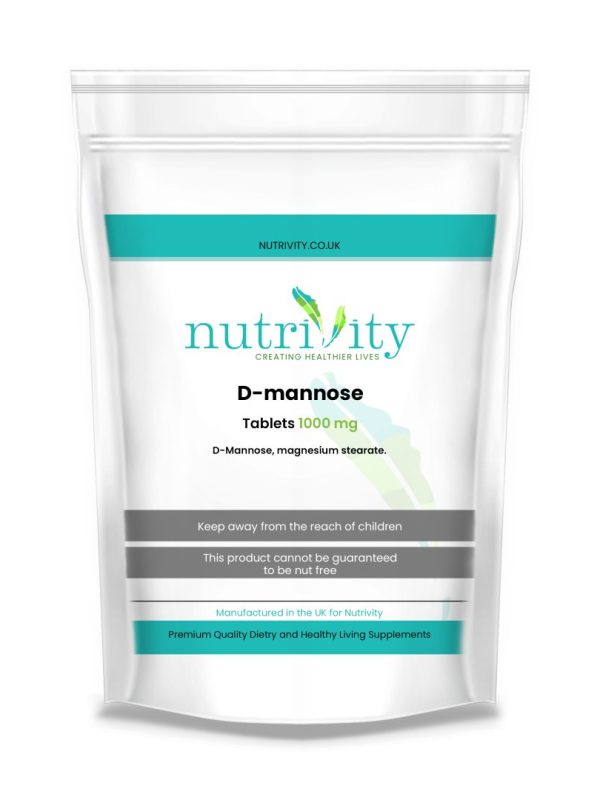
D-Mannose 1000mg Vegan Tablets – High Strength | Women’s Health
Price range: £13.99 through £58.99
D-Mannose vs Antibiotics: What the Evidence Says
The Kranjčec trial found comparable outcomes between D-Mannose powder and nitrofurantoin for recurrent UTI prevention over six months, with fewer reported side effects in the D-Mannose group. This is the primary evidence base for discussions comparing the two approaches.
It would be misleading to conclude from this that D-Mannose is equivalent to antibiotics as a treatment — the trial was specifically examining prevention, not acute treatment of an active infection. Antibiotics remain the standard medical treatment for confirmed UTIs and are not comparable to supplements in this context.
For a full side-by-side comparison of D-Mannose and antibiotics: D-Mannose vs Antibiotics for Urinary Tract Infections
How to Interpret Supplement Research as a Consumer
Understanding supplement research requires some critical thinking. A few principles worth applying when reading claims about D-Mannose or any supplement:
One study is not proof — The Kranjčec 2014 trial is frequently cited but represents a single study. Replicated findings across multiple well-designed trials are a stronger basis for confidence than any single result.
Study populations matter — A trial conducted in women with recurrent UTIs does not necessarily tell you what will happen in a first-time UTI sufferer or in a man. The relevance of a finding depends on how closely you match the study population.
Effect size matters — A statistically significant result in a clinical trial does not always mean a large or clinically meaningful effect in real life. Look at what the actual numbers show, not just whether a result was significant.
Mechanism is not evidence of effect — The FimH binding mechanism is well established in laboratory research. Laboratory findings on bacteria in a dish do not automatically translate to the same effect in a living human urinary tract.
D-Mannose for Recurrent UTIs: The Strongest Evidence
The evidence for D-Mannose is strongest and most consistent for the preventative use case — daily supplementation in women with a history of recurrent UTIs. This is the population studied in the major trials and the use case for which the most clinical data exists.
For a dedicated article on recurrent UTI management: D-Mannose for Recurrent UTIs: Can It Help Long-Term?
The Safety Evidence
Across the clinical studies, D-Mannose has been generally well tolerated. The most commonly reported adverse effects are mild gastrointestinal symptoms — loose stools or bloating — in some participants, particularly at higher doses. No serious adverse events have been attributed to D-Mannose supplementation in the clinical literature.
For a full safety guide: Is D-Mannose Safe? Side Effects and What to Know
Nutrivity D-Mannose 1000mg Vegan Tablets
Nutrivity D-Mannose provides 1000mg per tablet, manufactured in the UK under GMP standards. Vegan friendly and halal friendly. Available from 16p per day on the 365-tablet pack.
View Nutrivity D-Mannose 1000mg Vegan Tablets
For the full comparison of UK D-Mannose brands: Best D-Mannose Supplements UK 2026
The Role of E. coli in UTIs and Why It Matters for D-Mannose
To understand the evidence for D-Mannose, it helps to understand the biology of the infections it is most studied against. Escherichia coli — E. coli — is responsible for approximately 80 to 90 percent of uncomplicated urinary tract infections in otherwise healthy adults in the UK. The uncomplicated UTI is the standard case: a healthy adult with no structural abnormality of the urinary tract, no underlying immunosuppression, and no involvement of the upper urinary tract (kidneys).
E. coli causes UTIs by a very specific adhesion mechanism. The bacteria have hair-like surface appendages called type 1 fimbriae, and at the tip of each fimbria is a protein called FimH. FimH binds specifically to mannose residues on the surface of uroepithelial cells — the cells lining the bladder and urinary tract. This binding allows the bacteria to resist being washed away during urination and to colonise the bladder wall.
D-Mannose targets this mechanism directly. The free-floating mannose provided by a supplement binds to the FimH adhesin, occupying it before it can attach to the cell lining. The bacteria, now bound to soluble mannose rather than the bladder wall, are eliminated during urination. This mechanism has been demonstrated repeatedly in laboratory and animal models, and it is the basis for the hypothesis that D-Mannose supplementation could reduce UTI frequency in people whose infections are primarily E. coli-driven.
Limitations of the Current Evidence Base
The evidence for D-Mannose, while encouraging, has meaningful limitations that any honest discussion should acknowledge.
Small number of large trials — The clinical evidence rests substantially on the Kranjčec 2014 trial and the more recent MERIT trial. Two major trials, even when well-designed, provide a narrower evidence base than exists for pharmaceutical interventions that have been tested across dozens of large randomised controlled trials over many years.
Study duration — Most D-Mannose trials have followed participants for six months. The evidence for long-term daily use beyond six months is thinner, though the mechanism of action does not suggest a time-limited effect.
Population specificity — The evidence is clearest for women with recurrent UTIs who have a history of E. coli-driven infections. The applicability to men, to women with first-time UTIs, to older adults, or to people with structural urinary abnormalities is not well established.
Dose questions — The Kranjčec trial used 2g per day — twice the dose provided by a single 1000mg tablet. Whether 1g per day is sufficient for a preventative effect, or whether higher doses provide more benefit, is not definitively established by current evidence.
What Does This Mean in Practice?
For a UK consumer considering D-Mannose, the evidence picture suggests the following practical conclusions:
If you have a history of recurrent UTIs that are likely E. coli-driven — which covers the majority of recurrent UTI sufferers — the clinical evidence for daily D-Mannose supplementation as a preventative measure is the most developed of any supplement option in this category. It is not equivalent in strength to pharmaceutical trial evidence, but it is more substantial than for many other supplements commonly recommended for urinary health.
If you are experiencing an acute UTI with active symptoms, seek medical assessment. D-Mannose is not a treatment for an active infection and should not be used as a substitute for medical care when symptoms are present.
If you are male, or are using D-Mannose for a different purpose than recurrent UTI prevention, the evidence is less directly applicable to your situation, and medical guidance is more important before starting supplementation.
For dosage information specific to preventative use, see: D-Mannose Dosage: How Much Should You Take Per Day?
For information on how D-Mannose compares to cranberry supplements: D-Mannose vs Cranberry: Which Is Better for Urinary Health?
Frequently Asked Questions About D-Mannose Research
Has D-Mannose been tested in NHS clinical trials?
Yes. The MERIT trial was a UK-based randomised controlled trial examining D-Mannose for recurrent UTI prevention, conducted with NHS patient populations. This represents one of the more rigorous evaluations of D-Mannose in a UK clinical setting and adds credibility to the evidence base beyond the earlier Kranjčec trial conducted in Croatia.
Is the evidence for D-Mannose as strong as for antibiotics?
No. Antibiotics have been tested across a vastly larger number of trials with much larger total patient populations. The evidence base for antibiotics in treating active UTIs is substantially stronger than the evidence for D-Mannose in prevention. Where the comparison becomes more interesting is in long-term daily prophylaxis, where the Kranjčec trial found comparable recurrence rates between D-Mannose and nitrofurantoin with fewer side effects — but this is a single trial comparison, not a definitive conclusion.
Does the research support D-Mannose for men?
The major clinical trials have been conducted predominantly or exclusively in women. The biological mechanism of D-Mannose action against E. coli FimH adhesin is not sex-specific — E. coli uses the same mechanism in male and female urinary tracts. However, UTIs in men are less common and more often associated with underlying causes such as prostate issues. The research does not currently provide a strong evidence base for D-Mannose use in men specifically. See: D-Mannose for Men: Does It Work the Same Way?
What dose did the research studies use?
The Kranjčec 2014 trial used 2g (2000mg) of D-Mannose powder per day, dissolved in water. This is higher than the 1000mg per tablet dose provided by most UK tablet-form supplements including Nutrivity. Whether 1g daily provides equivalent preventative benefit to 2g daily is not established by current clinical evidence.
Food supplements must not replace a varied and balanced diet and a healthy lifestyle. This article does not constitute medical advice. Always consult a healthcare professional if you have concerns about your urinary health or are experiencing symptoms of infection.