




D-Mannose vs Antibiotics for Urinary Tract Infections
-
By Chris Jones
Written by Chris Jones | Last Updated May 2026 | Social Media Manager at Nutrivity (7+ years in the UK supplement industry)
D-Mannose vs Antibiotics for Urinary Tract Infections
When it comes to urinary tract infections, antibiotics are the standard medical treatment. But for people experiencing recurrent UTIs — multiple infections a year — the question of whether daily antibiotic prophylaxis is the only option is an increasingly common one. This article examines how D-Mannose and antibiotics compare, where each is appropriate, and what the evidence actually shows.
This is part of our complete D-Mannose guide: D-Mannose Supplements: The Complete Guide
What Antibiotics Do
Antibiotics treat bacterial infections by either killing bacteria directly (bactericidal) or inhibiting their growth and reproduction (bacteriostatic). For an acute UTI, antibiotics prescribed by a GP or via a pharmacy under a patient group direction are effective and fast-acting — symptoms typically improve within 24 to 48 hours of starting a course.
The antibiotics most commonly prescribed for UTIs in the UK include nitrofurantoin, trimethoprim, and fosfomycin. Each has a different spectrum of activity, different resistance profiles, and different side effect considerations. The choice of antibiotic depends on local resistance patterns, the patient’s medical history, and any culture results if a urine sample has been sent for analysis.
The Problems With Long-Term Antibiotic Prophylaxis
For people with recurrent UTIs — defined as two or more infections within six months, or three or more within a year — long-term low-dose antibiotic prophylaxis is a common medical approach. A small daily dose of an antibiotic is taken continuously, sometimes for months or years, to suppress the bacterial colonisation that leads to repeated infections.
This approach is effective but carries well-documented risks. Antibiotic resistance is the most significant systemic concern — repeated exposure to antibiotics selects for resistant bacterial strains, not only in the individual patient but contributing to resistance in the broader community. This is a recognised public health problem that the NHS and international health bodies have identified as a serious long-term threat.
At the individual level, long-term antibiotic use disrupts the gut microbiome — the community of beneficial bacteria in the digestive system that plays roles in immunity, digestion, and overall health. This disruption can cause digestive symptoms, increase susceptibility to other infections including Clostridium difficile, and affect wellbeing in ways that take significant time to resolve. Vaginal thrush is another common side effect of repeated antibiotic courses in women, because antibiotics also affect the vaginal microbiome.
D-Mannose as an Alternative to Antibiotic Prophylaxis
D-Mannose does not have antibiotic properties. It does not kill bacteria and it does not disrupt the gut microbiome. Its mechanism — competitive inhibition of E. coli adhesion via the FimH pathway — is entirely different from antibiotics, and does not contribute to antibiotic resistance.
The most directly relevant clinical comparison between D-Mannose and antibiotic prophylaxis comes from the Kranjčec 2014 trial, which randomised women with recurrent UTIs to D-Mannose powder (2g/day), nitrofurantoin (50mg/day), or no prophylaxis. Over six months, the D-Mannose group showed a recurrence rate of around 15 percent compared to around 20 percent for nitrofurantoin and 60 percent for the no-treatment group. The D-Mannose group also reported fewer side effects than the antibiotic group.
This is a single trial, and it should not be overinterpreted as proof that D-Mannose is equivalent to antibiotics. But it is meaningful evidence that D-Mannose deserves serious consideration as a preventative option for women with recurrent UTIs who are motivated to reduce antibiotic exposure.
OUR TOP RECOMMENDED
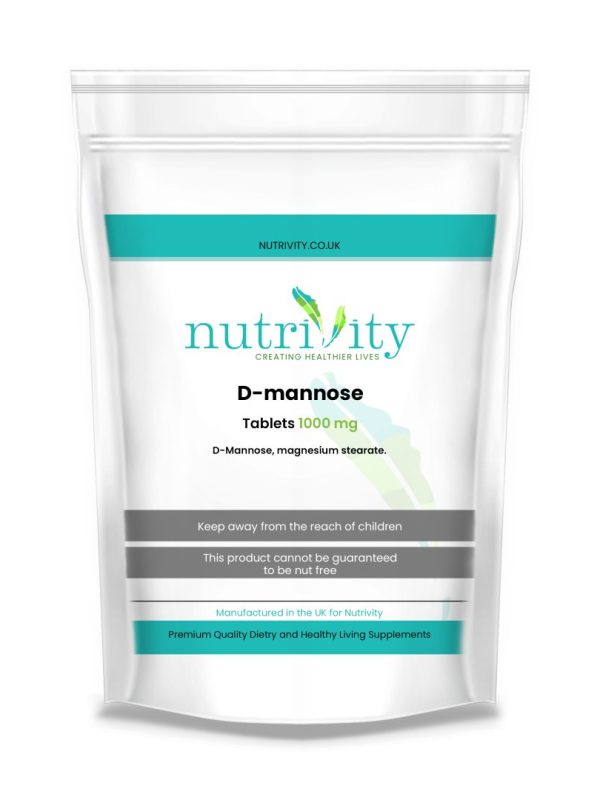
D-Mannose 1000mg Vegan Tablets – High Strength | Women’s Health
Price range: £13.99 through £58.99
When Antibiotics Are Necessary
This comparison should not obscure an essential point: antibiotics are the correct response to an active, confirmed bacterial infection. D-Mannose is a food supplement. It cannot treat an established infection. If you have symptoms consistent with a UTI — burning urination, frequent urge to urinate, cloudy or strong-smelling urine, lower abdominal pain — seek medical assessment and treatment.
If symptoms suggest the infection has reached the kidneys — back pain, fever, nausea, vomiting — seek urgent medical attention. Kidney infections are serious and require prompt antibiotic treatment. D-Mannose is not appropriate as a response to suspected kidney infection under any circumstances.
A Practical Framework for Thinking About D-Mannose and Antibiotics
| Situation | Appropriate response |
|---|---|
| Active UTI symptoms | Medical assessment and antibiotics if confirmed bacterial infection |
| Suspected kidney infection | Urgent medical attention and antibiotics |
| History of recurrent UTIs — prevention | D-Mannose daily supplementation is a evidence-supported option alongside medical advice |
| Post-antibiotic course — maintenance | D-Mannose daily may support urinary environment during recovery period |
| Wanting to reduce antibiotic exposure long-term | Discuss with GP — D-Mannose is one option to explore alongside lifestyle measures |
 Antibiotic Resistance: Why This Matters
Antibiotic resistance is one of the most significant global health challenges of the 21st century. In the UK, the NHS has explicitly identified reducing inappropriate antibiotic prescribing as a public health priority. UTIs are among the most common reasons antibiotics are prescribed in primary care, and the volume of prescriptions in this area is significant.
This does not mean people with genuine bacterial infections should avoid antibiotics. It means that for the specific use case of long-term daily prophylaxis in recurrent UTI sufferers — where the evidence supports alternatives — reducing antibiotic dependency is a meaningful goal for individual and public health. D-Mannose sits within this context as one option that the evidence suggests may be worth exploring in this specific population.
Having the Conversation With Your GP
If you have recurrent UTIs and are currently on long-term antibiotic prophylaxis, or are being considered for it, D-Mannose is worth raising with your GP as a supplement you are considering. Some GPs are familiar with the Kranjčec trial data and will engage constructively with this conversation. Others may be less familiar with the supplement evidence but should be open to discussing the options.
Taking D-Mannose alongside a prescribed antibiotic course for an active infection is not problematic from a safety perspective — there is no known interaction. Some people begin D-Mannose daily supplementation at the end of an antibiotic course as a preventative measure going forward.
For dosage information: D-Mannose Dosage: How Much Should You Take Per Day?
For safety information: Is D-Mannose Safe? Side Effects and What to Know
For long-term daily use guidance: Can You Take D-Mannose Every Day?
View Nutrivity D-Mannose 1000mg Vegan Tablets
The Wider Context: UTI Management in the UK in 2026
The landscape for UTI management in UK primary care has shifted noticeably over the last several years. Growing awareness of antibiotic resistance has led NHS England and NICE to tighten guidance on antibiotic prescribing for UTIs. Self-care pathways — including pharmacy-led consultations and delayed prescribing — have become more common. This shift has created space for supplements like D-Mannose to be considered more seriously by both patients and clinicians as part of a broader management approach.
It is worth noting that the Cochrane Collaboration — which reviews the evidence base for medical interventions — has acknowledged D-Mannose in its discussions of recurrent UTI management options, which reflects growing recognition of the evidence base within the medical literature, not just in supplement marketing.
Side Effects: Antibiotics vs D-Mannose
Any honest comparison of D-Mannose and antibiotics for recurrent UTI management has to include a discussion of side effects, because this is one of the areas where D-Mannose has a practical advantage for long-term use.
Nitrofurantoin — one of the most commonly prescribed antibiotics for UTI prophylaxis in the UK — is generally well tolerated in short courses but is associated with pulmonary toxicity with prolonged use, which has led some clinicians to prefer shorter prophylaxis periods. It can also cause nausea, headaches, and skin reactions in some patients. Long-term use requires monitoring.
Trimethoprim, another common choice, has a simpler side effect profile for short courses but resistance rates in E. coli have increased substantially in the UK over recent years, reducing its effectiveness in many areas.
In the Kranjčec 2014 trial, participants in the D-Mannose group reported fewer side effects than those in the nitrofurantoin group over the six-month study period. The most commonly reported D-Mannose side effect was mild loose stools in a small number of participants — a significantly less burdensome profile than the antibiotic side effects reported.
For people considering long-term daily supplementation over months or years, this difference in side effect profile is a meaningful practical consideration, quite apart from the resistance question.
What About Antibiotic Courses After D-Mannose Has Not Prevented an Infection?
D-Mannose does not prevent all UTIs in everyone who takes it. The Kranjčec trial showed a 15 percent recurrence rate in the D-Mannose group over six months — meaning some people taking D-Mannose still experienced an infection. If you are taking D-Mannose daily and develop UTI symptoms, this does not mean anything has gone wrong — it means you need medical assessment and potentially antibiotic treatment for the current infection, before resuming D-Mannose supplementation afterwards.
Some people use D-Mannose daily as a preventative measure while also keeping a prescription on standby for use if an infection breaks through. This approach — sometimes called a standby antibiotic prescription — is available from some GPs and is a practical strategy for people with a history of recurrent infections who have been assessed medically and know their pattern well.
For information on recurrent UTI management specifically, see: D-Mannose for Recurrent UTIs: Can It Help Long-Term?
For dosage guidance including what to do at the first sign of symptoms: D-Mannose Dosage: How Much Should You Take Per Day?
Taking Action: Where to Start
If you have recurrent UTIs and are interested in D-Mannose as a preventative supplement, the most sensible starting point is a conversation with your GP to discuss your options. Bring the Kranjčec 2014 trial reference if helpful. Simultaneously, starting daily D-Mannose supplementation at 1000mg per day is straightforward, well-tolerated, and consistent with the evidence base for preventative use.
Nutrivity D-Mannose 1000mg Vegan Tablets are UK-made, GMP manufactured, vegan friendly and halal friendly, available from 16p per day on the 365-tablet pack. View the product here. For the full UK brand comparison: Best D-Mannose Supplements UK 2026.
Frequently Asked Questions
Can I take D-Mannose instead of antibiotics for a UTI?
No. D-Mannose is a food supplement and cannot treat an active bacterial infection. If you have UTI symptoms, seek medical assessment. Antibiotics are the appropriate treatment for a confirmed bacterial urinary tract infection. D-Mannose is relevant as a preventative daily supplement for people with a history of recurrent UTIs, not as a treatment for an infection that is already established.
Can D-Mannose replace long-term antibiotic prophylaxis?
This is a conversation to have with your GP. The Kranjčec 2014 trial found comparable recurrence rates between D-Mannose powder and nitrofurantoin over six months in women with recurrent UTIs. This evidence supports exploring D-Mannose as an option, but the decision depends on your medical history, the severity of your recurrent UTIs, and other individual factors that only a healthcare professional can properly assess.
Does D-Mannose cause antibiotic resistance?
No. D-Mannose has no antibiotic activity and does not contribute to antibiotic resistance. It does not kill bacteria and does not create selective pressure that drives resistance development. This is one of its main practical advantages as a long-term daily supplement compared to antibiotic prophylaxis.
Does D-Mannose affect gut bacteria?
No. D-Mannose is not absorbed in meaningful amounts in the gut and does not have antibiotic activity. It does not affect gut microbiome composition. This contrasts with antibiotics, which can cause significant disruption to gut bacteria during and after a course of treatment.
Food supplements must not replace a varied and balanced diet and a healthy lifestyle. This article does not constitute medical advice. Always consult a healthcare professional regarding the treatment of urinary tract infections or decisions about antibiotic use.