




D-Mannose for Men: Does It Work the Same Way?
-
By Chris Jones
Written by Chris Jones | Last Updated June 2026 | Social Media Manager at Nutrivity (7+ years in the UK supplement industry)
D-Mannose for Men: Does It Work the Same Way?
D-Mannose is most commonly discussed in the context of women’s urinary health, and for good reason — UTIs are significantly more common in women. But men do get UTIs too, and questions about whether D-Mannose works the same way in men are valid and deserve a direct answer. This article covers the evidence, the biology, and the practical considerations for men considering D-Mannose.
This is part of our complete D-Mannose guide: D-Mannose Supplements: The Complete Guide
Quick answer for D-mannose for men:
-
Same Mechanism, Extrapolated Evidence: D-Mannose prevents E. coli from sticking to the urinary tract exactly the same way in both men and women, though clinical trial data is extrapolated from female studies because male UTIs are much rarer.
-
Rule Out Underlying Causes First: Because male UTIs are anatomically uncommon, men must get a medical assessment first to rule out or treat underlying issues like prostate enlargement (BPH) or structural abnormalities before using D-Mannose.
-
Identical Practical Usage: For men with confirmed E. coli infections, the safety profile and dosage are identical to women—requiring a consistent daily 1000mg tablet with a full glass of water.
Do Men Get UTIs?
Yes, though far less commonly than women. The lifetime risk of a UTI in men is estimated at around 14 percent, compared to approximately 50 percent in women. The anatomical reason is straightforward: men have a significantly longer urethra than women — around 18 to 20 centimetres versus 3 to 4 centimetres — which makes it much harder for bacteria to travel from the external environment to the bladder.
When men do get UTIs, they are more likely to have an underlying cause than straightforward UTIs in otherwise healthy women. In younger men, UTIs are relatively rare and when they occur may be associated with sexual practices, anatomical abnormalities, or catheter use. In older men, the most common underlying factor is prostate enlargement (benign prostatic hyperplasia), which affects urine flow and can lead to incomplete bladder emptying — creating conditions more favourable to bacterial growth.
Does D-Mannose Work the Same Way in Men?
The biological mechanism of D-Mannose action — competitive inhibition of E. coli adhesion via the FimH binding site — is not sex-specific. E. coli uses the same Type 1 fimbriae and FimH adhesin to attach to uroepithelial cells in male and female urinary tracts. If D-Mannose is present in the urine, it provides the same competitive binding target for bacteria regardless of the sex of the individual.
From a mechanistic perspective, there is no reason to expect D-Mannose to work fundamentally differently in men than in women. The molecule reaches the male urinary tract via the same pathway — absorbed from the gut, filtered by the kidneys, excreted in the urine — and acts on the same bacterial adhesion mechanism.
What the Research Says About D-Mannose in Men
This is where honest reporting requires acknowledging a significant gap. The major clinical trials that have established the evidence base for D-Mannose — the Kranjčec 2014 trial and the MERIT trial — were conducted exclusively or predominantly in women. This means the clinical evidence for D-Mannose in men is not directly established by controlled trial data.
The mechanism-based argument for D-Mannose working in men is sound. The absence of trial data is partly a consequence of the epidemiology — UTIs are so much less common in men that recruiting sufficient male participants for a recurrent UTI prevention trial is significantly more difficult than doing so in women.
What this means practically is that men considering D-Mannose should understand that the evidence base is extrapolated from female trial data via the shared mechanism, rather than directly established in male populations.
OUR TOP RECOMMENDED
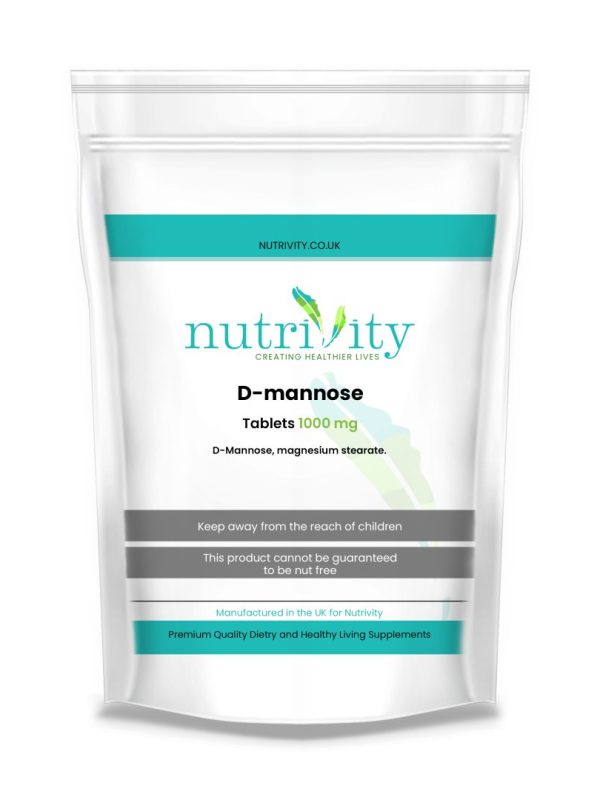
D-Mannose 1000mg Vegan Tablets – High Strength | Women’s Health
Price range: £13.99 through £58.99
When Should Men Consider D-Mannose?
For men experiencing UTIs, the first priority is medical assessment to identify whether there is an underlying cause. A UTI in a man under 50 with no obvious risk factor warrants investigation. A UTI in an older man needs prostate evaluation. Once an underlying cause has been excluded or addressed medically, the question of whether D-Mannose is worth considering as a preventative supplement becomes relevant.
Men who have experienced recurrent UTIs with confirmed E. coli as the causative organism — without an unaddressed underlying structural or functional cause — are the most plausible candidates for D-Mannose supplementation based on the mechanism and the extrapolated evidence.
Men who use intermittent urinary catheters, who have spinal cord injuries affecting bladder function, or who have other complex urological conditions should discuss any supplement use with their specialist rather than self-managing.
D-Mannose and Prostate Health
D-Mannose does not have a direct mechanism of action on the prostate. It works in the urinary tract specifically by targeting bacterial adhesion. If UTIs in an older man are caused by incomplete bladder emptying secondary to prostate enlargement, D-Mannose addresses the adhesion aspect of the infection risk but not the underlying cause — which is the prostate issue. Medical management of the prostate condition is the primary intervention in this case.
That said, D-Mannose is safe for men with prostate conditions who also want to take it alongside medical management. There is no known interaction between D-Mannose and medications commonly prescribed for prostate conditions including alpha-blockers (tamsulosin, alfuzosin) or 5-alpha reductase inhibitors (finasteride, dutasteride).
 Practical Guidance for Men Taking D-Mannose
The dosage and practical guidance for men is the same as for women. One 1000mg tablet daily with a full glass of water is the standard maintenance dose. Maintaining good hydration is important. Consistency of daily use is more effective than intermittent use. For full dosage information: D-Mannose Dosage: How Much Should You Take Per Day?
Men with any of the following should discuss D-Mannose with their doctor before starting: diabetes, kidney disease, taking multiple prescribed medications, or any history of serious urological conditions.
Safety of D-Mannose in Men
The safety profile of D-Mannose is the same for men and women. It is a naturally occurring sugar, well tolerated at supplement doses, with mild gastrointestinal effects as the most commonly reported side effect. There are no male-specific safety concerns. For a full safety guide: Is D-Mannose Safe? Side Effects and What to Know
Nutrivity D-Mannose — Suitable for Men and Women
Nutrivity D-Mannose 1000mg Vegan Tablets are suitable for both men and women. They are vegan friendly and halal friendly, UK-made under GMP standards, available in five pack sizes from 30 to 365 tablets. From 16p per day on the year supply.
View Nutrivity D-Mannose 1000mg Vegan Tablets
For the complete hub: D-Mannose Supplements: The Complete Guide
Understanding Male UTIs: Types and Causes
Male UTIs are categorised differently to female UTIs in clinical practice. A UTI in a woman without structural abnormality or systemic illness is typically classified as uncomplicated. In men, UTIs are often classified as complicated by default because the male anatomy makes spontaneous bacterial ascent to the bladder less likely — implying that when it does occur, a reason should be sought.
The main categories of UTI in men are as follows:
Uncomplicated UTI in younger men — Relatively rare. Most commonly seen in men who have sex with men (MSM), where the risk of E. coli UTI is higher due to specific sexual practices. Also seen in men with anatomical abnormalities such as urethral strictures. In otherwise healthy younger men, a first UTI warrants at minimum a clinical assessment and urine culture.
UTI associated with benign prostatic hyperplasia (BPH) — The most common context for recurrent UTIs in older men. BPH causes the prostate to enlarge and compress the urethra, reducing urine flow and often leading to incomplete bladder emptying. The residual urine in the bladder provides a growth medium for bacteria. Management of the BPH is the primary intervention; D-Mannose may support urinary health alongside this but does not treat the underlying prostate condition.
Catheter-associated UTI — Men who use intermittent or indwelling urinary catheters — for example due to spinal cord injury, neurogenic bladder, or post-surgical recovery — have substantially elevated UTI risk due to the catheter providing a direct pathway for bacterial entry. Management of catheter-associated UTIs is specialised and should be supervised by the relevant medical team.
UTI associated with prostatitis — Bacterial prostatitis is an infection of the prostate gland itself and requires specific antibiotic treatment with agents that penetrate prostate tissue. D-Mannose is not relevant to the treatment of prostatitis.
The Importance of Urine Culture in Men
In women with straightforward recurrent UTIs, empirical treatment — prescribing antibiotics based on likely bacteria without waiting for culture results — is often appropriate given the high probability of E. coli. In men, urine culture is generally considered more important, because the broader range of potential causes means identifying the specific organism matters more for treatment decisions.
If you are a man with recurrent UTIs and are considering D-Mannose, knowing the causative organism from culture results is particularly useful. If cultures consistently show E. coli, the mechanistic case for D-Mannose is stronger. If cultures show a range of different organisms or organisms that do not use the FimH mechanism, D-Mannose is less likely to be relevant to your specific situation.
Hydration and Urinary Health in Men
The same hydration principles that apply to women apply to men. Adequate fluid intake — at least 1.5 to 2 litres per day — supports urinary flow and bacterial flushing. For men with BPH, maintaining good fluid intake is sometimes complicated by concerns about urinary urgency or nocturia, but completely restricting fluids is counterproductive. A urologist or GP can advise on appropriate fluid management strategies alongside BPH treatment.
D-Mannose works best when taken with a full glass of water and when overall hydration is maintained. This is as true for men as for women.
For information on daily use: Can You Take D-Mannose Every Day?
For research context: D-Mannose for UTIs: What the Research Actually Says
For the complete UK brand comparison: Best D-Mannose Supplements UK 2026
Summary: D-Mannose for Men
D-Mannose is suitable for men and works through the same mechanism as in women — competitive inhibition of E. coli adhesion in the urinary tract. The clinical evidence is extrapolated from female-population trials rather than directly established in men, which is an honest limitation to acknowledge. Men with recurrent E. coli-confirmed UTIs without an unaddressed underlying structural cause are the most plausible candidates. Always seek medical assessment for any UTI in a man to exclude underlying causes before considering supplementation as a preventative strategy. Nutrivity D-Mannose is suitable for men — vegan friendly, halal friendly, UK-made, from 16p per day. View here.
Frequently Asked Questions on D-Mannose for men
Can men take D-Mannose for UTIs?
Yes. D-Mannose is suitable for both men and women. The mechanism of action — competitive inhibition of E. coli adhesion — is not sex-specific. Men experiencing recurrent UTIs with no underlying structural cause are the most relevant candidates for preventative D-Mannose supplementation. Any UTI in a man should first be assessed medically to exclude an underlying cause.
Is there clinical trial evidence for D-Mannose in men?
The major clinical trials for D-Mannose have been conducted in women. There is currently no large randomised controlled trial specifically examining D-Mannose in men. The evidence for men is extrapolated from the shared mechanism of action rather than directly established by male-population trial data.
Can D-Mannose help with urinary symptoms caused by prostate enlargement?
No. D-Mannose does not address prostate conditions. Urinary symptoms caused by benign prostatic hyperplasia — such as reduced flow, incomplete emptying, or urgency — require medical management of the prostate, not supplementation. D-Mannose may be relevant for men who are also experiencing UTIs secondary to incomplete bladder emptying, but always in conjunction with medical management of the prostate condition.
What dose should men take?
The same dose applies as for women — 1000mg per day as a daily maintenance dose, or 2000mg per day to match the Kranjčec trial dose. Take with a full glass of water at a consistent time each day. For more detail: D-Mannose Dosage Guide
Is D-Mannose halal?
Nutrivity D-Mannose is explicitly confirmed as halal friendly — suitable for halal diets with no gelatine or animal derivatives. This applies equally to male and female customers following halal dietary requirements. See the full UK brand comparison — Nutrivity is the only brand in the comparison that explicitly confirms halal suitability.
Food supplements must not replace a varied and balanced diet and a healthy lifestyle. This article does not constitute medical advice. Men experiencing urinary symptoms should seek medical assessment to exclude underlying conditions before using supplements.