




How Long Does D-Mannose Take to Work?
-
By Chris Jones
Written by Chris Jones | Last Updated June 2026 | Social Media Manager at Nutrivity (7+ years in the UK supplement industry)
How Long Does D-Mannose Take to Work?
How long does D-Mannose take to work? It is one of the most searched questions about this supplement, and the honest answer depends on what you mean by “work” and how you are using it. This article breaks down timelines for both preventative daily use and higher-dose protocols, and sets realistic expectations based on what the research and mechanism of action actually support.
This is part of our complete D-Mannose guide: D-Mannose Supplements: The Complete Guide.
Quick answer on How Long D-Mannose take to work:
D-Mannose is a water-soluble sugar that absorbs rapidly to reach peak concentrations in the urine within one to two hours, where it actively blocks E. coli bacteria from adhering to the bladder wall. However, it is not an overnight cure or an active infection treatment; its true preventative success is measured over a consistent three-to-six-month daily window as a gradual reduction in the frequency of recurrent UTIs. To ensure optimal results, it must be taken consistently every day with a full glass of water to support the physical flushing of bacteria, ideally backed by a GP urine culture confirming E. coli.
Two Different Contexts for D-Mannose Use
Understanding timelines for D-Mannose requires separating two distinct use cases, because the answer is fundamentally different for each.
Preventative daily supplementation — Taking 1000mg of D-Mannose per day as an ongoing daily supplement to support urinary tract health and reduce the likelihood of recurrent UTIs. This is the use case most supported by clinical evidence, and the one for which Nutrivity D-Mannose is designed.
Higher-dose acute protocol — Taking larger and more frequent doses at the first sign of urinary discomfort, with the aim of rapidly increasing mannose concentration in the urine. This use is common anecdotally but is not the primary focus of the major clinical trials.
Preventative Daily Use: What to Expect
For daily preventative supplementation, there is no single moment at which D-Mannose “works.” The mechanism is ongoing — D-Mannose is present in the urine within one to two hours of taking a tablet, providing a competitive binding target for E. coli fimbriae during each voiding cycle. The effect is present as long as you are taking the supplement consistently.
The clinical evidence for preventative benefit comes from the Kranjčec 2014 trial, which examined outcomes over a six-month period. The trial did not measure a specific onset time — it measured recurrence rates across the full study period. This means the evidence does not tell us whether D-Mannose “works” in two weeks versus two months; it tells us that over six months, people taking D-Mannose powder daily had a lower rate of recurrent UTIs than those taking nothing.
A practical expectation for someone starting daily D-Mannose supplementation is that the mechanism is active from the first dose, but the meaningful outcome — fewer recurrent infections over time — is something you assess over months, not days. Stick with it consistently for at least three months before drawing conclusions about its effectiveness for you.
How Quickly Does D-Mannose Reach the Urine?
D-Mannose is water-soluble and absorbed relatively quickly from the gut. After oral ingestion, D-Mannose enters the bloodstream and is filtered by the kidneys into the urine. Studies on D-Mannose pharmacokinetics suggest that urinary mannose concentrations rise within approximately one to two hours of ingestion and remain elevated for several hours before declining.
This is one reason some people take D-Mannose with a full glass of water — adequate hydration supports kidney filtration and helps maintain urine flow, which in turn supports the flushing mechanism that complements D-Mannose’s anti-adhesion effect.
OUR TOP RECOMMENDED
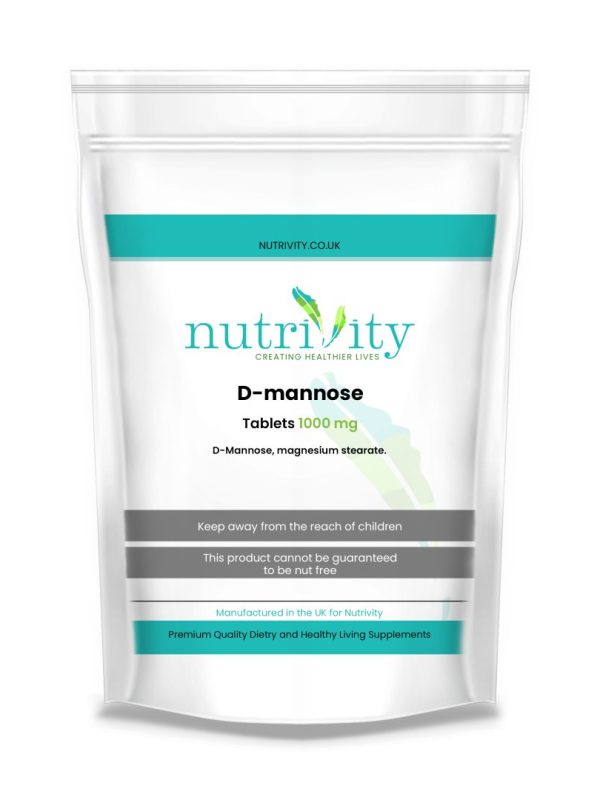
D-Mannose 1000mg Vegan Tablets – High Strength | Women’s Health
Price range: £13.99 through £58.99
Higher-Dose Protocols: Anecdotal Use at Symptom Onset
A common practice among D-Mannose users — particularly those with a history of recurrent UTIs who know their early warning signs — is to increase the dose significantly at the first hint of urinary discomfort. Some people take two to three times their normal daily dose multiple times throughout the day when they feel early symptoms coming on.
The rationale for this makes mechanistic sense: higher urinary mannose concentrations provide more competitive binding targets for bacteria. However, the clinical evidence specifically for acute high-dose D-Mannose is limited. The Kranjčec trial used 2g once daily as a preventative dose, not a higher acute protocol.
Anecdotal reports of relief within a few hours to a day are common in user communities, but these are not controlled observations and cannot be reliably attributed to D-Mannose alone — many people also increase fluid intake significantly at the same time, which independently helps flush the urinary tract.
If you have significant UTI symptoms — not just mild discomfort but burning urination, frequent urge to urinate, cloudy urine — seek medical assessment rather than relying on a self-managed supplement protocol. D-Mannose is not a treatment for a confirmed infection.
How Long Before You Can Tell If D-Mannose Is Working for You?
For preventative use, a meaningful assessment requires tracking your infection frequency over time. Keep a simple log: dates of any infections, severity, whether you needed medical treatment. Compare the frequency over three to six months of daily D-Mannose use to your previous pattern. This is the only practical way to determine whether it is making a difference for you individually.
If your previous pattern was three infections per year and you have none in the first six months of daily D-Mannose use, that is an encouraging signal. If your pattern continues unchanged, it may not be the right approach for you — which could reflect the specific bacteria involved in your infections (D-Mannose is most effective against E. coli), or individual variation in response.
Factors That Affect How Well D-Mannose Works
Hydration — D-Mannose works by occupying bacterial binding sites and being flushed out in urine. Good hydration — regular fluid intake throughout the day — supports both the concentration of mannose in the urinary tract and the flushing mechanism. Taking D-Mannose with inadequate water intake reduces its effectiveness.
Consistency — Missing doses reduces the continuous mannose presence in the urine. Daily supplementation works best when taken at the same time each day as part of a consistent routine.
The bacteria involved — D-Mannose is most effective against E. coli, which uses Type 1 fimbriae and the FimH adhesin mechanism. If your UTIs are caused by other bacteria, D-Mannose will be less effective. If you have recurrent infections and want to know whether they are E. coli-driven, ask your GP for a urine culture on your next infection rather than treating empirically.
Dose — The clinical trial evidence uses 2g per day. Most tablet-form supplements provide 1000mg per tablet. Whether 1g daily is sufficient for a full preventative effect or whether higher doses are needed is not definitively established. Some people choose the 1g daily maintenance dose and increase to 2g at times of higher risk.
D-Mannose and Sexual Activity
Sexual activity is a recognised risk factor for UTIs in women, as it can introduce bacteria into the urethra. Some people who are prone to post-coital UTIs specifically take D-Mannose before or after sexual activity as a targeted preventative measure. The mechanism supports this timing — elevated urinary mannose concentration in the hours following ingestion provides the anti-adhesion effect during the period of highest risk.
For dosage guidance including this use case: D-Mannose Dosage: How Much Should You Take Per Day?
For information on long-term daily use: Can You Take D-Mannose Every Day?
For recurrent UTI management: D-Mannose for Recurrent UTIs: Can It Help Long-Term?
View Nutrivity D-Mannose 1000mg Vegan Tablets
Setting Realistic Expectations
D-Mannose is not a quick fix and it is not a medicine. It is a daily supplement whose benefit — for those it helps — is measured over months, not hours. The people who get the most from D-Mannose are typically those who take it consistently every day, maintain good hydration, and track their infection frequency honestly over time rather than expecting immediate dramatic results.
The evidence from the Kranjčec trial shows that at six months, the D-Mannose group had around a 15 percent recurrence rate compared to around 60 percent in the no-treatment group. That is a substantial difference, but it took six months of consistent daily use to observe it. There is no shortcut to that timeline for preventative supplementation.
For anyone experiencing active UTI symptoms, the timeline question becomes irrelevant — medical assessment and appropriate treatment come first. D-Mannose is not the right tool for an infection that is already established. It is the tool for reducing the likelihood of the next one.
For the full guide to D-Mannose research: D-Mannose for UTIs: What the Research Actually Says
For safety information: Is D-Mannose Safe? Side Effects and What to Know
For the full UK brand comparison including pricing: Best D-Mannose Supplements UK 2026
 Practical Tips for Getting the Most From D-Mannose
Based on seven years in the supplement industry and the available evidence, here are the practical habits that support D-Mannose working as effectively as possible for preventative urinary tract support.
Take it at the same time each day — Consistency matters for maintaining a steady presence of mannose in the urine. Many people take it first thing in the morning or last thing at night as part of a fixed routine alongside other supplements or medication.
Take it with a full glass of water — The flushing effect of good hydration complements D-Mannose’s anti-adhesion mechanism. Taking your tablet with 250ml or more of water supports both absorption and the physical clearance of bacteria from the urinary tract.
Maintain overall hydration — Regular fluid intake throughout the day keeps urine dilute and urination frequent, which mechanically supports a healthy urinary environment. The NHS guidance on fluid intake for adults is at least 6 to 8 glasses of fluid per day.
Do not stop and start — If you stop taking D-Mannose for several weeks, the urinary mannose concentration drops and the protective mechanism is no longer active. Consistency over time is what generates the preventative benefit seen in the clinical trials. If you run out of a pack, order the next one before you finish so you do not have a gap in supplementation.
Consider pack size for cost and convenience — Buying the 365-tablet pack at 16p per day eliminates the inconvenience of frequent reordering and provides the lowest cost per day. If you plan to take D-Mannose long-term, the larger pack sizes are the most practical and cost-effective choice. View Nutrivity D-Mannose pack sizes and pricing here.
For the complete picture on D-Mannose, visit the hub article: D-Mannose Supplements: The Complete Guide
Frequently Asked Questions
How quickly does D-Mannose reach the urine after taking a tablet?
D-Mannose is water-soluble and absorbed relatively quickly. Urinary mannose concentrations typically rise within one to two hours of ingestion. This means the anti-adhesion mechanism is active from within a couple of hours of taking your dose. For this reason, some people time their dose to coincide with periods of higher risk — for example, before sexual activity.
How long should I take D-Mannose before deciding if it works?
For preventative use, assess over a minimum of three months and ideally six months. Track your infection frequency before and after starting supplementation. A single months trial is too short to draw conclusions about a supplement whose benefit is measured by a reduction in infection rate over time.
Does D-Mannose work immediately for UTI symptoms?
There is limited clinical evidence for D-Mannose as an acute treatment for UTI symptoms. Some users report improvement in mild symptoms within hours of a higher dose, but this is anecdotal and may reflect increased fluid intake or natural resolution rather than D-Mannose specifically. If you have UTI symptoms, seek medical assessment rather than waiting for a supplement to resolve them.
Can I take D-Mannose with water to make it work faster?
Taking D-Mannose with a full glass of water supports its absorption and the broader flushing mechanism that complements its anti-adhesion effect. Good hydration throughout the day is important for urinary tract health generally and works alongside D-Mannose supplementation. It does not change the fundamental pharmacokinetics significantly but is good practice.
Food supplements must not replace a varied and balanced diet and a healthy lifestyle. This article does not constitute medical advice.