




Can You Take Psyllium Husk Every Day? Long-Term Use Guide
-
By Chris Jones
Written by Chris Jones | Last Updated April 2026 | Social Media Manager at Nutrivity (7+ years in the UK supplement industry)
Can You Take Psyllium Husk Every Day? Long-Term Use Guide
One of the most commonly asked questions about psyllium husk is whether it is safe to take every day — or whether long-term daily use creates dependency, weakens the bowel, or causes harm over time. This concern is understandable, particularly among people who have been told to avoid long-term stimulant laxative use. The answer for psyllium husk is clear and backed by clinical evidence: yes, daily long-term use is not only safe but is often the intended and most effective way to take it.
This article addresses the dependency question directly, summarises what the long-term research shows, explains how the daily benefits of psyllium accumulate over time, and provides practical guidance for building psyllium into a sustainable daily routine. It also covers the annual cost of daily supplementation, which is relevant for anyone planning to use psyllium as a long-term health supplement.
The Dependency Question: Does Psyllium Husk Cause Dependency?
The concern about supplement dependency typically arises in the context of stimulant laxatives — products such as senna, bisacodyl, and cascara sagrada that work by triggering muscular contractions in the colon wall. With prolonged daily use, the colon can become less responsive to its natural neural stimuli because it has become reliant on pharmacological stimulation. This is a genuine clinical concern with stimulant laxatives, and it is why medical guidelines caution against their long-term daily use.
Psyllium husk is not a stimulant laxative. It is a bulk-forming agent. It does not stimulate the colon wall. It does not interact with the enteric nervous system. It works entirely mechanically — by adding physical bulk to intestinal contents, retaining moisture, and creating a gel that softens stool. These effects are physical, not pharmacological, and the bowel does not develop tolerance to them.
Stopping psyllium after long-term daily use does not leave the bowel less capable than it was before. Stool consistency may return to baseline as the fibre bulk is no longer present, which for people with low dietary fibre intake may mean a return to harder, less regular stools. But this reflects the withdrawal of a beneficial fibre source, not bowel dysfunction caused by the supplement. It is no different from the bowel’s response to a reduction in dietary fibre from food.
The clinical position is consistent: psyllium husk does not cause dependency. This has been confirmed in long-term trials and is supported by the biological mechanism — a mechanical fibre supplement cannot create neurological dependency.
What Long-Term Research Shows
Clinical trials on psyllium husk have examined supplementation periods of up to 12 months. A 12-month randomised trial examining psyllium supplementation for chronic constipation found no evidence of adverse effects from daily use across the full study period, no development of tolerance (the dose required for effect did not increase over time), and maintained benefit throughout the trial. Participants did not experience rebound constipation at the end of the study beyond the expected return to baseline fibre levels.
Longer-term observational data from populations with consistently high dietary fibre intake — which psyllium supplementation emulates — shows strongly positive associations with bowel health, cholesterol management, blood sugar regulation, and cardiovascular health outcomes. The health benefits associated with adequate soluble fibre intake are cumulative and dose-sustained: they require ongoing fibre intake to be maintained, which is the primary argument for long-term daily supplementation rather than sporadic use.
There is no documented upper limit on safe duration of psyllium husk supplementation in healthy adults. The World Health Organisation, NHS, NICE, and FDA have all recognised psyllium as a safe dietary fibre source for long-term use.
OUR TOP RECOMMENDED
Psyllium Husk 500mg Capsules — Natural Dietary Fibre Supplement
Price range: £8.99 through £13.99
Why Daily Use Produces Better Outcomes Than Sporadic Use
For most of psyllium’s evidence-supported applications, consistent daily supplementation produces meaningfully better outcomes than sporadic use. Understanding why helps make the case for establishing a daily routine.
Cholesterol management — The LDL-lowering effect of psyllium depends on daily bile acid binding. Every meal that psyllium accompanies is an opportunity to intercept and excrete bile acids rather than allow their reabsorption. Missing days means missed interception cycles. The cholesterol benefit is sustained only through ongoing daily use — studies measuring LDL at 8 to 12 weeks require consistent supplementation across that entire period to show the measured effect.
Blood sugar regulation — The post-meal glucose moderation produced by psyllium occurs at each meal where psyllium is present. Sporadic use produces only the meals where psyllium was taken — it does not produce a cumulative metabolic change that persists after stopping. Consistent daily use consistently moderates post-meal glucose across all supplemented meals.
IBS management — The BMJ trial demonstrating IBS symptom reduction was conducted over 12 weeks of consistent supplementation. NICE guidelines recommend ongoing dietary fibre management for IBS, not episodic use. The bowel regularity benefits of psyllium in IBS reflect a sustained environmental change in the intestinal fibre content — which requires daily maintenance.
Bowel regularity — Even for simple constipation management, daily fibre supplementation produces better stool consistency than taking psyllium only when constipation becomes problematic. By maintaining consistent bulk in intestinal contents, daily psyllium prevents the accumulation of hard, slow-moving stool rather than remedying it after the fact.
 Building Psyllium Into a Daily Routine
The most common reason people fail to maintain any supplement regimen is that it is not integrated into an existing routine. Psyllium requires water with every dose, which makes taking it with meals the most practical approach — water is typically already being consumed, and the habit can anchor to an existing mealtime routine.
Morning routine — Many people take a serving of psyllium with their morning meal. This anchors it to the most consistent daily habit — breakfast — and provides bowel regularity support for the day ahead. If taking psyllium for blood sugar moderation, a morning serving with breakfast also addresses post-breakfast glucose response, which is often the highest of the day following overnight fasting.
Evening routine — A second serving with an evening meal is appropriate for people using psyllium for cholesterol management, where multiple daily doses are preferable to one. Ensure the evening dose is taken at least 30 to 60 minutes before sleep and with a full glass of water.
Consistency matters more than perfect timing — If a dose is missed, simply continue with the next scheduled dose. Do not double up. Long-term consistency over months is what produces the measured outcomes in clinical research — not perfect adherence to a rigid daily schedule.
Annual Cost of Daily Psyllium Husk Supplementation
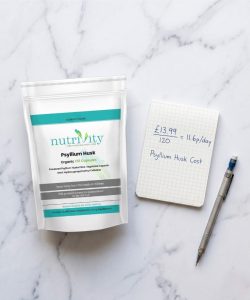
For anyone planning daily long-term use, the annual cost is a practical consideration. The 120-capsule pack from Nutrivity is the most economical option for regular use.
| Pack Size | Price | Cost Per Capsule | Annual Cost (2 capsules/day) | Annual Cost (4 capsules/day) |
|---|---|---|---|---|
| 60 Capsules | £8.99 | 15p | £109.50 | £219.00 |
| 120 Capsules | £13.99 | 11.6p | £84.68 | £169.36 |
The 120-capsule pack represents a 23 percent reduction in per-capsule cost compared to the 60-capsule pack and is the most practical choice for anyone supplementing daily. The annual cost at typical daily doses is lower than most prescription dietary supplements and comparable to or less than many over-the-counter laxative products used for the same purpose.
View the Nutrivity Psyllium Husk range here.
Psyllium Husk and Fibre Adequacy in the UK
The case for daily long-term psyllium supplementation in the UK is strengthened by a straightforward fact about the UK diet: most adults are significantly under-consuming dietary fibre. The UK recommended fibre intake is 30 grams per day. Average actual intake is approximately 18 grams per day — a shortfall of around 12 grams. This chronic fibre deficit is associated with higher rates of constipation, IBS, elevated cholesterol, blood sugar dysregulation, and increased colorectal cancer risk.
Dietary change alone — increasing intake of whole grains, legumes, vegetables, and fruit — is the optimal route to closing this gap. In practice, many people find that sustaining a dietary fibre intake of 30 grams per day from food alone is difficult given the constraints of modern eating patterns. Daily psyllium supplementation bridges this gap reliably and economically, delivering concentrated soluble fibre in a form that requires no meal planning or food preparation. For people who are unlikely to dramatically change their dietary pattern, daily psyllium is a practical long-term investment in the health outcomes that adequate fibre supports.
Who Might Consider Long-Term Daily Psyllium Supplementation
Daily long-term psyllium supplementation is most appropriate for people in the following situations:
Chronically low dietary fibre intake — UK average dietary fibre intake is approximately 18 grams per day against a recommended 30 grams. Most UK adults are significantly below target. Daily psyllium supplementation bridges this gap and sustains the bowel health and cardiovascular benefits associated with adequate fibre intake.
IBS management — NICE recommends ongoing soluble fibre supplementation for IBS. People whose IBS symptoms are well managed on psyllium have clear reason to continue daily use.
Elevated LDL cholesterol — For people managing borderline elevated cholesterol through dietary approaches, psyllium’s LDL-lowering effect requires daily ongoing use. Stopping supplementation will return LDL toward its baseline level over time.
Type 2 diabetes or prediabetes — The blood sugar moderation effects of psyllium are present at every meal where it is taken. For people managing blood glucose, daily consistent use at each major meal provides ongoing glucose moderation support.
For the full context on using psyllium for specific health goals: Psyllium Husk Supplements: The Complete Guide
Dosage guide: Psyllium Husk Dosage: How Much Should You Take?
Cholesterol evidence: Psyllium Husk for Cholesterol: Can It Help?
IBS evidence: Psyllium Husk for IBS: What the Evidence Says
Frequently Asked Questions
Is it safe to take psyllium husk every day?
Yes. Psyllium husk has been studied in clinical trials lasting 12 months with no evidence of adverse effects from daily use over that period. There is no documented upper limit on safe duration of supplementation in healthy adults without contraindications. Regulatory bodies including the NHS and FDA recognise psyllium as safe for ongoing dietary use.
Does psyllium husk cause dependency?
No. Psyllium husk is a bulk-forming mechanical fibre supplement, not a stimulant laxative. It does not interact with the enteric nervous system and the bowel does not develop tolerance to its mechanical effects. Stopping psyllium does not leave the bowel less capable — stool consistency simply returns toward baseline as the fibre bulk is removed. This is categorically different from the dependency mechanism of stimulant laxatives.
What happens if I stop taking psyllium husk?
The effects of psyllium are sustained by ongoing supplementation. Stopping psyllium will result in stool consistency returning toward baseline over several days, and the cholesterol and blood sugar moderation effects will diminish over time as the daily bile acid binding and glucose gel effects cease. There are no withdrawal symptoms and no rebound effects beyond the return to pre-supplementation baseline.
Can I take psyllium husk every day if I have IBS?
Yes. NICE clinical guidelines recommend ongoing soluble fibre supplementation including ispaghula/psyllium for IBS management. Daily consistent use is preferable to sporadic supplementation for IBS, as it maintains consistent stool consistency and bowel regularity that are disrupted by intermittent fibre intake.
Will daily psyllium husk weaken my bowel?
No. This concern relates to stimulant laxatives, not bulk-forming fibre supplements. Psyllium does not stimulate the bowel wall, does not affect enteric nerve function, and does not cause the bowel to become dependent on external stimulation. Daily psyllium supplementation supports rather than replaces normal bowel function.
How long should I take psyllium husk for?
As long as it is producing the benefit you are supplementing for. For cholesterol and blood sugar management, the benefits require ongoing daily use. For IBS, many people continue indefinitely as long as symptoms are well managed. For general bowel regularity and digestive health, daily supplementation is safe and beneficial for as long as you choose to take it.
What is the cheapest way to take psyllium husk every day?
Nutrivity Psyllium Husk 500mg Capsules in the 120-capsule pack at £13.99 offer the best per-capsule cost at 11.6p per capsule. This is the most economical option for daily long-term supplementation. The 60-capsule pack at 15p per capsule is better suited to people starting out or wanting to try the product before committing to the larger pack.
Can I take psyllium husk every day alongside other supplements?
Yes. Psyllium husk is generally compatible with other dietary supplements. If you take prescription medication, leave at least one to two hours between psyllium and your medication, as psyllium can reduce the absorption of some drugs if taken simultaneously. Consult your GP or pharmacist for personalised guidance if you take multiple medications.