




What Is Psyllium Husk and How Does It Work?
-
By Chris Jones
Written by Chris Jones | Last Updated June 2026 | Social Media Manager at Nutrivity (7+ years in the UK supplement industry)
What Is Psyllium Husk and How Does It Work?
If you have been prescribed Fybogel by your GP, bought a fibre supplement at a health food shop, or researched natural ways to support digestive health, you have likely encountered psyllium husk — possibly without knowing what it actually is. It is one of the most widely used dietary fibre supplements in the world, yet surprisingly few people understand what it consists of at a basic level or why it works the way it does.
This article explains exactly what psyllium husk is, where it comes from, what it contains, and how it produces its effects in the digestive system. Understanding the mechanism is useful not just as background knowledge but because it directly informs how to take psyllium effectively and safely.
What Is Psyllium Husk?
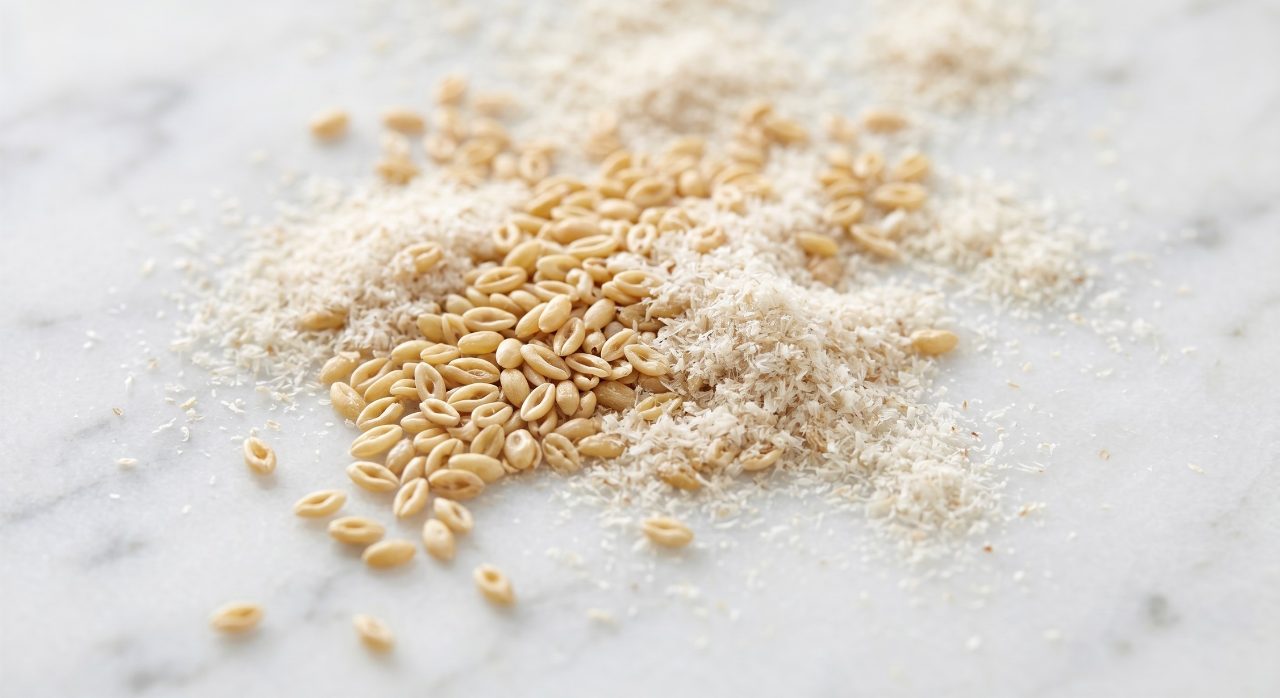
Psyllium husk is the outer seed coat of the Plantago ovata plant. Plantago ovata is a small annual herb native to western Asia and the Indian subcontinent, and today India accounts for approximately 85 to 90 percent of global psyllium production. The majority of commercial cultivation takes place in the state of Gujarat, where the dry climate and sandy soil conditions suit the crop. The plant has been grown for its seeds for well over a century.
After harvest, the seeds are cleaned and the outer husk — the thin, papery coating surrounding the seed — is mechanically separated from the inner seed body. The seed itself is discarded or used separately. The husk is then dried, milled to a fine powder, and either sold as a bulk powder or encapsulated for use as a dietary supplement. It is the husk, not the seed, that carries the fibre content that makes psyllium so useful.
The terms psyllium husk and ispaghula husk are interchangeable — they describe the same material. Ispaghula is the older pharmaceutical term, derived from the Persian name for the plant, and you will see it used on packaging for Fybogel and in NICE clinical guidelines. Psyllium husk is the more common term in supplement marketing and in North American usage. In everyday conversation and purchasing decisions, they mean the same thing.
What Does Psyllium Husk Contain?
The defining characteristic of psyllium husk as a supplement ingredient is its fibre density. It contains approximately 70 percent soluble fibre and 30 percent insoluble fibre by dry weight, making it one of the most concentrated sources of soluble fibre available from any plant material.
For context: oats contain approximately 55 percent soluble fibre by composition; apples contain far less, with most of their bulk being water and simple sugars. Psyllium husk as a supplement delivers fibre in a concentrated, practical form that would be difficult to replicate through food alone.
The soluble fibre fraction of psyllium consists primarily of arabinoxylans — long-chain polysaccharides with a strong ability to absorb water and form a gel. This gel-forming capacity is measurably higher in psyllium than in other commonly used soluble fibre sources such as oat beta-glucan or guar gum, and it is this property that accounts for psyllium’s effects on bowel function, cholesterol, and blood sugar.
The insoluble fibre fraction adds bulk without forming a gel and passes through the digestive system largely unchanged. In combination with the soluble fraction, it contributes to stool volume and helps support transit through the large intestine.
Soluble vs Insoluble Fibre: Why the Distinction Matters
The distinction between soluble and insoluble fibre is important for understanding why different fibre sources have different effects in the body — and why psyllium husk behaves differently from, say, a high-bran cereal or a serving of green vegetables.
Soluble fibre — Dissolves in water to form a gel or viscous solution. In the digestive tract, this gel slows digestion, moderates glucose absorption, and binds certain compounds (including bile acids and dietary cholesterol). The clinical effects associated with soluble fibre include lower post-meal blood glucose, reduced LDL cholesterol, and improved stool consistency. Psyllium’s soluble fibre fraction is responsible for most of its documented therapeutic benefits.
Insoluble fibre — Does not dissolve in water. It adds physical bulk to stool and speeds intestinal transit. Wheat bran is predominantly insoluble fibre. While useful for increasing stool frequency, insoluble fibre does not have the cholesterol-binding or blood sugar-moderating properties of soluble fibre, and it can worsen symptoms in people with IBS by adding irritant bulk to a sensitive intestine.
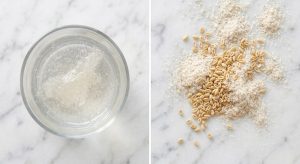 Psyllium’s high soluble fibre content — particularly its gel-forming arabinoxylans — is what sets it apart from wheat bran and most other common fibre supplements. It delivers the benefits associated with soluble fibre in a more concentrated and controllable form than dietary sources alone.
OUR TOP RECOMMENDED
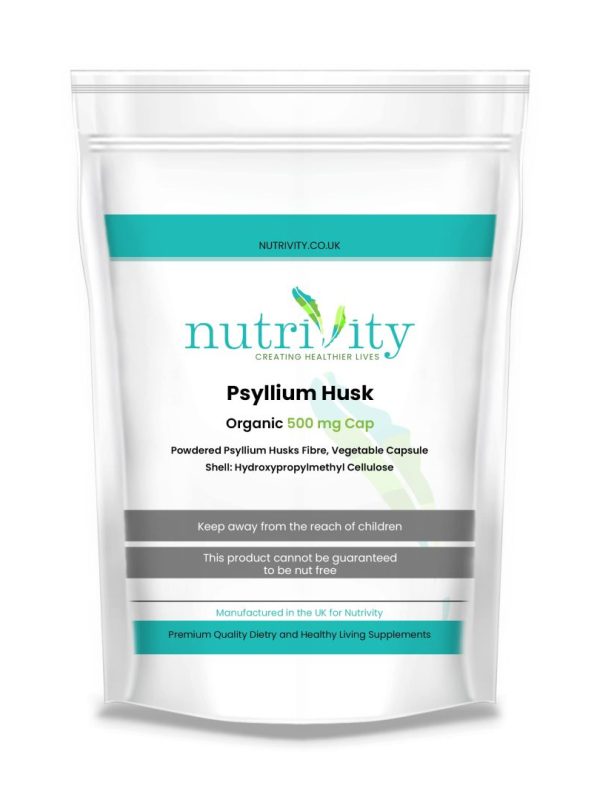
Psyllium Husk 500mg Capsules — Natural Dietary Fibre Supplement
Price range: £8.99 through £13.99
How Does Psyllium Husk Work in the Digestive Tract?
When psyllium husk is swallowed with adequate water, the gel-forming process begins almost immediately. In the mouth and oesophagus, the husk begins absorbing liquid. By the time it reaches the stomach, it has begun forming a viscous mass.
In the stomach — The gel occupies physical space and increases the viscosity of stomach contents. This slows gastric emptying — the rate at which the stomach transfers its contents into the small intestine. Slower gastric emptying means the stomach takes longer to process a meal, which contributes to a prolonged feeling of fullness after eating. This is the mechanism behind psyllium’s effect on appetite and satiety.
In the small intestine — The gel creates a physical layer between the intestinal contents and the intestinal wall. This layer reduces the rate at which glucose from digested carbohydrates diffuses across the intestinal wall and enters the bloodstream — producing a slower, more gradual post-meal glucose rise rather than a sharp spike. The same gel also interferes with the reabsorption of bile acids. Bile acids are produced by the liver using cholesterol and secreted into the small intestine to emulsify dietary fats. Normally, the vast majority of bile acids are reabsorbed near the end of the small intestine and returned to the liver for recycling. When psyllium’s gel binds to bile acids, they pass out of the body with the stool instead of being reabsorbed. The liver must then synthesise new bile acids — and to do so, it draws on LDL cholesterol circulating in the blood. This repeated cycle, sustained through daily psyllium supplementation, is how psyllium produces consistent reductions in LDL cholesterol over time.
In the large intestine — Psyllium adds bulk to stool and retains moisture within the stool mass, softening consistency and supporting easier passage. An important feature at this stage is that psyllium is largely resistant to bacterial fermentation. Most soluble fibres are rapidly fermented by colonic bacteria — a process that produces short-chain fatty acids with their own benefits but also generates significant gas as a byproduct. This gas production is what causes bloating and wind with fibre sources like inulin and FOS, and what makes them poorly tolerated in IBS. Because psyllium resists fermentation, it produces significantly less gas than these alternatives while still adding the structural bulk and moisture-retention benefits of a soluble fibre. This low-fermentation profile is one of the primary reasons psyllium is the preferred fibre supplement for people with IBS.
Is Psyllium Husk Absorbed by the Body?
No. This is a commonly misunderstood point. Psyllium husk is not digested or absorbed. The human body lacks the enzymes needed to break down the arabinoxylans in psyllium into usable molecules. The husk passes through the stomach, small intestine, and large intestine performing its mechanical and binding functions, and is then excreted in the stool.
This means psyllium husk does not contribute calories in any meaningful amount, does not affect liver metabolism directly, and does not interact with the systems of the body in the way that an absorbed compound would. Its effects are entirely mechanical — physical bulk, water retention, gel formation, and bile acid binding — not metabolic. This is why it is so well tolerated by most people and has such a limited side effect profile compared to pharmacological agents that are absorbed and metabolised.
Why Does Psyllium Require Water?
Water is not optional with psyllium husk — it is a functional requirement. The gel-forming properties that make psyllium effective depend entirely on sufficient hydration. Without water, the husk cannot form a gel; instead it remains a dry, compact mass that can be difficult to move through the oesophagus and intestine.
Cases of oesophageal obstruction have been reported in people who took psyllium with insufficient liquid — particularly in older adults or those with swallowing difficulties. This is not a theoretical risk. It is the most clinically significant safety concern associated with psyllium supplementation, and it is entirely preventable by following the instruction to take psyllium with a full glass of water and staying adequately hydrated throughout the day.
As a practical rule: always take psyllium with at least 200ml of water, and do not take it immediately before bed without drinking a full glass. If you are unwell and dehydrated, do not increase your psyllium dose until hydration is restored.
Nutrivity Psyllium Husk 500mg Capsules
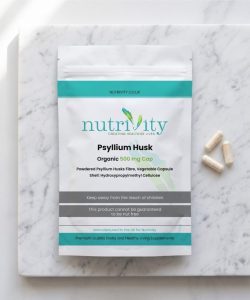 Nutrivity Psyllium Husk 500mg Capsules are manufactured in the UK under GMP-certified conditions. Each capsule contains 500mg of psyllium husk in an HPMC vegetable capsule — vegan friendly and suitable for halal diets. Available in 60-capsule (£8.99) and 120-capsule (£13.99) pack sizes.
For our complete guide to the full range of psyllium husk benefits: Psyllium Husk Supplements: The Complete Guide
For buying guidance: Best Psyllium Husk Supplements UK 2026
Frequently Asked Questions About Psyllium Husk Supplement
Is psyllium husk the same as ispaghula husk?
Yes. Ispaghula husk and psyllium husk are two names for the same material — the outer seed coat of Plantago ovata. Ispaghula is the pharmaceutical term used in UK medical contexts including on Fybogel packaging and in NICE guidelines. Psyllium husk is the term used more widely in supplements and internationally. They are clinically interchangeable.
Where does psyllium husk come from?
Psyllium husk comes from the outer seed coat of the Plantago ovata plant. India produces approximately 85 to 90 percent of the world’s psyllium supply, with most cultivation concentrated in the state of Gujarat. The husk is separated from the seed after harvest and processed into powder or capsule form.
Is psyllium husk absorbed by the body?
No. Psyllium husk is not digested or absorbed. The human body cannot break down the arabinoxylans in psyllium into usable molecules. It passes through the digestive system intact, performing its mechanical functions — gel formation, bulk addition, moisture retention, and bile acid binding — and is then excreted in the stool. It does not contribute meaningfully to caloric intake.
Why does psyllium husk need to be taken with water?
Psyllium’s gel-forming properties depend entirely on water. Without sufficient water, the husk cannot form the gel needed for its beneficial effects, and it can form a dry mass that is difficult to pass through the oesophagus or intestine. Cases of oesophageal blockage have been reported in people who took psyllium without enough liquid. Always take psyllium with a minimum of 200ml of water.
What makes psyllium different from other fibre supplements?
Psyllium’s key differentiators are its very high soluble fibre content (approximately 70 percent) and its resistance to bacterial fermentation in the colon. The high soluble fibre content gives it cholesterol-binding and blood sugar-moderating properties that insoluble fibres like wheat bran lack. Its resistance to fermentation means it produces significantly less gas than fermentable fibres like inulin — making it far better tolerated in people with IBS or sensitive digestive systems.
Can psyllium husk be taken long term?
Yes. Psyllium husk is designed for daily long-term use. It does not cause dependency and does not reduce the bowel’s natural function over time. The cholesterol and blood sugar benefits of psyllium are cumulative and require consistent ongoing supplementation to be maintained.
Is psyllium husk vegan?
Psyllium husk itself is entirely plant-derived. Whether a psyllium supplement is suitable for vegans depends on the capsule shell used — gelatin capsules are animal-derived and not suitable for vegans. Nutrivity Psyllium Husk Capsules use HPMC vegetable capsules and are vegan friendly.
Is psyllium husk the same as flaxseed?
No. Psyllium husk and flaxseed are different plants with different fibre compositions. Flaxseed contains both soluble and insoluble fibre but also provides omega-3 fatty acids and lignans. Psyllium husk is far more concentrated as a soluble fibre source and has a much more extensive clinical evidence base for bowel function, cholesterol management, and blood sugar regulation. They are not interchangeable in terms of evidence or mechanism.