





Cod Liver Oil vs Omega-3 — What’s the Difference?
-
By Chris Jones
Last Updated May 2026 | Written by Chris Jones, Social Media Manager at Nutrivity with 7+ years in the supplement industry.
Quick Answer
Cod liver oil and standard omega-3 fish oil both deliver EPA and DHA, but they are not the same supplement. Cod liver oil is extracted from the liver of cod fish and naturally contains vitamins A and D alongside its omega-3 content. Standard omega-3 fish oil is typically sourced from the body oils of oily fish like mackerel, sardines, and anchovies, and provides higher concentrations of EPA and DHA without the added fat-soluble vitamins. If you want an all-in-one supplement that covers omega-3s plus vitamins A and D, cod liver oil is the more efficient choice. If you need a high-dose omega-3 for cardiovascular support and already get enough vitamins A and D from your diet, standard fish oil may be more appropriate.
Cod Liver Oil vs Omega-3 — What’s the Difference?
The confusion between cod liver oil and omega-3 fish oil is one of the most common in the supplement world. Many people use the terms interchangeably, but they refer to two distinct products with different nutrient profiles, different sourcing methods, and different reasons for taking them. Understanding these differences is essential before you decide which one belongs in your daily routine.
At the most basic level, the distinction comes down to source and composition. Cod liver oil comes specifically from the livers of Atlantic cod (Gadus morhua). Because the liver is where fat-soluble vitamins are stored, cod liver oil naturally contains meaningful amounts of vitamin A (retinol) and vitamin D3 (cholecalciferol) in addition to the omega-3 fatty acids EPA (eicosapentaenoic acid) and DHA (docosahexaenoic acid). Standard omega-3 fish oil, by contrast, is extracted from the flesh and body oils of various oily fish species. It delivers EPA and DHA — often in higher concentrations than cod liver oil — but contains little to no vitamin A or vitamin D.
This means that choosing between the two is not simply a question of “which has more omega-3.” It is a question of what your body actually needs and what the rest of your diet and supplement regimen already provides.
Cod Liver Oil — A Closer Look
Cod liver oil has been used as a nutritional supplement for centuries. In northern European countries, it was traditionally given to children during winter months to ward off rickets and support bone development — long before anyone understood that vitamin D was the mechanism behind those benefits.
The key advantage of cod liver oil is its multi-nutrient profile. A single serving typically provides:
EPA and DHA — The same omega-3 fatty acids found in standard fish oil, contributing to normal heart function. The European Food Safety Authority recognises that a daily intake of 250mg of EPA and DHA contributes to the normal function of the heart.
Vitamin A (retinol) — A fat-soluble vitamin that contributes to the maintenance of normal vision, the normal function of the immune system, and the maintenance of normal skin. Cod liver oil provides preformed retinol, which is the most bioavailable form of vitamin A and does not require conversion from beta-carotene.
Vitamin D3 — Contributes to the maintenance of normal bones, normal muscle function, and the normal function of the immune system. Given that vitamin D deficiency remains widespread in the UK — particularly during autumn and winter months when UVB exposure is insufficient for cutaneous synthesis — this is a significant practical benefit.
For anyone looking to cover multiple nutritional bases with a single supplement, cod liver oil is remarkably efficient. Rather than taking a separate omega-3 capsule, a separate vitamin D supplement, and potentially a vitamin A supplement, one cod liver oil product can address all three.
Nutrivity’s Cod Liver Oil & Glucosamine 1000mg takes this multi-nutrient approach a step further by combining cod liver oil with glucosamine sulphate. Glucosamine is widely used to support joint health, making this a particularly practical option for anyone who wants omega-3s, fat-soluble vitamins, and joint support in a single daily capsule.
Who Should Consider Cod Liver Oil?
Cod liver oil tends to suit people who want a broad-spectrum supplement without managing multiple individual products. It is especially worth considering if:
You live in the UK or northern latitudes — Where vitamin D synthesis from sunlight is limited for roughly six months of the year. Public Health England recommends that everyone considers a vitamin D supplement during autumn and winter, and cod liver oil naturally provides it.
You want joint support alongside omega-3s — Particularly when combined with glucosamine, as in Nutrivity’s formulation, cod liver oil becomes a joint-focused supplement that simultaneously delivers cardiovascular and immune-supporting nutrients.
You prefer fewer capsules per day — Consolidating omega-3s, vitamin A, and vitamin D into one product simplifies your routine and often reduces overall cost compared to buying three separate supplements.
Vitamin A — The Dosage Consideration
One important factor with cod liver oil is vitamin A intake. Because retinol is fat-soluble and stored in the liver, excessive intake over long periods can lead to hypervitaminosis A. This is rarely a concern at standard supplementation doses, but it does mean that you should be mindful of how much vitamin A you are getting from all sources combined — including diet, multivitamins, and cod liver oil. Pregnant women are typically advised to avoid high-dose vitamin A supplements, so if you are pregnant or planning pregnancy, consult your GP before taking cod liver oil.
Standard Omega-3 Fish Oil — A Closer Look
Standard omega-3 fish oil supplements are the most widely consumed omega-3 product globally. They are manufactured by extracting oil from the body tissue of oily fish — most commonly anchovies, sardines, mackerel, and herring — and then concentrating the EPA and DHA content through molecular distillation or similar purification processes.
The primary advantage of standard fish oil over cod liver oil is concentration. Because the oil comes from the body rather than the liver, it can be processed and concentrated to deliver higher levels of EPA and DHA per capsule without the accompanying vitamin A. This makes it easier to take higher omega-3 doses when needed without risking excessive vitamin A intake.
Higher EPA and DHA per serving — Many standard fish oil products deliver 500mg to 1,000mg or more of combined EPA and DHA per capsule, whereas cod liver oil capsules tend to provide lower omega-3 concentrations because they also contain fat-soluble vitamins.
No vitamin A ceiling to manage — If you already take a multivitamin that contains vitamin A, or if your diet is rich in retinol-containing foods like liver, eggs, and dairy, standard fish oil lets you increase your omega-3 intake without stacking vitamin A.
Greater flexibility in dosing — For people who want to take higher amounts of EPA and DHA for specific purposes — such as supporting normal blood triglyceride levels (EFSA recognises that 2g of EPA and DHA daily contributes to the maintenance of normal blood triglyceride concentrations) — standard fish oil is the more practical vehicle.
Who Should Consider Standard Omega-3 Fish Oil?
Standard fish oil is generally the better choice if your primary goal is maximising your EPA and DHA intake without additional fat-soluble vitamins. It is worth considering if:
You already supplement vitamin D separately — If you take a standalone vitamin D3 product like Nutrivity’s Vitamin D3 4000IU & K2 MK-7, adding cod liver oil would mean doubling up on vitamin D without necessarily needing to.
You want the highest possible omega-3 dose — For those who have been advised to take higher-dose omega-3 supplementation, concentrated fish oil makes it easier to reach the required intake in fewer capsules.
You are pregnant or breastfeeding — DHA contributes to the normal development of the eye and brain of the foetus and breastfed infant (EFSA-approved claim, at 200mg DHA daily in addition to 250mg EPA+DHA). However, high vitamin A intake during pregnancy carries risk, so a standard fish oil that provides DHA without retinol is generally preferred. Always consult your midwife or GP before starting any supplement during pregnancy.
Head-to-Head Comparison
| Feature | Cod Liver Oil | Standard Omega-3 Fish Oil |
|---|---|---|
| Source | Liver of Atlantic cod | Body oil of oily fish (sardines, anchovies, mackerel) |
| EPA & DHA | Moderate per serving | Typically higher per serving |
| Vitamin A (retinol) | Yes — naturally occurring | No |
| Vitamin D3 | Yes — naturally occurring | No (unless fortified) |
| Suitability in pregnancy | Caution required due to vitamin A — consult GP | Generally preferred for DHA intake — consult GP |
| Best for | All-in-one coverage (omega-3 + vitamins A & D) | Maximising EPA/DHA without added fat-soluble vitamins |
| Risk of vitamin A excess | Possible at high doses or combined with other retinol sources | Not applicable |
| Joint support combinations | Available with glucosamine (e.g. Nutrivity CLO & Glucosamine) | Typically standalone |
| Typical capsule form | Soft gel | Soft gel |
| Cost efficiency | Higher — replaces multiple supplements | Lower per omega-3 mg, but may need additional supplements |
OUR TOP RECOMMENDED
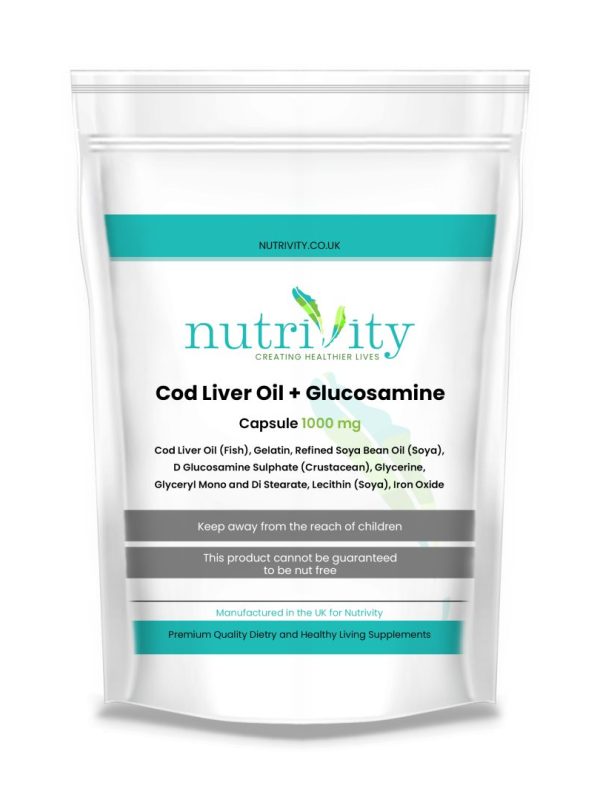
Cod Liver Oil, Omega 3 & Glucosamine 1000mg High Strength Soft Gels – 3 in 1 | Joint Support
Price range: £11.99 through £51.99🐟 Cod Liver Oil, Omega 3 & Glucosamine High Strength - 3 in 1 Formula. 📦 Up to 12 months supply – from just 15p per day. 

Can You Take Both Together?
Technically, you can take both cod liver oil and standard omega-3 fish oil. However, doing so is rarely necessary and introduces a risk of excessive vitamin A intake from the cod liver oil component. For most people, it makes more sense to choose one or the other based on your individual needs rather than doubling up.
If your primary concern is joint health and you want the broadest nutrient coverage from a single product, cod liver oil combined with glucosamine — like Nutrivity’s Cod Liver Oil & Glucosamine 1000mg — provides omega-3 fatty acids, vitamins A and D, and glucosamine sulphate all in one capsule. This eliminates the need for separate fish oil, vitamin D, and glucosamine products.
What About Plant-Based Omega-3?
It is worth noting that neither cod liver oil nor standard fish oil is suitable for vegans. Both are derived from fish. If you follow a vegan diet, plant-based omega-3 sources include flaxseed oil, chia seeds, and hemp seeds, though these provide ALA (alpha-linolenic acid) rather than preformed EPA and DHA. The body can convert ALA to EPA and DHA, but the conversion rate is generally low — estimated at roughly 5-10% for EPA and less than 5% for DHA.
For vegan-friendly supplementation at Nutrivity, products like Sea Buckthorn Oil 500mg provide omega-7 fatty acids alongside other beneficial compounds, though they are not a direct replacement for EPA and DHA.
Quality and Sourcing Considerations
Regardless of whether you choose cod liver oil or standard fish oil, supplement quality matters. Key factors to look for include:
Purity testing — Reputable manufacturers test for heavy metals (mercury, lead, cadmium), PCBs, and dioxins. Fish oil sourced from smaller, short-lived fish species like anchovies and sardines tends to have lower contaminant levels than oil from larger, longer-lived species.
Manufacturing standards — Look for products manufactured in GMP-certified facilities. All Nutrivity supplements are manufactured in the UK under GMP certification, ensuring consistent quality control from raw material intake through to finished product.
Freshness — Omega-3 oils are susceptible to oxidation. High-quality products use nitrogen flushing, antioxidant additions (such as vitamin E), or encapsulation methods that minimise exposure to light and oxygen.
Transparent labelling — The actual EPA and DHA content per capsule should be clearly stated, not just the total fish oil amount. A capsule containing 1000mg of fish oil might deliver anywhere from 300mg to 600mg of combined EPA and DHA depending on the concentration — always check the breakdown.
The Bottom Line
Cod liver oil and standard omega-3 fish oil are related but distinct supplements. Cod liver oil gives you EPA, DHA, vitamin A, and vitamin D in a single product — making it ideal for people who want comprehensive nutrient coverage without managing multiple capsules. Standard fish oil delivers higher concentrations of EPA and DHA without the added fat-soluble vitamins, making it the better choice if you need high-dose omega-3s or already supplement vitamins A and D separately.
For joint health specifically, a cod liver oil and glucosamine combination like Nutrivity’s Cod Liver Oil & Glucosamine 1000mg offers an efficient multi-purpose solution that covers omega-3s, fat-soluble vitamins, and glucosamine in one daily capsule — manufactured in the UK to GMP standards and halal friendly.

Key Takeaways
Different source, different profile — Cod liver oil comes from cod livers and includes vitamins A and D. Standard fish oil comes from oily fish body oils and focuses purely on EPA and DHA.
Cod liver oil is the all-in-one option — If you want omega-3s plus vitamins A and D without buying multiple supplements, cod liver oil covers all three.
Standard fish oil suits high-dose omega-3 needs — If you specifically need higher EPA and DHA concentrations and already manage your fat-soluble vitamins separately, standard fish oil is more practical.
Watch vitamin A intake with cod liver oil — Retinol accumulates in the body, so be mindful of total intake from all sources, especially during pregnancy.
Quality matters for both — Choose UK-manufactured, GMP-certified products with transparent EPA/DHA labelling and purity testing.
Frequently Asked Questions
Is cod liver oil better than omega-3 fish oil?
Neither is universally better — they serve different purposes. Cod liver oil provides a broader nutrient profile including vitamins A and D alongside omega-3 fatty acids, making it a more comprehensive single supplement. Standard omega-3 fish oil provides higher concentrations of EPA and DHA per capsule. The better choice depends on whether you value all-in-one coverage or maximum omega-3 potency.
Can I take cod liver oil and omega-3 at the same time?
You can, but it is generally unnecessary and may lead to excessive vitamin A intake from the cod liver oil. Most people are better served choosing one or the other based on their individual needs. If you need both high-dose omega-3 and vitamins A and D, speak to your GP about appropriate dosing.
Does cod liver oil help with joint pain?
Cod liver oil provides omega-3 fatty acids and vitamin D, both of which are associated with supporting normal bone and muscle function (EFSA-approved claims for vitamin D). When combined with glucosamine — as in Nutrivity’s Cod Liver Oil & Glucosamine formulation — the joint support profile is further enhanced. However, no supplement should be relied upon as a sole treatment for joint pain; consult your GP if you are experiencing persistent discomfort.
Is cod liver oil suitable for vegans?
No. Cod liver oil is derived from fish and is not suitable for vegans. If you follow a plant-based diet and want omega fatty acid support, consider plant-based alternatives such as flaxseed oil or algae-derived DHA supplements.
How much EPA and DHA do I need daily?
The European Food Safety Authority recognises that a daily intake of 250mg of combined EPA and DHA contributes to the normal function of the heart. Higher intakes of 2g daily of EPA and DHA contribute to the maintenance of normal blood triglyceride concentrations, and 3g daily of EPA and DHA contributes to the maintenance of normal blood pressure. These higher doses should be discussed with your healthcare professional before starting.
Why does Nutrivity combine cod liver oil with glucosamine?
Combining cod liver oil with glucosamine in a single capsule addresses multiple aspects of joint and overall health simultaneously. The omega-3 fatty acids and vitamin D from cod liver oil support heart function and bone maintenance, while glucosamine sulphate is widely used for joint support. This combination reduces the number of individual supplements needed and is manufactured in the UK to GMP standards.