




Glucosamine vs Collagen for Joints – Which Is Better?
-
By Chris Jones
Last Updated May 2026 | Written by Chris Jones, Social Media Manager at Nutrivity with 7+ years in the supplement industry.
Quick Answer
Glucosamine and collagen both support joint health, but they work through different mechanisms. Glucosamine is a building block of cartilage — the firm, rubbery tissue that cushions joints — and is primarily used to support the maintenance and repair of existing cartilage. Collagen is the main structural protein in connective tissues throughout the body, including cartilage, tendons, and ligaments. While both are popular joint supplements, glucosamine has a longer track record in joint-specific research, and collagen has gained significant attention in recent years for its broader connective tissue benefits. For dedicated joint support, glucosamine — especially when combined with complementary nutrients like cod liver oil — remains the more established choice.
Glucosamine vs Collagen — How They Differ
The glucosamine vs collagen debate has become one of the most common questions in the joint health supplement space. Both are marketed for joint support, both are widely available, and both have their advocates. But they are fundamentally different substances that work in different ways, and understanding those differences is the key to making the right choice for your situation.
Glucosamine is an amino sugar — a naturally occurring compound that the body produces and uses as a building block in the synthesis of glycosaminoglycans, which are essential components of cartilage. As we age, the body’s natural production of glucosamine can decline, which is one of the reasons cartilage tends to thin and degrade over time. Supplemental glucosamine is typically derived from shellfish shells (glucosamine sulphate or glucosamine hydrochloride) and is taken to provide the raw material the body needs for cartilage maintenance.
Collagen, by contrast, is a protein — the most abundant protein in the human body, in fact. It provides structural support to skin, bones, tendons, ligaments, and cartilage. There are at least 28 identified types of collagen, but types I, II, and III account for the vast majority of collagen in the body. Type II collagen is the primary form found in cartilage, which is why it is the type most commonly associated with joint health supplements. Collagen supplements are usually made from bovine (cow), porcine (pig), marine (fish), or chicken sources, and are typically hydrolysed into smaller peptides to improve absorption.
How Glucosamine Works
Glucosamine’s role in joint health is centred on cartilage — the smooth, slippery tissue that covers the ends of bones where they meet to form joints. Healthy cartilage acts as a shock absorber and allows bones to glide over each other with minimal friction. When cartilage deteriorates, joints become stiff, uncomfortable, and less mobile.
The theory behind glucosamine supplementation is straightforward. Glucosamine is a precursor to glycosaminoglycans, which in turn are essential for the production and maintenance of cartilage matrix. By supplementing with glucosamine, you are providing the body with additional raw material to support the ongoing repair and maintenance of cartilage tissue.
Glucosamine sulphate vs glucosamine hydrochloride — The sulphate form is more widely studied in the context of joint health and is the form used in the majority of clinical trials that have reported positive outcomes. The sulphate component itself may also play a role, as sulphate is required for the synthesis of proteoglycans in cartilage.
Dosage considerations — The most commonly studied dose of glucosamine sulphate is 1,500mg per day, typically taken as a single dose or divided into two or three doses. Most research protocols use this dose consistently over periods of several weeks to months.
Combination products — Glucosamine is frequently combined with other joint-supporting ingredients. Chondroitin sulphate is the most common pairing, but cod liver oil is another valuable combination. Nutrivity’s Cod Liver Oil & Glucosamine 1000mg pairs glucosamine with cod liver oil, which provides omega-3 fatty acids (EPA and DHA) plus naturally occurring vitamins A and D — creating a multi-purpose joint and general health supplement in a single capsule.

The Research Behind Glucosamine
Glucosamine has been the subject of extensive research over several decades. It is one of the most studied joint health supplements in the world, with hundreds of clinical trials and systematic reviews examining its effects. The evidence is not unanimously positive — some studies show significant benefits, others show modest or no effects — but the overall body of research has been sufficient for glucosamine to remain a mainstream recommendation from many healthcare practitioners.
In Europe, glucosamine sulphate is available as a licensed medicinal product in several countries, which reflects a level of regulatory confidence in its efficacy that few other joint supplements share. In the UK, it is available as a food supplement and is widely recommended by pharmacists and GPs as part of a joint health management strategy.
How Collagen Works
Collagen supplementation takes a different approach. Rather than providing a specific cartilage building block, collagen supplements aim to supply the body with the amino acids and peptides it needs to support collagen synthesis throughout the body — including in cartilage, tendons, ligaments, and bones.
When you take a hydrolysed collagen supplement, the collagen has been broken down into small peptides (typically 2-5 kilodaltons in molecular weight) that can be absorbed through the gut wall and enter the bloodstream. Research suggests that these peptides may accumulate in cartilage tissue and stimulate the activity of chondrocytes — the cells responsible for producing and maintaining cartilage matrix.
Type II collagen for joints — Most joint-focused collagen supplements use type II collagen, which is the predominant collagen type in articular (joint) cartilage. Some products use undenatured type II collagen (UC-II), which works through a different mechanism — modulating the immune response in the gut to reduce the body’s tendency to attack its own cartilage (a process relevant to certain autoimmune conditions).
Hydrolysed collagen peptides — The more common form in supplements, hydrolysed collagen is broken down into easily absorbed peptides. These are not type-specific after hydrolysis — the peptides are the same amino acids regardless of whether they came from type I, II, or III collagen — so the “type” labelling on hydrolysed products is more about the source than the final product.
Broader benefits — Unlike glucosamine, collagen supplementation is not limited to joint health. Collagen peptides have been studied for skin elasticity, bone density, nail strength, and gut health. This makes collagen a more versatile supplement, but also a less targeted one when it comes specifically to joint cartilage support.
The Research Behind Collagen
Collagen research for joint health is growing but less mature than the glucosamine evidence base. Several clinical trials have shown positive outcomes for joint comfort and function, particularly with UC-II (undenatured type II collagen) and hydrolysed collagen peptides at doses of 10-40mg (UC-II) or 8-12g (hydrolysed peptides) per day.
However, the total volume of research is smaller, and many of the most-cited studies have been funded by collagen supplement manufacturers, which warrants caution when interpreting results. This does not invalidate the findings, but it does mean the evidence base is still maturing compared to glucosamine’s decades of independent research.
Head-to-Head Comparison
| Feature | Glucosamine | Collagen |
|---|---|---|
| What it is | Amino sugar — cartilage building block | Protein — structural component of connective tissue |
| Primary mechanism | Provides raw material for cartilage synthesis and repair | Supplies amino acids/peptides to support collagen production |
| Focus area | Targeted — primarily joint cartilage | Broader — joints, skin, bones, tendons, ligaments |
| Research maturity | Extensive — decades of clinical trials | Growing — promising but less established |
| Typical daily dose | 1,500mg glucosamine sulphate | 10-40mg UC-II or 8-12g hydrolysed peptides |
| Common form | Capsules or tablets | Powder, capsules, or liquid |
| Common sources | Shellfish shells | Bovine, porcine, marine, or chicken |
| Allergen considerations | Shellfish allergy risk | Varies by source — fish, egg, or none |
| Combination potential | Often paired with chondroitin or cod liver oil | Often paired with vitamin C for collagen synthesis |
| Vegan options available | Limited — most derived from shellfish | Very limited — most derived from animal sources |
OUR TOP RECOMMENDED
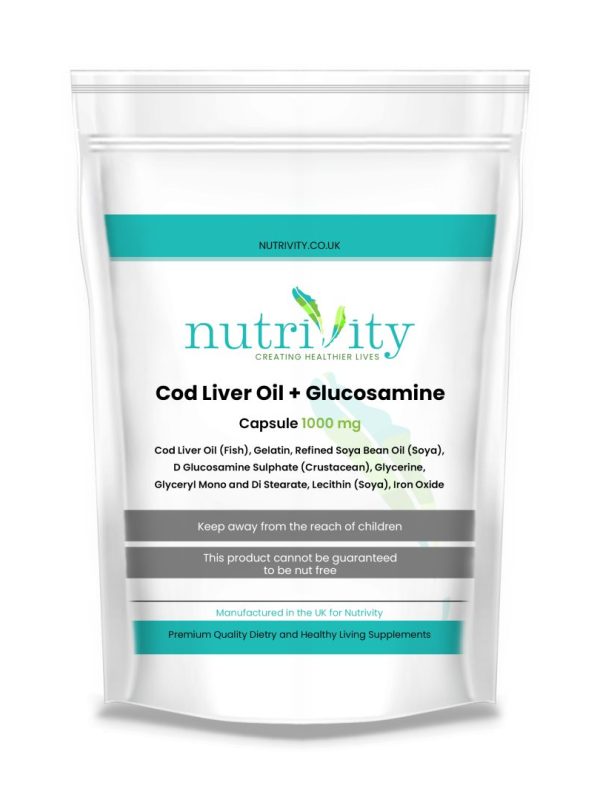
Cod Liver Oil, Omega 3 & Glucosamine 1000mg High Strength Soft Gels – 3 in 1 | Joint Support
Price range: £11.99 through £51.99🐟 Cod Liver Oil Omega 3 & Glucosamine High Strength - 3 in 1 Formula.
📦 Up to 12 months supply – from just 15p per day.

Can You Take Glucosamine and Collagen Together?
Yes, glucosamine and collagen can be taken together, and some people do combine them for a more comprehensive joint support approach. Because they work through different mechanisms — glucosamine supporting cartilage matrix synthesis and collagen providing structural protein building blocks — they are complementary rather than redundant.
That said, combining supplements adds cost and complexity to your daily routine. For most people, starting with one well-formulated glucosamine product is the more practical approach. If you want additional support, you can always add collagen later and assess whether you notice a difference. A product like Nutrivity’s Cod Liver Oil & Glucosamine 1000mg already combines glucosamine with omega-3 fatty acids and vitamins A and D — giving you joint, cardiovascular, and immune support without the need for multiple separate supplements.
Other Supplements Worth Considering for Joint Health
Joint health is multifactorial, and both glucosamine and collagen represent just part of the picture. Other nutrients and supplements that contribute to normal joint and connective tissue function include:
Vitamin D — Contributes to the maintenance of normal bones and normal muscle function. Given widespread deficiency in the UK, ensuring adequate vitamin D intake is foundational for musculoskeletal health. Nutrivity’s Vitamin D3 4000IU & K2 MK-7 provides a high-strength dose alongside vitamin K2 for optimal calcium metabolism.
Devil’s Claw — A traditional herbal extract widely used in Europe for joint comfort. Nutrivity’s Devil’s Claw 2200mg provides a high-strength extract in vegan friendly capsules.
Omega-3 fatty acids — EPA and DHA contribute to normal heart function and are associated with supporting overall wellbeing. Cod liver oil provides these alongside joint-supporting vitamins.
Vitamin C — Contributes to normal collagen formation for the normal function of cartilage, bones, and skin. If you are taking collagen supplements, ensuring adequate vitamin C intake is essential, as the body requires vitamin C to synthesise its own collagen.
Which Should You Choose?
The right choice depends on your priorities and what else you are already taking:
Choose glucosamine if — Your primary concern is joint cartilage support, you want the supplement with the longer and more robust evidence base, and you value a targeted approach. Glucosamine’s decades of research and its availability as a licensed medicine in parts of Europe make it the more established joint health supplement.
Choose collagen if — You want broader connective tissue benefits beyond just joints (skin, hair, nails, tendons), you are looking for a protein-based supplement that fits into a wider wellness routine, or you have a shellfish allergy that rules out most glucosamine products.
Consider both if — You have significant joint health concerns and want to cover multiple mechanisms of action. Start with glucosamine and add collagen after 8-12 weeks to evaluate each product’s contribution independently.
The Bottom Line
Glucosamine and collagen are both legitimate joint health supplements, but they are not interchangeable. Glucosamine is the more targeted and more researched option for cartilage-specific support, while collagen offers broader connective tissue benefits with a still-developing evidence base. For most people starting a joint support regimen, glucosamine — particularly in a well-formulated combination product like Nutrivity’s Cod Liver Oil & Glucosamine 1000mg — provides the strongest foundation. Manufactured in the UK to GMP standards and halal friendly, it delivers glucosamine alongside omega-3 fatty acids and vitamins A and D in a single daily capsule.
Key Takeaways
Different substances, different mechanisms — Glucosamine is an amino sugar that supports cartilage matrix synthesis. Collagen is a protein that provides structural building blocks for connective tissues throughout the body.
Glucosamine has the deeper evidence base — Decades of clinical research and licensed medicine status in parts of Europe give glucosamine a more established position in joint health.
Collagen offers broader benefits — If you want skin, nail, tendon, and bone support alongside joints, collagen covers more ground, but is less specifically targeted for cartilage.
They can be combined — Glucosamine and collagen work through complementary mechanisms and can be taken together if desired.
A good combination product simplifies things — Nutrivity’s Cod Liver Oil & Glucosamine combines joint support with omega-3s and fat-soluble vitamins, reducing the need for multiple separate supplements.
Frequently Asked Questions
Is glucosamine or collagen better for knee pain?
For knee-specific joint concerns, glucosamine has the stronger evidence base, particularly glucosamine sulphate at 1,500mg daily. It directly supports cartilage maintenance, which is the tissue most relevant to knee joint function. Collagen may offer complementary benefits but has less knee-specific research behind it. Always consult your GP for persistent knee pain.
How long does glucosamine take to work?
Most clinical trials evaluate glucosamine over periods of 4 to 12 weeks, with some studies running for 6 months or longer. It is generally recommended to take glucosamine consistently for at least 8 weeks before assessing whether it is making a difference. Joint health supplements are not fast-acting pain relievers — they support gradual cartilage maintenance over time.
Can vegans take glucosamine or collagen?
Most glucosamine is derived from shellfish shells, and most collagen comes from animal sources (bovine, porcine, marine, or chicken). Vegan-friendly glucosamine made from fermented corn does exist but is less widely available. Vegan collagen supplements are extremely rare — most products marketed as “vegan collagen” are actually collagen-boosting formulas containing vitamin C, zinc, and amino acids rather than collagen itself.
Is Nutrivity's Cod Liver Oil and Glucosamine suitable for vegetarians?
No. This product contains cod liver oil (from fish) and glucosamine derived from shellfish, so it is not suitable for vegetarians or vegans. It does contain fish and crustacean allergens. The product is halal friendly and manufactured in the UK to GMP standards.
Does collagen actually help joints?
The evidence is promising but still developing. A 2019 systematic review found that collagen supplementation was associated with improvements in joint pain and function, but noted that study quality was variable. The most promising results are with undenatured Type II collagen (UC-II) at 40mg per day. Collagen also supports tendons, ligaments, and skin, making it a broader connective tissue supplement rather than a joint-specific one.
Should I take glucosamine with food?
Glucosamine can be taken with or without food. Some people find it more comfortable to take with a meal to minimise any mild digestive effects. If you are taking a combination product that includes cod liver oil, taking it with a meal that contains some dietary fat may support absorption of the fat-soluble vitamins A and D.