





Agnus Castus for Hormonal Acne — Does It Work? UK Guide 2026
-
By Chris Jones
Posted June 2026 | Written by Chris Jones, Social Media Manager at Nutrivity with 7+ years in the supplement industry.
Agnus Castus for Hormonal Acne — Does It Work?
Hormonal acne — the deep, tender breakouts that tend to appear along the jaw and chin and flare in the run-up to a period — is frustrating precisely because ordinary face washes and spot creams often do little for it. That frustration is why hormonal remedies like agnus castus (Vitex agnus-castus, or chasteberry) get suggested. But this is an area where it pays to be honest rather than hopeful: the evidence for agnus castus and acne is the weakest of all its common uses, and managing expectations here matters.
This guide explains what hormonal acne is, the theory behind why agnus castus is suggested for it, what the evidence does and does not show, and what genuinely works — so you can make an informed decision. For the full mechanism, see our guide to what agnus castus is and how it works.
What Is Hormonal Acne?
Hormonal acne is acne that is driven or worsened by the body’s hormonal fluctuations. In women it characteristically appears on the lower face — jawline, chin, and around the mouth — and often flares cyclically, worsening in the luteal phase before a period. It tends to involve deeper, inflamed spots and cysts rather than surface blackheads.
The main hormonal driver is androgen activity. Androgens (male-type hormones such as testosterone, present in smaller amounts in women) stimulate the skin’s oil glands to produce more sebum, which combines with skin cells and bacteria to clog pores and cause inflammation. This is why conditions involving raised androgens, such as some presentations of PCOS, are associated with persistent hormonal acne. Prolactin can play a secondary role by influencing the broader hormonal balance, but androgens are the central player.
Why Agnus Castus Is Suggested for Acne
The logic runs like this: agnus castus lowers prolactin and supports a more regular cycle, and since hormonal acne is tied to cycle-related hormonal shifts, regulating those shifts might calm cyclical breakouts. There is a thread of plausibility here — if your acne is closely tied to a luteal-phase flare and to prolactin-related cycle disruption, then improving cycle regularity could, in theory, reduce the cyclical component.
But notice the gap in that logic: agnus castus acts mainly on prolactin, whereas hormonal acne is driven mainly by androgens. Agnus castus does not directly lower androgens or reduce sebum production. So even on a mechanistic basis, its expected effect on classic androgen-driven acne is modest at best. It is most likely to help, if at all, the woman whose breakouts are tightly cycle-linked and accompanied by other prolactin-related premenstrual symptoms — not the woman with persistent, androgen-driven cystic acne.
 What the Evidence Actually Shows
This is the part to be clear about: there is very little direct clinical trial evidence that agnus castus treats acne. Acne is not among the uses supported by good randomised controlled trials, unlike PMS and cyclical breast pain. What you will find online is largely mechanistic reasoning, traditional use, and anecdote — not robust data. Some women report that their cyclical breakouts improved when they took agnus castus for other premenstrual symptoms, but that is a side observation, not proof of an acne treatment.
So the honest position is that agnus castus is not an evidence-based treatment for hormonal acne. If you try it, do so with realistic expectations and ideally as part of addressing premenstrual symptoms generally, rather than expecting it to clear your skin. Anyone marketing it as an acne cure is going well beyond what the evidence supports. It is also slow-acting, as our guide on how long agnus castus takes to work explains, so even a possible cyclical benefit would take months to appear.
What Actually Works for Hormonal Acne
Because hormonal acne is androgen-driven, the treatments with real evidence target that mechanism or the acne process directly. Topical treatments such as retinoids and other proven acne actives address the skin directly. For persistent hormonal acne, GPs and dermatologists can prescribe options that act on the hormonal driver — including certain combined hormonal contraceptives and anti-androgen medications — which have far stronger evidence than any herb. A consistent, gentle skincare routine and not over-washing or over-treating the skin also matter more than most supplements. If your acne is persistent, scarring, or affecting your confidence, seeing your GP is a far better use of your time than a herbal trial.
If You Still Want to Try Agnus Castus
If your breakouts are clearly cyclical and you are also dealing with other premenstrual symptoms, a trial of agnus castus is low-risk, provided you keep expectations realistic and clear it with your GP first — particularly because some acne is linked to PCOS, and because agnus castus interacts with hormonal contraception, which is itself a common acne treatment. Take it once daily, every day, continuously, and give it at least three complete cycles. Nutrivity’s Agnus Castus 1000mg Vegan Tablets provide a high-strength whole-herb dose in one daily vegan tablet. If three cycles bring no skin improvement, that is a strong signal to pursue evidence-based acne treatment instead of continuing.
OUR TOP RECOMMENDED
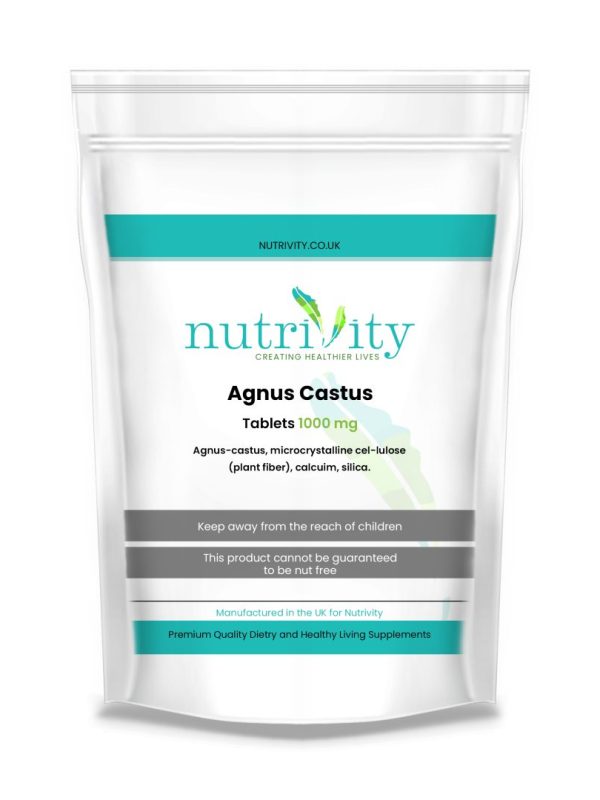
Agnus Castus 1000mg Vegan Tablets | 8 Months Supply (240 Tablets) | Women’s Health
Original price was: £28.99.£24.99Current price is: £24.99.
A Note on Interactions and Acne Medication
This point is important enough to repeat: combined hormonal contraceptives are a mainstay of hormonal-acne treatment, and agnus castus can interact with hormonal contraception. So if you are on, or considering, the pill for your skin, do not add agnus castus without medical advice — the two should not simply be stacked together. The same applies to any prescribed acne medication and to anyone with PCOS. Agnus castus should also be avoided in pregnancy and breastfeeding.
Hormonal Acne vs Other Types of Acne
Not all acne is hormonal, and the distinction affects what is worth trying. Teenage acne is largely driven by the surge of hormones during puberty and tends to spread across the forehead, nose, and cheeks (the T-zone). Adult hormonal acne in women has a more specific signature: it concentrates on the lower face — jaw, chin, and around the mouth — tends to involve deeper, tender, inflamed spots and cysts rather than surface blackheads and whiteheads, and characteristically flares in the days before a period. If your breakouts match that lower-face, cyclical, deep-spot pattern, the hormonal label fits. If they are mostly surface congestion across the T-zone, the cause is less likely to be primarily hormonal, and cycle-acting approaches are even less relevant.
This matters because agnus castus, if it does anything for skin, would only plausibly touch the cyclical, hormonally linked component. It will do nothing for congestion that is really about skincare, products, or non-hormonal factors. Matching the treatment to the actual driver is what separates progress from months of disappointment.
The PCOS and Androgen Connection
Persistent hormonal acne in adult women — especially when it comes with irregular periods or excess hair growth — can be a sign of elevated androgens, and sometimes of PCOS. This is clinically important for two reasons. First, it means stubborn hormonal acne deserves a GP conversation rather than an endless cycle of over-the-counter products and supplements, because the underlying driver may be treatable in a more targeted way. Second, it underlines why agnus castus is a poor fit for this kind of acne: the problem is androgen-driven, and agnus castus acts on prolactin, not androgens. The treatments that actually move androgen-driven acne — certain combined hormonal contraceptives and anti-androgen medications — work on the relevant mechanism and have real evidence behind them. If there is any suggestion your acne is part of a wider picture of raised androgens, that is a strong reason to see your GP rather than experiment.
Setting Realistic Expectations
If, after all of that, you still want to try agnus castus because your breakouts are clearly cyclical and you are dealing with other premenstrual symptoms too, the key is to go in with calibrated expectations. Treat it as a low-priority experiment that might, at best, soften the cyclical flare over several months — not as a skin treatment in its own right. Keep using sensible, evidence-based skincare in the meantime, do not abandon any treatment that is working, and give it a defined three-cycle window rather than an open-ended trial. If your skin has not changed after three cycles, stop and redirect your effort and money toward the approaches that actually have evidence behind them.
Skincare and Diet Basics Worth Getting Right
Whatever you decide about agnus castus, getting the fundamentals right does more for most people’s skin than any supplement. A gentle, consistent routine beats an aggressive one: a mild cleanser used twice daily, a non-comedogenic moisturiser, and broad-spectrum sun protection form a sensible base. Over-washing, harsh scrubbing, and piling on multiple strong actives at once tends to irritate the skin barrier and make inflammation worse, not better. Where over-the-counter active ingredients are used, introducing one at a time and giving it several weeks is far more effective than constant switching.
On diet, the evidence is more limited and often overstated, but a few threads are reasonably consistent: very high-glycaemic eating patterns (lots of sugary, refined carbohydrates) may worsen acne for some people, and the picture around skimmed milk and acne has some support, though it is far from settled. None of this is a cure, and elimination diets are rarely worth the stress they cause. The realistic takeaway is that a balanced diet that supports stable blood sugar is a reasonable backdrop, but it will not clear genuinely hormonal acne on its own.
If your acne is persistent, painful, leaving marks, or affecting your confidence, the most effective single step is not a tweak to your diet or a herbal trial — it is booking time with your GP or a dermatologist, who can offer treatments with real evidence and, where relevant, investigate whether an underlying hormonal driver such as raised androgens is involved. That is a far better use of your money and your hope than waiting on a supplement with little evidence behind it.
 The Bottom Line
Agnus castus is not a proven treatment for hormonal acne, and the evidence is far weaker than for its established uses. Its action is on prolactin, while hormonal acne is driven mainly by androgens — so even in theory its effect is limited, and at best it might help breakouts that are tightly cycle-linked. If clear skin is your goal, evidence-based topical and medical treatments are a much better bet, and persistent acne deserves a GP visit. If you do try agnus castus, treat it as a low-priority experiment with realistic expectations, run it for three cycles, and check with your GP first. For the products on the market, see our Agnus Castus comparison guide.
Related Reading
- What Is Agnus Castus? Benefits, Uses and UK Guide
- How Long Does Agnus Castus Take to Work?
- Agnus Castus for PCOS — Does It Help?
- Agnus Castus for Breast Tenderness (Cyclical Mastalgia)
- Best Agnus Castus Supplement UK — Brands Compared
Disclaimer: This article is for general information only and is not a substitute for professional medical advice. Food supplements are not intended to diagnose, treat, cure, or prevent any disease. Persistent or scarring acne should be assessed by a healthcare professional. If you are pregnant, breastfeeding, taking any medication, or have a medical condition, consult your GP before taking any supplement.
Frequently Asked Questions
Does agnus castus help hormonal acne?
There is very little direct evidence that agnus castus treats acne. It lowers prolactin, but hormonal acne is driven mainly by androgens, which agnus castus does not directly reduce. At best it may help breakouts that are tightly cycle-linked, as a side effect of regulating premenstrual symptoms — it is not a proven acne treatment.
How long would agnus castus take to affect skin?
Agnus castus is slow-acting and works gradually across cycles, so any cyclical benefit would take at least three complete menstrual cycles to appear. If three cycles bring no improvement, it is a clear signal to pursue evidence-based acne treatment instead.
What works better than agnus castus for hormonal acne?
Evidence-based options target the skin or the androgen driver directly — topical retinoids and other proven acne actives, and, for persistent cases, prescription treatments your GP or dermatologist can offer, including certain hormonal options. These have far stronger evidence than any herbal supplement.
Can I take agnus castus with the contraceptive pill for acne?
Not without medical advice. Combined hormonal contraceptives are a common acne treatment, and agnus castus can interact with hormonal contraception, so the two should not simply be combined. Speak to your GP first, especially if you have PCOS or take any prescribed medication.
Is agnus castus safe to try for acne?
For most women it is well tolerated, but it interacts with hormonal contraception and dopamine-related medication and should be avoided in pregnancy and breastfeeding. Because acne can be linked to PCOS and is often treated with the pill, check with your GP before starting agnus castus.