





What is the difference between vitamins and supplements?
-
By Chris Jones
Last Updated May 2026 | Written by Chris Jones, Social Media Manager at Nutrivity with 7+ years in the supplement industry.
What Is the Difference Between Vitamins and Supplements?
The terms “vitamins” and “supplements” are used interchangeably by most people, but they actually mean different things. Understanding the distinction matters because it helps you make better decisions about what to take, why, and whether you actually need it.
The short version: vitamins are a specific category of nutrient. Supplements are any product you take to add something to your diet. All vitamin products are supplements, but not all supplements are vitamins.
| Quick Answer |
| Vitamins are specific organic compounds that your body needs in small amounts to function properly — like vitamin D, vitamin C, and the B vitamins. Supplements is the broader category that includes anything taken to supplement (add to) your diet — vitamins, minerals, herbal extracts, omega fatty acids, amino acids, probiotics, and more. When someone says “I take vitamins,” they usually mean “I take supplements,” which may or may not include actual vitamins. |
What Are Vitamins?
Vitamins are organic compounds that the body needs in small amounts for normal growth, development, and function. The word “organic” here means they contain carbon — it is a chemistry term, not a reference to farming methods. There are 13 recognised vitamins, divided into two groups:
Fat-soluble vitamins — Vitamins A, D, E, and K. These are stored in the body’s fat tissue and liver. Because they accumulate, it is possible to take too much of them (particularly vitamin A), which is why dosing matters. Vitamin D is the most commonly deficient in the UK population — the NHS recommends all adults consider supplementing during autumn and winter. Nutrivity’s Vitamin D3 4000 IU + K2 MK7 provides both vitamin D3 and vitamin K2 in a single tablet.
Water-soluble vitamins — The B vitamins (B1, B2, B3, B5, B6, B7, B9, B12) and vitamin C. These dissolve in water and are not stored in the body — excess amounts are excreted through urine. This means you need a regular dietary supply, but it also means toxicity from over-supplementation is rare (with some exceptions, such as very high-dose vitamin B6).
The key point about vitamins is that your body cannot produce most of them (vitamin D and vitamin K are partial exceptions) — they must come from food or supplements.
What Are Supplements?
A supplement (formally a “food supplement” under UK and EU regulation) is any product intended to supplement the normal diet by providing concentrated sources of nutrients or other substances with a nutritional or physiological effect. This is a much broader category than vitamins alone.
Types of Supplements
Vitamins — As described above. Single vitamins (like vitamin D) or combinations (like multivitamins). These replace or top up nutrients your diet may be lacking.
Minerals — Inorganic elements the body needs, including iron, zinc, magnesium, calcium, selenium, and potassium. Like vitamins, minerals are essential — your body cannot produce them. They must come from food, water, or supplements.
Herbal and botanical extracts — Concentrated plant compounds used for their physiological effects. Examples include Devil’s Claw for joint pain, Agnus Castus for hormonal balance, Damiana for vitality, and Echinacea for immune support. These are supplements but not vitamins.
Omega fatty acids and oils — Fish oils, seed oils, and plant oils providing essential fatty acids the body cannot produce. Examples include omega-3 from cod liver oil, GLA from blackcurrant seed oil, omega-7 from sea buckthorn, and ricinoleic acid from castor oil. These are supplements but not vitamins.
Amino acids and proteins — The building blocks of protein. Supplements like glucosamine (found in Nutrivity’s Cod Liver Oil & Glucosamine) and collagen peptides fall into this category.
Coenzymes and compounds — Naturally occurring substances the body produces but that may decline with age or be depleted by medication. CoQ10 is the most prominent example — it is present in every cell and essential for energy production, but levels decline significantly with age. CoQ10 is a supplement but not a vitamin.
Fibre supplements — Concentrated sources of dietary fibre used to support digestive health. Psyllium husk is one of the most evidence-backed fibre supplements for constipation and IBS.
Probiotics — Live microorganisms intended to support the gut microbiome.

Why the Distinction Matters
Understanding the difference between vitamins and supplements matters for three practical reasons:
Not all health concerns are vitamin deficiencies. Joint pain is not caused by a vitamin deficiency — it is caused by cartilage degradation and inflammation. The appropriate supplements are glucosamine and omega-3, not a multivitamin. Age-related energy decline is often caused by falling CoQ10 levels, not a B-vitamin shortage. Matching the right supplement to the right problem requires understanding that “vitamins” are only one tool in the toolkit.
Multivitamins are not a catch-all. A multivitamin will not provide omega-3, CoQ10, glucosamine, herbal extracts, or fibre — the very supplements that are often more relevant to specific health concerns than additional vitamins. If you eat a varied diet, you are likely getting adequate vitamins already, and a multivitamin adds little. Targeted supplementation based on your individual needs is more effective.
Regulation differs. In the UK, all food supplements are regulated under the Food Supplements Directive and must be manufactured to Good Manufacturing Practice (GMP) standards. However, the evidence requirements for supplements are different from pharmaceutical drugs — supplements cannot legally claim to treat, cure, or prevent disease. Health claims on supplements must be authorised by the European Food Safety Authority (EFSA) or listed on the UK Nutrition and Health Claims Register.
How to Choose the Right Supplements
Start with your specific concern — What problem are you trying to address? Joint pain, energy, skin health, digestive regularity, hormonal balance, immunity? The answer determines which category of supplement is relevant.
Check if a vitamin deficiency is the cause — For fatigue, check vitamin D, B12, and iron with your GP before buying supplements. For hair or skin problems, check vitamin D and iron. Supplementing a vitamin you are not deficient in rarely produces noticeable results.
Look for evidence-backed products — Not all supplements have equal research support. Omega-3, vitamin D, CoQ10, psyllium husk, and Devil’s Claw all have substantial clinical evidence. Others rely more heavily on tradition or marketing.
Check the dose — Many supplements contain sub-therapeutic doses — enough to list on the label but not enough to produce a meaningful effect. Compare the dose in the product to the doses used in clinical research.
Check manufacturing standards — In the UK, look for products manufactured in GMP-certified facilities. All Nutrivity supplements are manufactured in the UK under GMP standards.
The Bottom Line
Vitamins are a specific group of 13 essential organic compounds your body needs to function. Supplements are a much broader category that includes vitamins, minerals, herbal extracts, oils, amino acids, coenzymes, and more. Understanding the difference helps you choose the right product for your specific health concern rather than defaulting to a multivitamin that may not address what you actually need.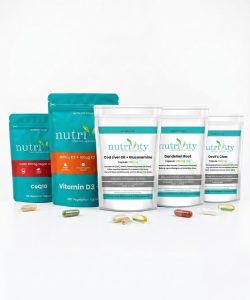
Key Takeaways
— Vitamins are 13 specific organic compounds the body needs but mostly cannot produce
— Supplements include anything taken to add to your diet — vitamins, minerals, herbs, oils, amino acids, and more
— All vitamin products are supplements, but most supplements are not vitamins
— Multivitamins do not provide omega-3, CoQ10, glucosamine, herbal extracts, or fibre
— Targeted supplementation based on individual needs is more effective than generic multivitamin stacks
— Match the supplement to the problem — joint pain needs omega-3 and glucosamine, not a multivitamin
— UK supplements must be manufactured to GMP standards and can only make EFSA-authorised health claims
— When in doubt, get a blood test from your GP before supplementing
Frequently Asked Questions
Are vitamins and supplements the same thing?
Not exactly. Vitamins are a specific category of nutrient — 13 organic compounds the body needs but mostly cannot produce itself. Supplements are the broader category that includes anything taken to add to your diet: vitamins, minerals, herbal extracts, omega fatty acids, amino acids, coenzymes like CoQ10, fibre, and more. When people say “I take my vitamins,” they usually mean supplements in general, which may or may not include actual vitamins.
Do I need to take vitamins if I eat well?
If you eat a varied diet including fruits, vegetables, whole grains, protein, and dairy (or fortified alternatives), you are likely getting adequate amounts of most vitamins. The main exception in the UK is vitamin D — the NHS recommends all adults consider supplementing during autumn and winter because UVB exposure is insufficient for synthesis. Other supplements that may still be beneficial regardless of diet quality include CoQ10 (levels decline with age), omega-3 (unless you eat oily fish regularly), and fibre (most UK adults fall short of the 30g daily recommendation).
What is the difference between a vitamin and a mineral?
Vitamins are organic compounds (they contain carbon) and are produced by plants and animals. Minerals are inorganic elements (like iron, zinc, calcium, and magnesium) that come from soil and water and are absorbed by plants or consumed by animals. Both are essential for health, and both must come from food or supplements because the body cannot produce them in sufficient quantities. The distinction is chemical, not functional — both play critical roles in bodily functions.
Are herbal supplements the same as vitamins?
No. Herbal supplements are concentrated plant extracts taken for their physiological effects — for example, Devil’s Claw for joint pain, Agnus Castus for hormonal balance, or Echinacea for immune support. They do not contain vitamins (unless the plant happens to be rich in a particular vitamin). They work through different mechanisms — typically through bioactive plant compounds like harpagoside, thymoquinone, or agnuside — rather than by replacing essential nutrients.
What supplements should I take?
The right supplements depend on your individual health concerns, diet, age, and lifestyle. As a general guide for UK adults: vitamin D3 is recommended for everyone during autumn and winter. CoQ10 becomes increasingly relevant from age 40 onwards. Omega-3 is important if you do not eat oily fish regularly. Beyond that, the choice depends on specific needs — joint pain, hormonal balance, digestive health, skin health, or energy. A blood test through your GP can identify any deficiencies worth addressing with targeted supplementation.