





What is the best herbal sleeping aid?
-
By Chris Jones
Last Updated May 2026 | Written by Chris Jones, Social Media Manager at Nutrivity with 7+ years in the supplement industry.
What Is the Best Herbal Sleeping Aid — Natural Approaches That Actually Work
Poor sleep is one of the UK’s most widespread health complaints. The NHS estimates that one in three people experience insomnia at some point, and the demand for natural sleep solutions has grown steadily as more people look to avoid the dependency risks associated with prescription sleeping medications.
The herbal sleep aid market is enormous — and much of it is poorly substantiated. Some supplements have genuine evidence behind them. Others rely entirely on tradition and marketing. And in many cases, the real cause of poor sleep is not something any supplement can fix — it is a lifestyle, environmental, or hormonal issue that needs addressing at the source.
This guide covers the herbal and natural sleep aids with the strongest evidence, what the research actually shows, and how to determine whether a supplement is likely to help your particular sleep problem.
| Quick Answer |
| The herbal sleep aids with the most research support are valerian root, magnesium, and lavender. However, the most commonly overlooked cause of poor sleep in UK adults is vitamin D deficiency — research has linked low vitamin D status to shorter sleep duration, poorer sleep quality, and increased daytime sleepiness. For women experiencing sleep disruption related to hormonal fluctuations, Agnus Castus may help by supporting hormonal balance. No herbal supplement will overcome poor sleep hygiene, excessive screen use, or an untreated medical condition. |
Before You Buy a Sleep Supplement — Rule These Out First
The most effective sleep intervention for the majority of people is not a supplement — it is fixing the behavioural and environmental factors that are disrupting sleep in the first place. Before spending money on herbal sleep aids, assess whether any of the following apply:
Screen exposure before bed — Blue light from phones, tablets, and laptops suppresses melatonin production. Using screens within an hour of bedtime is one of the most common and easily fixable causes of difficulty falling asleep.
Caffeine timing — Caffeine has a half-life of approximately five to six hours. A coffee at 3pm means half the caffeine is still in your system at 9pm. Many people who report difficulty sleeping are simply consuming caffeine too late in the day.
Inconsistent sleep schedule — The body’s circadian rhythm responds to consistency. Going to bed and waking at different times each day undermines the internal clock that regulates sleep onset.
Room environment — Temperature, light, and noise all affect sleep quality. The optimal bedroom temperature for sleep is 16–18°C. Any ambient light — including standby LEDs on electronics — can interfere with melatonin production.
Underlying medical conditions — Sleep apnoea, restless leg syndrome, thyroid dysfunction, chronic pain, anxiety, and depression all cause sleep disruption that supplements cannot resolve. If your sleep problems are persistent and severe, see your GP.
Valerian Root — The Most Researched Herbal Sleep Aid
Valerian root (Valeriana officinalis) is the herbal sleep aid with the longest history of use and the most extensive research base. It has been used as a sleep remedy in Europe since at least the second century, and modern clinical trials have investigated its effects in numerous randomised controlled studies.
The evidence is mixed but generally positive for mild to moderate sleep difficulties. A 2020 systematic review and meta-analysis published in the Journal of Evidence-Based Integrative Medicine concluded that valerian supplementation was associated with modest improvements in subjective sleep quality, particularly in people with mild insomnia. The effect is not dramatic — valerian is not a sedative — but it appears to reduce the time taken to fall asleep and improve perceived sleep quality when taken consistently over two to four weeks.
Valerian works through interaction with GABA receptors in the brain, the same system that benzodiazepine medications target, though at a much milder level. It does not cause morning grogginess or dependency at recommended doses, which is its primary advantage over pharmaceutical sleep aids.
Magnesium — The Mineral Most People Are Missing
Magnesium is involved in over 300 enzymatic reactions in the body, including the regulation of the neurotransmitters that govern sleep. It activates the parasympathetic nervous system — the system responsible for calming the body and preparing it for rest — and regulates melatonin production.
Magnesium deficiency is relatively common in the UK. The National Diet and Nutrition Survey has consistently shown that a significant proportion of UK adults do not meet the recommended daily intake. Symptoms of mild magnesium deficiency include muscle tension, restlessness, anxiety, and — notably — difficulty sleeping.
Clinical studies have found that magnesium supplementation improves sleep quality, sleep duration, and sleep onset time in older adults and individuals with insomnia. Magnesium glycinate is generally considered the best-absorbed form for sleep support, as glycine itself has calming properties.
Vitamin D and Sleep Quality — The Overlooked Connection
Vitamin D is not typically categorised as a sleep supplement, but emerging research has established a significant link between vitamin D status and sleep quality. A 2018 meta-analysis published in Nutrients found that vitamin D deficiency was associated with a significantly increased risk of sleep disorders, shorter sleep duration, and poorer sleep quality.
The mechanism is not yet fully understood, but vitamin D receptors are present in brain regions that regulate sleep, including the hypothalamus and brainstem. Vitamin D also influences serotonin production — a precursor to melatonin, the hormone that drives the sleep-wake cycle.
For UK adults, this connection is particularly relevant because vitamin D deficiency is so common — affecting approximately one in five people, with higher rates during autumn and winter when daylight hours are shortest. Many people who experience seasonal worsening of sleep quality may be experiencing the downstream effects of declining vitamin D levels.
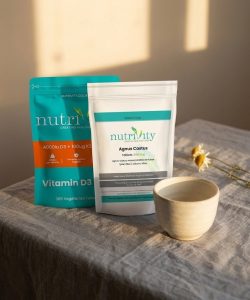
Nutrivity’s Vitamin D3 4000 IU + K2 MK7 365 Tablets provides a full year’s supply at 3.5p per day. If your sleep problems worsen from October to March, checking your vitamin D status is a practical first step. For more on D3+K2, see our guide to D3 and K2 side effects. Agnus Castus — Hormonal Sleep Disruption in Women
Sleep problems in women frequently have a hormonal component. Fluctuations in oestrogen and progesterone throughout the menstrual cycle, during perimenopause, and through menopause directly affect sleep architecture. Many women report worsening sleep quality in the luteal phase (the two weeks before a period), during PMS, and particularly during the menopausal transition.
Agnus Castus (Vitex agnus-castus) is a herbal supplement that has been used for centuries to support hormonal balance in women. Clinical evidence suggests that it acts on the pituitary gland to modulate prolactin levels and support a healthier balance between oestrogen and progesterone. By addressing the hormonal fluctuations that disrupt sleep, Agnus Castus can indirectly improve sleep quality for women whose insomnia is cycle-related or hormone-driven.
Nutrivity’s Agnus Castus 1000mg Vegan Tablets provide a high-strength daily dose. For more detail, see our guides to how quickly Agnus Castus works and Agnus Castus and weight.
Lavender — Aromatherapy with Some Evidence
Lavender is one of the most widely used aromatherapy remedies for sleep, and it has more research support than most essential oils. Several small but well-designed studies have found that inhaled lavender essential oil before bed improves self-reported sleep quality and increases the proportion of deep (slow-wave) sleep.
A 2015 study published in the Journal of Alternative and Complementary Medicine found that a combination of sleep hygiene education and lavender aromatherapy produced significantly better outcomes than sleep hygiene alone. The effect is mild but consistent across studies, and lavender has an excellent safety profile when used appropriately.
Lavender is best used as part of a bedtime routine rather than as a standalone solution. A few drops of essential oil on a pillow, in a diffuser, or in a warm bath before bed can support relaxation alongside other sleep hygiene practices.
Chamomile, Passionflower, and Lemon Balm
These three herbs are commonly found in “sleep tea” blends and herbal sleep supplements. The evidence for each is limited but promising:
Chamomile — A 2019 systematic review found that chamomile had a modest positive effect on sleep quality, particularly when consumed as a tea or extract over several weeks. The effect is primarily anxiolytic (anxiety-reducing) rather than directly sedative.
Passionflower — A small number of clinical studies have found that passionflower extract improves subjective sleep quality. A 2011 study found that passionflower tea consumed before bed improved sleep quality scores compared to placebo over a seven-day period.
Lemon balm — Often combined with valerian in supplement formulations. Limited evidence suggests it may reduce anxiety and promote calmness, which can indirectly support sleep onset. More research is needed.
None of these herbs have strong enough evidence to recommend as standalone insomnia treatments, but they are reasonable additions to a broader sleep support strategy and have excellent safety profiles at normal doses.
What About Melatonin?
Melatonin is a hormone naturally produced by the pineal gland that regulates the sleep-wake cycle. In many countries, melatonin supplements are available over the counter. In the UK, however, melatonin is a prescription-only medication — it is not available to buy as a supplement without a GP prescription.
If you believe melatonin supplementation would help your sleep, speak to your GP. They can assess whether it is appropriate for your situation and prescribe it if warranted. Do not purchase melatonin from unregulated overseas websites, as product quality and dosing accuracy cannot be verified.
Nutrivity Supplements That Support Sleep
| Supplement | Sleep Mechanism | Best For | Price From |
|---|---|---|---|
| Vitamin D3 4000 IU + K2 | Serotonin/melatonin precursor, sleep regulation | Seasonal sleep decline Oct–Mar, vitamin D deficiency | 3.5p/day |
| Agnus Castus 1000mg | Hormonal balance, oestrogen/progesterone regulation | Women with cycle-related or perimenopausal sleep issues | 10.4p/day |
All Nutrivity supplements are manufactured in the UK in GMP-certified facilities. Vegan friendly products use HPMC plant-based capsules. Halal friendly. Free UK delivery on every order.
The Bottom Line
The best herbal sleeping aid depends entirely on why you are not sleeping well. If the cause is behavioural — screens before bed, caffeine timing, inconsistent schedule — no supplement will fix it. If the cause is vitamin D deficiency, a cheap daily tablet may resolve months of poor sleep. If the cause is hormonal, Agnus Castus may help where valerian and chamomile will not. Start by identifying the cause, address lifestyle factors first, and then consider targeted supplementation if a nutritional or hormonal component remains.
 Key Takeaways
— Fix sleep hygiene first — screens, caffeine timing, consistent schedule, room temperature
— Valerian root has the most research support among herbal sleep aids but the effect is mild
— Vitamin D deficiency is linked to poor sleep quality and is the UK’s most common nutritional inadequacy
— Women with cycle-related or perimenopausal sleep disruption may benefit from Agnus Castus for hormonal balance
— Magnesium deficiency is common and directly affects the neurotransmitters governing sleep
— Chamomile, passionflower, and lemon balm have limited but promising evidence
— Melatonin is prescription-only in the UK — do not buy from unregulated overseas sources
— Persistent or severe sleep problems warrant a GP visit, not a supplement
Frequently Asked Questions
What is the strongest herbal sleeping aid?
Valerian root is generally considered the strongest herbal sleeping aid with clinical evidence. It interacts with GABA receptors in the brain — the same system targeted by benzodiazepines — though at a much milder level. It is most effective for mild to moderate sleep difficulties when taken consistently for two to four weeks. It does not cause morning grogginess or dependency at recommended doses.
Can vitamin D help you sleep better?
Research has established a significant link between vitamin D status and sleep quality. A 2018 meta-analysis found that vitamin D deficiency was associated with increased risk of sleep disorders, shorter sleep duration, and poorer sleep quality. Vitamin D receptors are present in brain regions that regulate sleep, and vitamin D influences serotonin production — a precursor to melatonin. For UK adults, particularly those whose sleep worsens from October to March, checking and correcting vitamin D status is a practical first step.
What natural supplements help with sleep?
The natural supplements with the most evidence for sleep support are valerian root, magnesium (particularly magnesium glycinate), lavender (inhaled as aromatherapy), and vitamin D (for people who are deficient). For women with hormone-related sleep disruption, Agnus Castus may help by supporting hormonal balance. Chamomile, passionflower, and lemon balm have limited but promising evidence. No natural supplement matches the potency of prescription sleep medication, and none will compensate for poor sleep hygiene.
Why is my sleep getting worse in winter?
Seasonal decline in sleep quality is commonly linked to reduced daylight exposure, which affects both vitamin D synthesis and melatonin regulation. With shorter days and less sunlight from October to March, vitamin D levels drop and circadian rhythm signalling weakens. Supplementing with vitamin D during these months and maximising daylight exposure during the day — even on overcast days — can help maintain sleep quality through the darker months.
Is Agnus Castus good for sleep?
Agnus Castus is not a direct sleep aid, but it can improve sleep in women whose sleep disruption is driven by hormonal fluctuations. It acts on the pituitary gland to modulate prolactin levels and support a healthier balance between oestrogen and progesterone. Women who experience worsening sleep during PMS, the luteal phase, or perimenopause may find that hormonal balance through Agnus Castus indirectly improves their sleep quality.
Can I buy melatonin in the UK?
No. Melatonin is a prescription-only medication in the UK. It is not legally available as an over-the-counter supplement. If you believe melatonin supplementation would help your sleep, speak to your GP, who can assess whether it is appropriate and prescribe it if warranted. Do not purchase melatonin from unregulated overseas websites.