





CoQ10 for Skin UK — Anti-Ageing, Protection, and Cellular Health
-
By Chris Jones
Written by Chris Jones, Social Media Manager at Nutrivity with 7+ years in the supplement industry.
CoQ10 for Skin UK — Anti-Ageing, Protection, and Cellular Health
CoQ10 has been used in topical skincare products for decades, and the ingredient is now appearing in oral supplement marketing with increasing frequency. The mechanisms connecting CoQ10 to skin health are real and well-understood — but the evidence base for oral CoQ10 supplementation on skin outcomes is less developed than for topical application, and it is worth being clear about what the research actually supports.
This guide covers the biology of CoQ10 and skin ageing, what the evidence shows for both oral and topical CoQ10, how it compares to other skin health supplements, and what realistic expectations look like. For a full overview of how CoQ10 works at the cellular level, see our guide to what is CoQ10. For full product information on Nutrivity’s CoQ10 300mg, visit our CoQ10 300mg Vegan Capsules product page.
Why CoQ10 Is Relevant to Skin Health
Skin cells — particularly the keratinocytes that form the outer skin layers and the fibroblasts that produce collagen and elastin in the dermis — are metabolically active cells with significant mitochondrial energy demands. They require ATP for cell proliferation, repair, collagen synthesis, and the maintenance of skin barrier function. CoQ10 is essential to this mitochondrial energy production, and its decline with age is therefore directly relevant to the age-related decline in skin function.
Beyond energy production, CoQ10 in its reduced form (ubiquinol) is a potent fat-soluble antioxidant in skin tissue. The skin is the body’s outermost barrier and is continuously exposed to UV radiation, pollution, and environmental oxidants — all of which generate free radicals and oxidative stress that damage skin cells, degrade collagen and elastin, and accelerate visible ageing. CoQ10 in skin tissue helps neutralise this oxidative damage. Research has found that CoQ10 levels in human skin decline significantly with age — by as much as 50% between young adulthood and middle age in the epidermis — and that this decline correlates with reduced antioxidant capacity and increased markers of oxidative damage in skin cells.
CoQ10 and Skin Ageing — The Oxidative Stress Connection
The visible signs of skin ageing — fine lines, wrinkles, loss of elasticity, uneven tone — are substantially driven by two processes: intrinsic ageing (the natural decline in cellular function with age) and extrinsic ageing (damage from UV radiation and environmental oxidants). CoQ10 is relevant to both.
In intrinsic ageing, the decline in CoQ10 levels in skin cells reduces mitochondrial energy availability for collagen synthesis and cellular repair. Fibroblasts — the cells responsible for producing collagen and elastin — require adequate ATP to function efficiently. As CoQ10 levels fall, fibroblast energy metabolism declines, collagen synthesis slows, and the structural integrity of the dermis weakens.
In extrinsic ageing, UV radiation generates reactive oxygen species (ROS) in skin tissue that oxidise lipids, proteins, and DNA in skin cells. CoQ10, as a lipid-soluble antioxidant in cell membranes and mitochondria, is one of the first lines of defence against this oxidative damage. UV exposure depletes cutaneous CoQ10 rapidly — research has shown significant reductions in skin CoQ10 levels following UV exposure, with recovery taking days.
This dual role — supporting energy for repair and neutralising oxidative damage — makes CoQ10 mechanistically relevant to both the prevention and mitigation of skin ageing.
Topical vs Oral CoQ10 — What the Research Shows
The research on CoQ10 and skin is divided between topical application and oral supplementation, and it is important to understand the difference.
Topical CoQ10 has a more developed evidence base for skin outcomes. Several controlled studies have demonstrated that topical CoQ10 application reduces fine lines and wrinkles, improves skin smoothness and elasticity, and reduces markers of oxidative stress in skin biopsies. The limitation of topical CoQ10 is penetration — CoQ10 is a relatively large molecule and does not penetrate deeply into the dermis. Its topical effects are primarily in the epidermis and superficial dermis.
Oral CoQ10 has the potential to reach deeper skin layers and support dermal fibroblast function from within, but the specific skin-outcome evidence for oral supplementation is less extensive. A Japanese study examining oral CoQ10 supplementation at 150mg daily for 12 weeks found significant reductions in wrinkle area and volume compared to placebo — one of the few well-designed oral CoQ10 skin trials published. Other studies have examined oral CoQ10 in combination with other antioxidants and found improvements in skin smoothness and photoprotection markers.
The practical position is that oral CoQ10 supplements with adequate skin-reaching doses complement topical skincare rather than replace it. The systemic delivery of oral CoQ10 can support dermal cell function in ways that topical application cannot reach, while topical CoQ10 addresses surface-level oxidative protection more directly.
CoQ10 and Collagen Synthesis
One of the mechanisms through which CoQ10 may support skin appearance is its role in the energy metabolism of dermal fibroblasts — the cells that produce collagen and elastin. Collagen synthesis is an energy-intensive process requiring adequate ATP. As CoQ10 levels decline with age and fibroblast mitochondrial function diminishes, collagen production slows. Supporting fibroblast energy metabolism through CoQ10 supplementation may therefore support the structural basis of skin elasticity and firmness.
This is distinct from collagen supplementation, which provides collagen peptides directly. CoQ10 supports the cellular machinery that produces collagen endogenously — a different mechanism with a different evidence base. For more on the vegan approach to collagen support through precursor nutrients, see our guide to vegan collagen alternatives.
CoQ10 and Ubiquinol for Skin — Does the Form Matter?
For skin health specifically, ubiquinol (the reduced, antioxidant-active form of CoQ10) has been argued to be particularly relevant because antioxidant protection is one of the primary mechanisms through which CoQ10 benefits skin. Ubiquinol is the form that donates electrons to neutralise free radicals. When you take ubiquinone, the body converts it to ubiquinol — a conversion that happens readily in most adults.
For most adults under 60 taking oral CoQ10 at 200–300mg daily, the form is less important than the dose. At higher doses, adequate ubiquinol is generated regardless of whether the supplement starts as ubiquinone or ubiquinol. For a detailed breakdown of the two forms, see our guide to ubiquinol vs ubiquinone.
CoQ10 in a Skin Health Supplement Routine
CoQ10 is best understood as one component of a broader cellular health and antioxidant strategy for skin, rather than a standalone skin supplement. The evidence-based oral supplements most relevant to skin health work through complementary mechanisms: vitamin C for collagen synthesis, vitamin D for skin cell regulation and barrier function, omega-3 fatty acids for inflammation and moisture retention, and CoQ10 for mitochondrial energy in skin cells and antioxidant protection at the cellular level.
For the energy and cellular protection benefits that CoQ10 provides across the whole body — not just skin — see our guide to CoQ10 for energy and fatigue UK.
Summary — CoQ10 for Skin Health in the UK
CoQ10 is a mechanistically credible ingredient for skin health — its roles in mitochondrial energy production and antioxidant protection are directly relevant to the cellular processes that maintain skin structure and slow visible ageing. The evidence base for oral supplementation on specific skin outcomes is growing, though less extensive than for topical application. For adults who want systemic antioxidant and cellular energy support — with skin health as one benefit alongside the cardiovascular, energy, and broader anti-ageing effects — oral CoQ10 at 200–300mg daily is a well-evidenced, well-tolerated choice.
For full product information and to purchase, visit Nutrivity’s CoQ10 300mg Vegan Capsules product page.
Frequently Asked Questions
Is CoQ10 good for skin?
CoQ10 supports skin health through two primary mechanisms: supporting mitochondrial energy production in skin cells (particularly dermal fibroblasts that produce collagen) and acting as a fat-soluble antioxidant that neutralises free radical damage from UV radiation and environmental oxidants. Skin CoQ10 levels decline significantly with age, correlating with reduced skin antioxidant capacity. Both topical and oral CoQ10 have research supporting skin benefits.
Does oral CoQ10 help skin?
Oral CoQ10 can reach dermal layers that topical application cannot, supporting fibroblast energy metabolism and providing systemic antioxidant protection. A Japanese clinical study found significant reductions in wrinkle area and volume with oral CoQ10 at 150mg daily over 12 weeks. The evidence base for oral CoQ10 on skin outcomes is smaller than for topical application but growing.
What dose of CoQ10 is good for skin?
The published oral CoQ10 skin research has used doses of 100–300mg daily. At Nutrivity, our CoQ10 300mg provides the higher end of this range in a single daily capsule. For skin-specific outcomes, consistency of daily supplementation over at least 8–12 weeks is important, as the cellular effects build gradually.
Is CoQ10 anti-ageing?
CoQ10 supports the cellular mechanisms that slow the visible signs of skin ageing — it helps maintain mitochondrial energy in skin cells, supports collagen-producing fibroblast function, and provides antioxidant protection against UV-induced oxidative damage. It is one of several evidence-based approaches to cellular anti-ageing support, rather than a standalone anti-ageing treatment.
Should I take CoQ10 or collagen for skin?
They work through different mechanisms. Collagen supplements provide collagen peptides directly to support skin structural proteins. CoQ10 supports the cellular energy and antioxidant environment in which skin cells function and produce their own collagen. Both have evidence supporting skin benefits and are complementary rather than competing. CoQ10 also has a broader systemic evidence base for cardiovascular and energy health that collagen supplements do not share.
Is Nutrivity's CoQ10 good for skin?
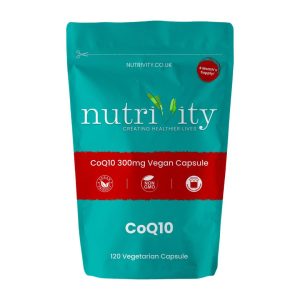
Yes. Nutrivity’s CoQ10 300mg provides naturally fermented ubiquinone in HPMC vegetable capsules — fully vegan-suitable and halal-suitable. At 300mg per capsule it provides the higher end of the dose range used in oral CoQ10 skin research, alongside its well-evidenced benefits for cardiovascular health, energy, and cellular protection. Full ingredients are on the product page.