




What Is CoQ10? Benefits, Dosage and UK Guide
-
By Chris Jones
Written by Chris Jones, Social Media Manager at Nutrivity with 7+ years in the supplement industry.
What Is CoQ10? Benefits, Dosage and UK Guide
CoQ10 — coenzyme Q10 — is one of the most important compounds produced by the human body, and one of the most commonly misunderstood supplements on the UK market. It is not a vitamin, not a mineral, and not an herbal extract. It is a naturally occurring compound found in every cell in the body, where it plays a central role in producing the energy that powers all biological processes. Unlike most supplements, the case for CoQ10 is not built on fringe health claims — it is rooted in decades of peer-reviewed research on cardiovascular health, mitochondrial function, and cellular protection.
This guide covers what CoQ10 is, what it does, who needs it, what the evidence says, and how to choose the right supplement. For full product information on Nutrivity’s high-strength vegan CoQ10, visit our CoQ10 300mg Vegan Capsules product page.
What Is CoQ10?
Coenzyme Q10 is a fat-soluble compound that exists naturally in two interconvertible forms — ubiquinone (the oxidised form) and ubiquinol (the reduced form). The body produces CoQ10 endogenously through a complex synthesis pathway that requires several B vitamins and other cofactors. This production peaks in early adulthood and declines progressively from the mid-twenties, with particularly significant reductions from the forties onwards.
CoQ10 is found in the highest concentrations in the organs with the greatest energy demands — the heart, liver, kidneys, and skeletal muscles. It is also obtained from dietary sources, primarily meat, fish, and nuts. However, even a well-balanced diet provides only around 3–6mg per day from food, compared to therapeutic supplement doses of 100–300mg. For vegan consumers, the dietary gap is wider still as plant sources are substantially lower than animal sources — supplementation is the only practical way to reach clinically relevant levels.
What Does CoQ10 Do in the Body?
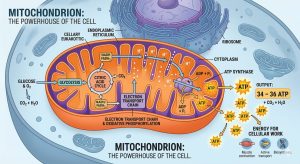 CoQ10 has two primary roles in human physiology, both fundamental to health.
Energy production. CoQ10 is an essential component of the mitochondrial electron transport chain — the process by which cells convert nutrients into ATP, the molecule that powers all cellular activity. CoQ10 acts as an electron carrier in this chain, shuttling electrons to drive the proton gradient that generates ATP. Without adequate CoQ10, cellular energy production is impaired. Every cell depends on this process, which is why CoQ10 depletion affects energy levels, organ function, and physical capacity across the whole body rather than in a single tissue.
Antioxidant protection. In its reduced form (ubiquinol), CoQ10 acts as a fat-soluble antioxidant, protecting cell membranes and mitochondria from oxidative damage caused by free radicals generated during normal metabolism. This is particularly significant in high-metabolic tissues — the heart and skeletal muscles — where free radical production is greatest. CoQ10 also regenerates other antioxidants including vitamin E, extending their protective effect at the cellular level.
Why CoQ10 Levels Decline
Three main factors drive CoQ10 depletion in adults: age, medication, and disease.
Age. Endogenous CoQ10 synthesis declines progressively from the mid-twenties. Research has found that CoQ10 levels in heart muscle tissue may be 30–40% lower at age 40 than in young adulthood, with the decline continuing beyond that. This age-related depletion coincides with the period when cardiovascular risk, energy decline, and cellular ageing become increasingly relevant.
Statin medications. Statins — the most widely prescribed class of cholesterol-lowering drugs in the UK, taken by an estimated 8 million people — inhibit the HMG-CoA reductase enzyme, which is part of the mevalonate pathway used to produce both cholesterol and CoQ10. Studies have measured reductions in blood CoQ10 levels of 40–50% in statin users. Muscle pain and weakness, one of the most commonly reported statin side effects, is thought to be at least partly attributable to CoQ10 depletion in muscle tissue. For a full breakdown of CoQ10 and statins, see our guide to CoQ10 and statins UK.
Disease. CoQ10 levels are measurably reduced in a range of conditions including heart failure, type 2 diabetes, and mitochondrial disorders. In heart failure specifically, the degree of CoQ10 depletion correlates with the severity of cardiac dysfunction.
What the Research Says
The evidence base for CoQ10 is more developed than for the vast majority of supplements, with clinical research spanning more than four decades.
In cardiovascular health, the Q-SYMBIO trial — a large, multicentre, randomised, double-blind, placebo-controlled study — found that CoQ10 at 300mg daily significantly reduced major adverse cardiovascular events, cardiovascular mortality, and all-cause mortality in chronic heart failure patients compared to placebo over two years. This level of evidence — a well-designed RCT showing mortality benefit — is unusual for a supplement.
For blood pressure, meta-analyses have found modest but meaningful reductions in systolic and diastolic blood pressure in CoQ10-supplemented groups. For energy and fatigue, studies in healthy adults and those with chronic fatigue conditions show consistent improvements in fatigue scores and exercise capacity. For fertility, CoQ10 has shown improvements in sperm count and motility in men, and improvements in egg quality and clinical pregnancy rates in women undergoing IVF in several RCTs.
CoQ10 Dosage and How to Take It
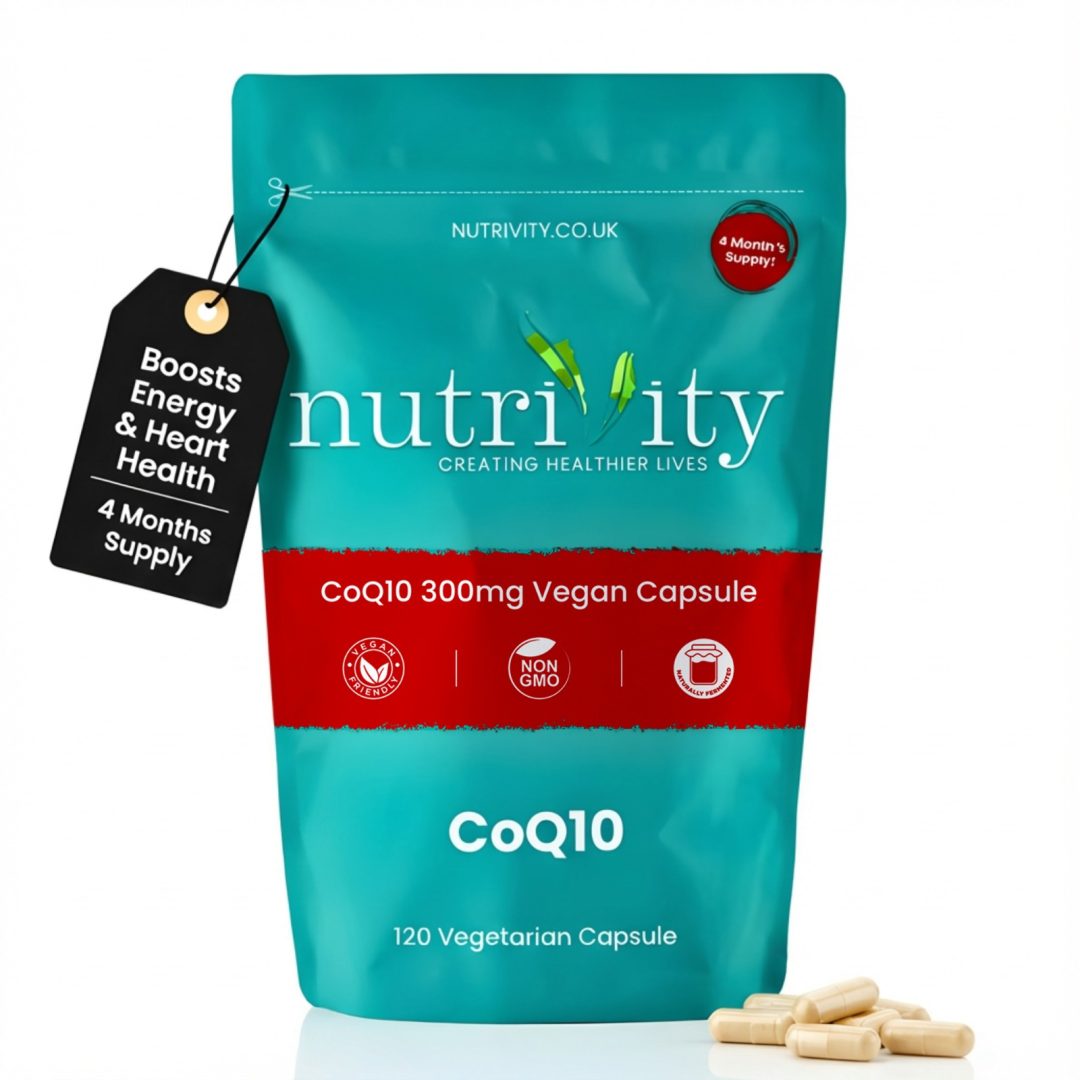
For general health maintenance, doses of 100–200mg daily are most commonly used. For cardiovascular conditions, statin users, and fertility support, 200–300mg daily is more typical in clinical research. Many UK supplements provide only 30–100mg — below what the evidence uses. Nutrivity’s CoQ10 300mg provides the higher end of the therapeutic range in a single daily capsule.
CoQ10 is fat-soluble and is best absorbed when taken with a meal containing fat. Taking it with your largest meal of the day is the most practical approach for maximising bioavailability.
Ubiquinone vs Ubiquinol
CoQ10 supplements are available as ubiquinone (oxidised) or ubiquinol (reduced). Ubiquinol is often marketed as superior because it is the form the body uses directly, but the body readily converts ubiquinone to ubiquinol through normal metabolism. For most adults under 60, ubiquinone at an adequate dose is effective and significantly more cost-efficient — ubiquinol is typically two to three times the price. Nutrivity’s CoQ10 300mg uses naturally fermented ubiquinone.
Summary
CoQ10 is one of the few supplements with a genuinely strong evidence base across multiple health areas — cardiovascular health, energy production, statin-related depletion, and fertility. Its relevance increases with age as endogenous production declines, and its clinical application in statin users and heart failure patients is among the best-evidenced in supplement medicine. The non-negotiable factor when buying is dose — many UK products provide 30–100mg, well below what the research uses. At 300mg per day, you are supplementing at a level that matches the clinical evidence.
For full product information and to purchase, visit Nutrivity’s CoQ10 300mg Vegan Capsules product page.
Frequently Asked Questions
What is CoQ10 good for?
CoQ10 supports mitochondrial energy production in every cell of the body and acts as a fat-soluble antioxidant protecting cells from oxidative damage. It is most commonly used for cardiovascular health, energy and fatigue support, and by people taking statin medications who may experience CoQ10 depletion as a side effect. It is also used for general cellular health maintenance, particularly from the forties onwards as endogenous production declines.
Who should take CoQ10?
CoQ10 is most relevant for adults over 40 as endogenous production declines with age, people taking statin medications, those with cardiovascular conditions particularly heart failure, people experiencing unexplained fatigue or low energy, and anyone wanting to support mitochondrial health and cellular protection. Consult your GP before starting CoQ10 if you have a medical condition or take prescription medication.
How long does CoQ10 take to work?
CoQ10 typically requires 4–12 weeks of consistent supplementation before meaningful effects on energy or cardiovascular markers are observed. It is a long-term maintenance supplement rather than an acute intervention — blood levels build gradually and the benefits accumulate over time. Short-term trials of a few weeks are unlikely to give an accurate picture of its effects.
Is CoQ10 safe to take every day?
CoQ10 has an excellent long-term safety record across multiple decades of research and clinical use. It is well tolerated at doses up to 1200mg per day in clinical studies, with no serious adverse effects reported. Minor gastrointestinal symptoms are the most commonly reported side effect and are typically resolved by taking CoQ10 with food. Always consult your GP if you take prescription medications, particularly blood thinners or blood pressure medication.
Is Nutrivity's CoQ10 vegan?
Yes. Nutrivity’s CoQ10 300mg uses naturally fermented ubiquinone — not animal-derived — in HPMC vegetable capsules with vegetable-derived magnesium stearate. It is fully vegan-suitable and halal-suitable. Full ingredients are published on the product page.
What is the best CoQ10 supplement in the UK?
The key factors to look for are dose (300mg provides a high therapeutic level in a single capsule), form (ubiquinone from natural fermentation is well-evidenced and cost-effective), capsule type (HPMC for vegan and halal suitability), and manufacturing standards (UK GMP-certified for quality assurance). For a full comparison of the top CoQ10 supplements available in the UK, see our best CoQ10 supplement UK guide.