




Ubiquinol vs Ubiquinone — Which Form of CoQ10 Is Better?
-
By Chris Jones
Written by Chris Jones, Social Media Manager at Nutrivity with 7+ years in the supplement industry.
Ubiquinol vs Ubiquinone — Which Form of CoQ10 Is Better?
Walk into any health food shop or browse CoQ10 supplements online and you will encounter two forms: ubiquinol and ubiquinone. Ubiquinol products are typically priced significantly higher, with marketing positioning them as the superior, more bioavailable, “active” form. Ubiquinone products are more widely available and substantially cheaper. For most consumers, the choice is unclear — and the marketing around ubiquinol does not always reflect the nuance of what the research actually shows.
This guide cuts through the marketing to explain what the two forms are, how they differ, what the research says about bioavailability and efficacy, and who — if anyone — should specifically choose one over the other. For a full overview of CoQ10 and how it works, see our guide to what is CoQ10. For full product information on Nutrivity’s CoQ10 300mg, visit our CoQ10 300mg Vegan Capsules product page.
What Are Ubiquinol and Ubiquinone?
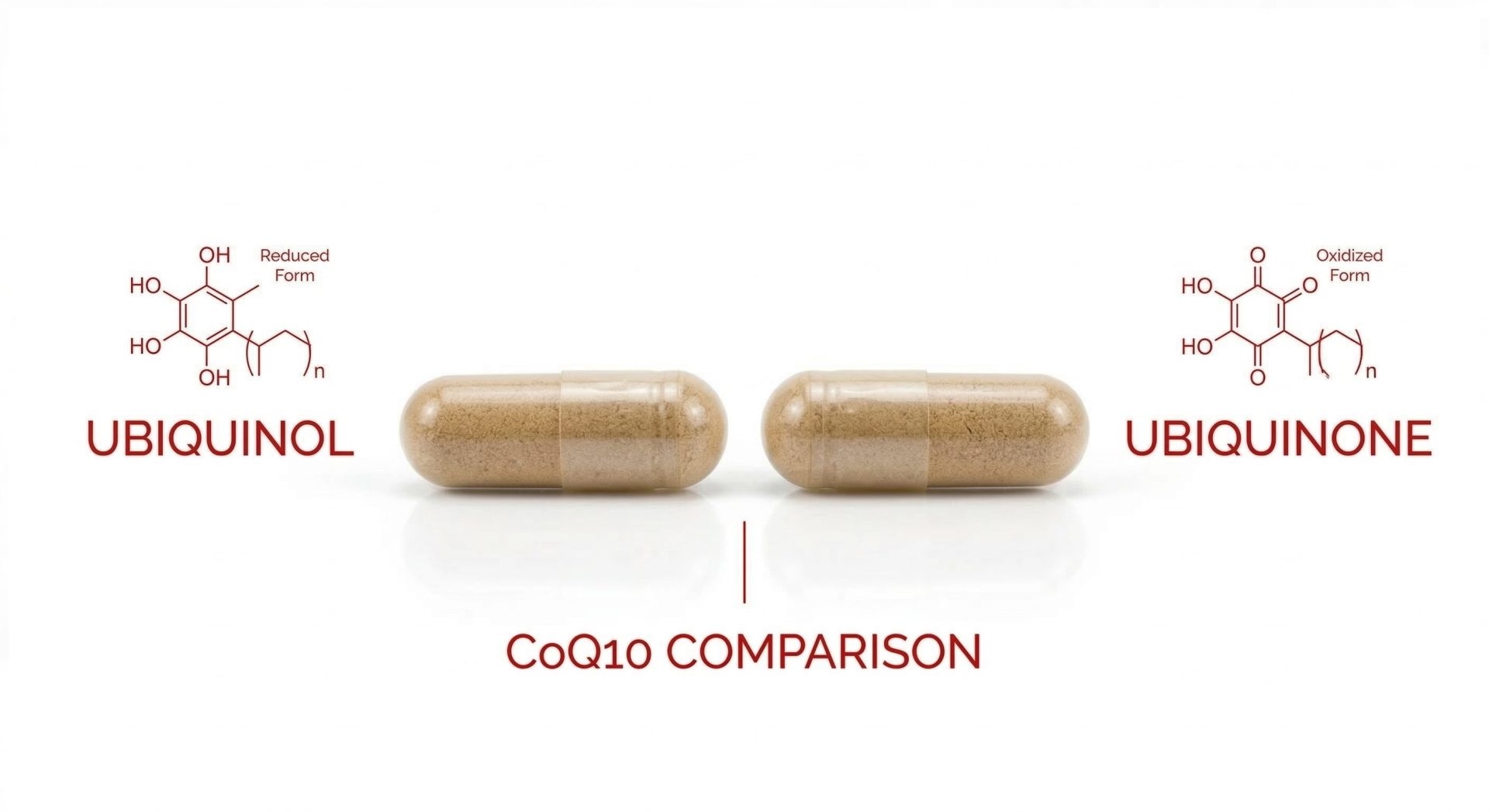
CoQ10 exists in two interconvertible redox forms — it cycles between them continuously as part of its function in the body.
Ubiquinone is the oxidised form of CoQ10. It is the form that accepts electrons in the mitochondrial electron transport chain, becoming reduced to ubiquinol in the process. It is also the form found in most supplement products, produced through natural fermentation of yeast. Ubiquinone is chemically stable, cost-effective to manufacture, and has been the form used in the majority of CoQ10 clinical research — including the Q-SYMBIO cardiovascular trial.
Ubiquinol is the reduced form of CoQ10 — the electron-rich version that donates electrons to function as an antioxidant and that circulates in the bloodstream. It is the predominant form of CoQ10 found in human blood plasma. Ubiquinol is less chemically stable than ubiquinone and more expensive to produce and package, which is reflected in its higher retail price.
The key point that ubiquinol marketing often glosses over: the body continuously and rapidly interconverts ubiquinone and ubiquinol. When you take a ubiquinone supplement, the body reduces it to ubiquinol as needed. When ubiquinol acts as an antioxidant by donating an electron, it becomes ubiquinone again — ready to be reduced back. The two forms are not competing ingredients; they are two states of the same molecule performing its normal function.
The Bioavailability Argument — What the Research Actually Shows
The primary marketing claim for ubiquinol is superior bioavailability — the idea that it is more readily absorbed and raises blood CoQ10 levels more effectively than ubiquinone. This claim has some basis in research but is frequently overstated.
Several studies have compared the pharmacokinetics of ubiquinol and ubiquinone supplementation and found that ubiquinol produces higher peak plasma CoQ10 levels and area under the curve (a measure of overall blood exposure) compared to equal doses of ubiquinone. A commonly cited Japanese study found that 150mg of ubiquinol produced higher plasma CoQ10 levels than 150mg of ubiquinone.
However, several important caveats apply. First, these bioavailability differences are most pronounced at lower doses — at higher doses, the advantage narrows because CoQ10 absorption is inherently dose-limited regardless of form. Second, higher plasma levels do not automatically translate to better clinical outcomes — what matters is whether tissue CoQ10 levels are raised to a degree that produces the biological effects associated with the research. Third, the majority of CoQ10 clinical research — including the cardiovascular trials showing mortality benefit — has used ubiquinone, not ubiquinol. The outcomes attributed to CoQ10 in the research are largely outcomes attributed to ubiquinone supplementation.
Fourth, and most practically: the bioavailability difference between the forms can be substantially addressed by simply increasing the ubiquinone dose. If ubiquinol at 100mg achieves higher plasma levels than ubiquinone at 100mg, ubiquinone at 200–300mg will achieve comparable or superior levels at a lower overall cost.
Does the Difference Actually Matter?
 For most adults taking CoQ10 for cardiovascular health, energy support, statin-related depletion, or general health maintenance, the form matters far less than the dose. The dose-response relationship for CoQ10 — more is generally more effective up to a point — is more clinically significant than the form-response relationship for most people.
The question to ask is not “ubiquinol or ubiquinone?” but “am I taking enough?” A 100mg ubiquinol supplement will raise plasma CoQ10 levels more than a 100mg ubiquinone supplement. A 300mg ubiquinone supplement will raise plasma CoQ10 levels more than either. For the dose levels used in the major clinical trials — 300mg — ubiquinone is well-evidenced and substantially more cost-effective.
For the dosage context on all of this, see our comprehensive guide to CoQ10 dosage UK.
Who Might Benefit From Ubiquinol Specifically?
There are specific circumstances where ubiquinol may offer a meaningful advantage over ubiquinone at equivalent doses.
Older adults with reduced conversion capacity. The enzyme systems that convert ubiquinone to ubiquinol may be less efficient in older adults, particularly those over 70. For this group, ubiquinol may achieve better tissue levels at the same oral dose. If you are over 70 and have been supplementing with ubiquinone without noticeable effect, switching to ubiquinol is a reasonable experiment.
People with specific mitochondrial disorders. In conditions where the electron transport chain is functionally impaired, the ability to reduce ubiquinone to ubiquinol may be compromised. Ubiquinol supplementation bypasses this conversion step. This is a niche clinical context and would typically be managed under specialist medical guidance.
People with malabsorption conditions. Conditions affecting fat absorption — Crohn’s disease, coeliac disease, short bowel syndrome — reduce the absorption of all fat-soluble compounds including CoQ10. In this context, the bioavailability advantage of ubiquinol may be more meaningful.
For the majority of adults under 70 without specific absorption issues, ubiquinone at 300mg is the evidence-based, cost-effective choice.
Nutrivity’s Position — Why We Use Ubiquinone
Nutrivity’s CoQ10 300mg uses naturally fermented ubiquinone. This is a deliberate formulation choice based on three factors. First, ubiquinone is the form used in the major clinical research on CoQ10 — including the Q-SYMBIO cardiovascular trial and the energy and fatigue studies. Supplementing with ubiquinone means supplementing with the form that produced the outcomes the research demonstrates. Second, at 300mg per capsule, the dose addresses the bioavailability question directly — the higher dose achieves comparable tissue levels to lower-dose ubiquinol products at a lower cost per effective dose. Third, naturally fermented ubiquinone is vegan-suitable, halal-suitable, and well-characterised from a quality control perspective.
Summary — Ubiquinol vs Ubiquinone
The ubiquinol vs ubiquinone debate is largely a dose debate in disguise. Ubiquinol has a modest bioavailability advantage at equivalent doses, but this advantage is largely overcome by taking ubiquinone at a higher dose — and ubiquinone at 300mg is the form and dose used in the clinical research that makes CoQ10 clinically credible. For most adults, the choice is straightforward: ubiquinone at 300mg daily, taken with food, is evidence-based, well-tolerated, vegan-suitable, and more cost-effective than lower-dose ubiquinol alternatives.
For full product information and to purchase, visit Nutrivity’s CoQ10 300mg Vegan Capsules product page.
Frequently Asked Questions
Is ubiquinol better than ubiquinone?
Ubiquinol has higher bioavailability at equivalent doses in some studies, but the clinical research showing meaningful health outcomes — including the Q-SYMBIO cardiovascular trial — has largely been conducted with ubiquinone. For most adults under 70, ubiquinone at an adequate dose (200–300mg) is as effective as ubiquinol and substantially more cost-efficient.
What is the difference between ubiquinol and ubiquinone?
Ubiquinone is the oxidised form of CoQ10; ubiquinol is the reduced form. They are two states of the same molecule — the body continuously interconverts them as part of CoQ10’s normal function. Ubiquinol is the predominant form in blood plasma and has slightly higher bioavailability in some studies. Ubiquinone is the form used in most clinical research and is significantly more cost-effective.
Should I take ubiquinol or ubiquinone?
For most adults under 70 without specific absorption conditions, ubiquinone at 300mg daily is the evidence-based, cost-effective choice. Ubiquinol may offer a meaningful advantage for adults over 70 with potentially reduced conversion capacity, people with malabsorption conditions, or those who have tried ubiquinone without effect.
Is ubiquinone the same as CoQ10?
Yes. Ubiquinone is one of the two forms of CoQ10 — the oxidised form. When people refer to “CoQ10” on a supplement label without specifying the form, they usually mean ubiquinone, which is the most widely used form in supplementation. Ubiquinol is also CoQ10 — the reduced form of the same molecule.
Why is ubiquinol more expensive?
Ubiquinol is less chemically stable than ubiquinone and requires more complex manufacturing and packaging to prevent oxidation. This increases production costs, which are passed on in the retail price. Ubiquinol products typically cost two to three times more than equivalent ubiquinone products for the same dose.
Is Nutrivity's CoQ10 ubiquinol or ubiquinone?
Nutrivity’s CoQ10 300mg uses naturally fermented ubiquinone — the form used in the major clinical research on CoQ10, including the Q-SYMBIO cardiovascular trial. At 300mg per capsule, it delivers a dose that addresses the bioavailability considerations directly, making it an effective and cost-efficient choice for most adults.