




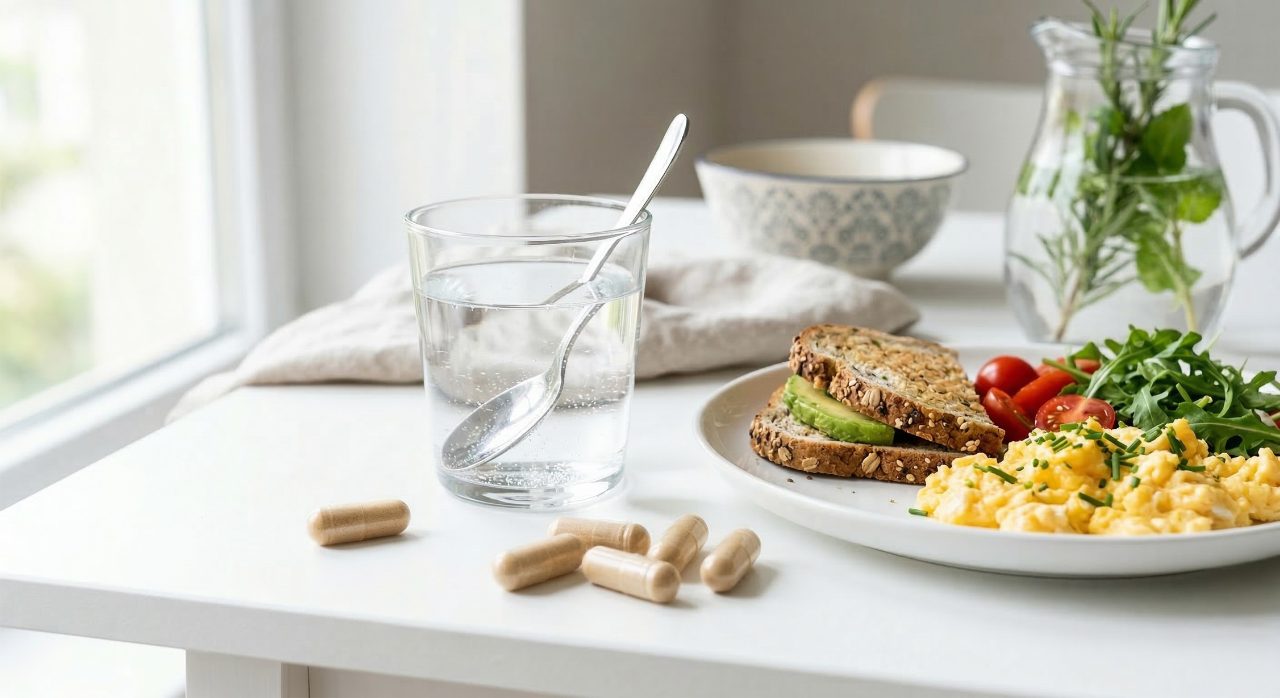
Best Time to Take CoQ10 — A Practical UK Guide
-
By Chris Jones
Written by Chris Jones, Social Media Manager at Nutrivity with 7+ years in the supplement industry.
Best Time to Take CoQ10 — A Practical UK Guide
CoQ10 is one of the most commonly asked-about supplements when it comes to timing. Unlike caffeine — where timing directly affects when the effect is felt — CoQ10 works by gradually building up in tissue over weeks and months. The question of when to take it is therefore less about feeling an immediate difference and more about maximising consistent absorption and bioavailability over the long term.
This guide covers the practical timing considerations for CoQ10 — with food vs without, morning vs evening, splitting the dose vs single dose, and how timing interacts with the other supplements you may be taking. For a full understanding of CoQ10 dosage, see our guide to CoQ10 dosage UK. For full product information on Nutrivity’s CoQ10 300mg, visit our CoQ10 300mg Vegan Capsules product page.
The Single Most Important Timing Rule — Take CoQ10 With Food
If there is one practical rule for CoQ10 timing that is clearly supported by pharmacokinetic research, it is this: take it with a meal that contains fat.
CoQ10 is a fat-soluble compound. Like vitamins A, D, E, and K, it requires dietary fat in the gut for proper absorption into the bloodstream. Without fat present during digestion, the absorption of CoQ10 from the gastrointestinal tract is significantly reduced. Studies comparing CoQ10 taken with a fat-containing meal versus taken fasting have found meaningful differences in peak plasma CoQ10 levels and total absorption — the fed state consistently produces substantially higher absorption.
The practical implication is straightforward. Take CoQ10 with the meal in your day that is most likely to contain fat — typically lunch or dinner for most people. A meal does not need to be high in fat to drive adequate CoQ10 absorption — even a moderate fat content (a tablespoon of olive oil in a salad dressing, a handful of nuts, a piece of salmon) is sufficient to significantly improve bioavailability compared to fasting.
Taking CoQ10 first thing in the morning on an empty stomach — a common approach for people building a morning supplement routine — is the least effective way to absorb it. If morning is the only time you will remember to take your CoQ10 consistently, a fat-containing breakfast is the solution, not a different supplement.
Morning vs Evening — Does It Matter?
Beyond the fat requirement, is there any meaningful difference between taking CoQ10 in the morning versus the evening? The short answer is no — not for most people.
CoQ10 does not have a circadian-dependent mechanism of action in the way that melatonin does. It is not a sleep supplement or a cortisol modulator. Its effects — supporting mitochondrial energy production and acting as an antioxidant — operate continuously at the cellular level regardless of the time of day. There is no research suggesting that morning CoQ10 provides superior cardiovascular protection, or that evening CoQ10 is better absorbed or more effective for energy.
What matters is consistency — taking CoQ10 at the same time each day, with food, every day. Whether that is with breakfast, lunch, or dinner is a matter of personal routine rather than pharmacology. The best time to take CoQ10 is whichever time you are most likely to remember and stick to.
One minor caveat: some people report that CoQ10 taken late in the evening produces mild sleep disturbance. This is not consistently reported in clinical research and is likely an individual response rather than a reliable effect. If you are sensitive to this, taking CoQ10 with lunch rather than dinner resolves it.
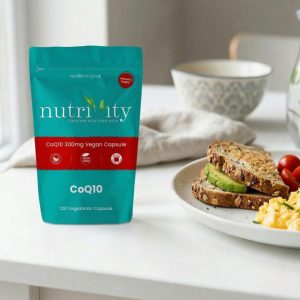
Should You Split Your CoQ10 Dose?
If you are taking 300mg of CoQ10 daily, should you take it all at once or split it across two meals? The pharmacokinetic argument for splitting is that CoQ10 absorption is somewhat dose-dependent — larger single doses are absorbed less efficiently than smaller doses, because the absorption mechanism in the gut becomes partially saturated. Splitting 300mg into two 150mg doses (one at lunch, one at dinner) may therefore produce slightly higher total absorption than a single 300mg dose.
The Q-SYMBIO cardiovascular trial — which used 300mg daily and showed meaningful reductions in cardiovascular mortality — split the dose across three 100mg doses per day. This protocol was chosen partly for practical reasons in a clinical trial setting and partly to maintain consistent blood levels throughout the day.
In practice, the absorption difference between a single 300mg dose and two 150mg doses is modest and is unlikely to be clinically significant for most people. The convenience advantage of a single daily dose — and the reduced likelihood of forgetting a second dose — generally outweighs the marginal absorption benefit of splitting. Take one 300mg capsule with your largest meal and do so consistently every day.
CoQ10 and Other Supplements — Timing Interactions
CoQ10 can be taken alongside most other supplements without timing concerns. However, a few interactions are worth noting.
Vitamin D3. Like CoQ10, vitamin D3 is fat-soluble and is best absorbed with a fat-containing meal. Taking both together with the same meal is entirely appropriate and convenient. Nutrivity’s Vitamin D3 4000 IU + K2 MK7 and CoQ10 300mg can be taken together with the same meal.
Omega-3 fish oil or algae oil. Omega-3 supplements contain fat themselves and can therefore improve CoQ10 absorption when taken together. Taking CoQ10 and omega-3 with the same meal is both convenient and pharmacokinetically sound.
Blood thinners (warfarin). CoQ10 may have mild effects on blood clotting and may interact with warfarin. If you take warfarin, inform your GP before starting CoQ10 and ensure your INR (international normalised ratio) is monitored after starting supplementation. Timing relative to warfarin doses is less relevant than the interaction itself.
Blood pressure medication. CoQ10 may potentiate the effects of antihypertensive drugs. This is generally a beneficial interaction rather than a harmful one, but it is worth monitoring blood pressure after starting CoQ10 if you are on medication for hypertension. For the full picture on CoQ10 and cardiovascular medication, see our guide to CoQ10 for heart health UK.
Statins. There are no negative timing interactions between CoQ10 and statins — they can be taken at the same time. Statins are often taken in the evening (particularly simvastatin, which is usually prescribed for evening use), and taking CoQ10 with an evening meal alongside a statin is a practical approach. For the full discussion of CoQ10 and statins, see our guide to CoQ10 and statins UK.
How Long Does CoQ10 Take to Work?
Timing questions often accompany questions about how quickly CoQ10 works. The honest answer is: not quickly. CoQ10 is a long-term maintenance supplement, not an acute intervention. It takes 4–12 weeks of consistent daily supplementation before meaningful changes in blood and tissue CoQ10 levels are achieved, and before any clinical effects — on energy, cardiovascular markers, or other outcomes — are likely to be noticeable.
Starting CoQ10 on a Monday and checking on Friday whether you feel different is not how this supplement works. The pharmacokinetics of tissue accumulation require weeks, and the biological changes that produce the outcomes seen in clinical research require consistent supplementation over months. The timing of each individual dose matters far less than the consistency of taking it every day over an adequate period.
Summary — When to Take CoQ10
The most important timing rule for CoQ10 is simple: always take it with a fat-containing meal. Morning or evening makes no meaningful difference for most people — choose whichever time fits your routine and you are most likely to maintain consistently. Splitting 300mg across two meals offers a modest absorption advantage but is not necessary for most people. The variable that matters most for CoQ10 outcomes is not when you take it on any given day — it is whether you take it every day, consistently, for long enough to build tissue levels and produce the effects seen in clinical research.
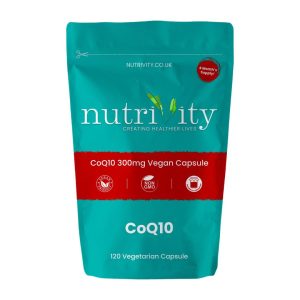
For full product information and to purchase, visit Nutrivity’s CoQ10 300mg Vegan Capsules product page.
Frequently Asked Questions
Should I take CoQ10 in the morning or at night?
Either is fine — the key variable is not morning versus evening but whether CoQ10 is taken with a fat-containing meal. Choose whichever meal time you are most consistent with. If evening CoQ10 causes mild sleep disturbance in your case, switch to lunchtime. Otherwise, morning or evening with food produces equivalent results.
Can I take CoQ10 on an empty stomach?
You can, but absorption will be significantly reduced. CoQ10 is fat-soluble and requires dietary fat for proper absorption from the gut. Taking it with a fat-containing meal meaningfully improves bioavailability compared to fasting. Always take CoQ10 with food.
Should I take CoQ10 with my other supplements?
Yes — CoQ10 can be taken with most other supplements without concern. Taking it alongside vitamin D3 and omega-3 with the same meal is particularly practical, as all three are fat-soluble and benefit from food co-administration. If you take warfarin or antihypertensive medication, inform your GP before starting CoQ10.
How long before I notice CoQ10 working?
Most people who respond to CoQ10 notice effects after 4–8 weeks of consistent daily supplementation. For cardiovascular and energy applications, 8–12 weeks is a more realistic timeframe for meaningful change. CoQ10 builds in tissue gradually — it is not an immediate-effect supplement.
Can I take CoQ10 twice a day?
Yes. Splitting 300mg into two 150mg doses taken with separate meals may offer a modest absorption advantage over a single 300mg dose. The Q-SYMBIO cardiovascular trial split 300mg across three doses daily. For most people, a single daily dose with one meal is sufficient and more practical.
Does it matter which meal I take CoQ10 with?
The meal should contain some fat — even a moderate amount improves absorption significantly compared to fasting. Taking CoQ10 with your largest meal of the day is the most practical approach as this meal is most likely to contain adequate fat. Beyond the fat requirement, the specific meal does not matter.