




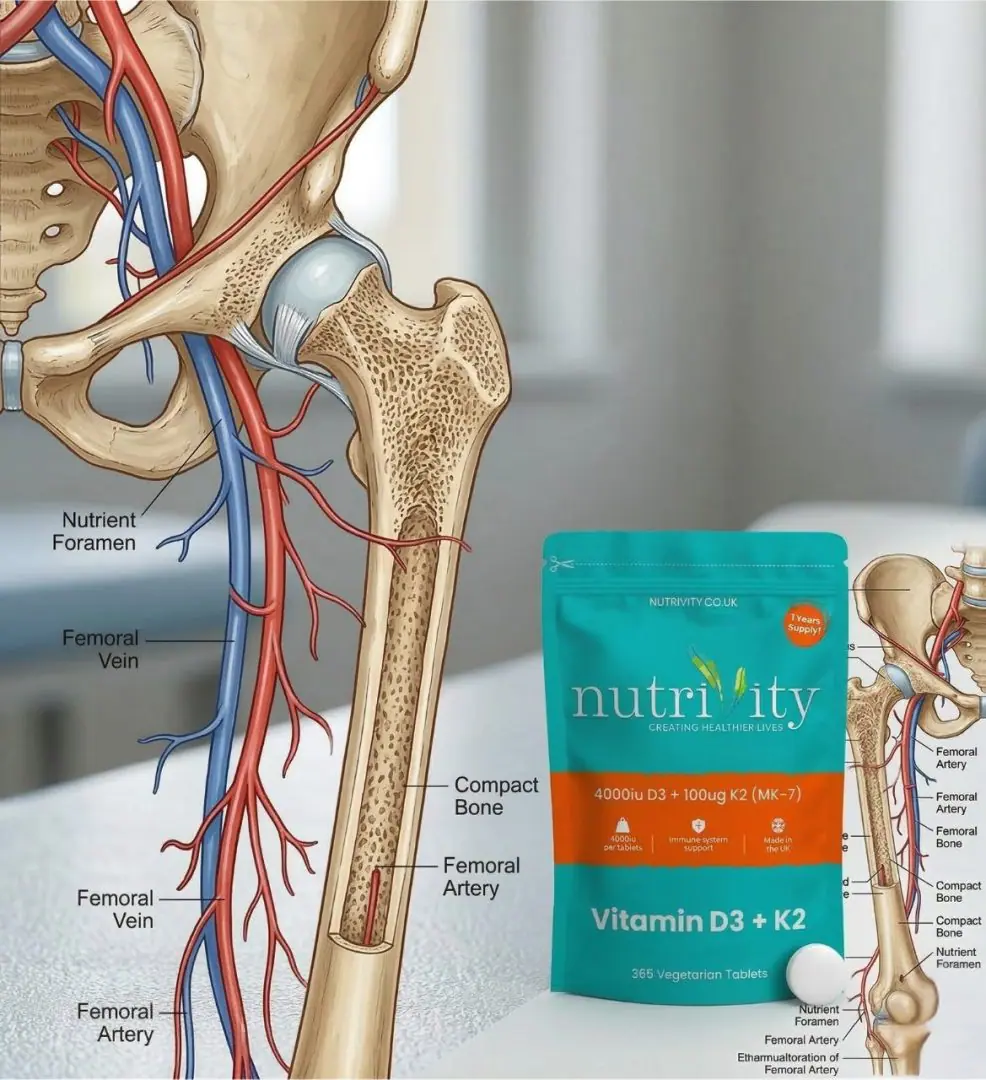
Why Take D3 and K2 Together? The Science Behind the Combination
-
By Chris Jones
Written by Chris Jones, Social Media Manager at Nutrivity with 7+ years in the supplement industry.
Why Take D3 and K2 Together? The Science Behind the Combination
Vitamin D3 and K2 are increasingly sold as a combined supplement, and the pairing is not a marketing invention — it is biochemically justified. The two nutrients operate in the same calcium regulation pathway, and taking one without the other leaves an important part of that pathway unaddressed. Understanding why the combination matters requires understanding what each nutrient does and where their functions intersect.
This guide covers the science behind the D3 + K2 combination, the evidence that informs it, and what the practical implications are for UK adults supplementing with vitamin D. For a full overview of what each nutrient does, see our guides to what is vitamin D3 + K2 and vitamin K2 MK7 benefits UK. For full product information on Nutrivity’s D3 + K2 tablets, visit our Vitamin D3 4000 IU + K2 MK7 product page.
What D3 Does — The Calcium Driver
Vitamin D3’s primary role in calcium metabolism is increasing calcium absorption from the gut. Without adequate vitamin D, only 10–15% of dietary calcium is absorbed. With sufficient vitamin D, absorption rises to 30–40%. This increased calcium absorption is the mechanism through which vitamin D supports bone mineralisation — providing more calcium for the skeleton to work with.
However, increasing calcium absorption also raises circulating calcium levels. Calcium in the bloodstream needs to go somewhere — and where it goes is determined by other regulatory factors, including vitamin K2-dependent proteins. Vitamin D alone does not determine whether calcium is deposited in bones or in soft tissues. That is K2’s role.
What K2 Does — The Calcium Director
Vitamin K2 activates two key proteins that determine calcium distribution in the body. Osteocalcin, produced by bone-forming cells, deposits calcium into bone matrix when activated by K2. Matrix Gla Protein (MGP), produced in vascular smooth muscle cells and cartilage, prevents calcium from depositing in arterial walls and soft tissues when activated by K2. Both proteins require K2-dependent carboxylation to function — without adequate K2, they remain inactive.
The consequence of inadequate K2 is that calcium absorbed under vitamin D’s influence has nowhere properly to go — and research shows it tends to accumulate in soft tissues, including arterial walls, rather than being efficiently incorporated into bone. This is the mechanistic basis for the concern that high-dose vitamin D supplementation without adequate K2 could contribute to arterial calcification rather than bone strength. For a full breakdown of K2’s mechanisms, see our guide to vitamin K2 MK7 benefits UK.
The Risk of D3 Without K2
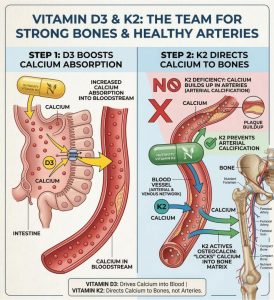 The concern about vitamin D supplementation without K2 has both mechanistic and epidemiological support. The Rotterdam Study — a large Dutch cohort study — found that while high vitamin D intake was associated with reduced cardiovascular risk, it also found that low K2 intake was associated with increased arterial calcification. Research measuring undercarboxylated MGP — the inactive, K2-deficient form that indicates K2 insufficiency — has found that it is a predictor of cardiovascular events and arterial calcification.
A 2015 study examining the relationship between vitamin D supplementation and vascular calcification in dialysis patients found that D supplementation was associated with increased vascular calcification in patients with low K2 status, but not in those with adequate K2. This is the kind of evidence that supports the combination rather than either nutrient alone.
The population most at risk from this mechanism is those taking high-dose vitamin D supplements (1000 IU and above) without considering K2 status — a large and growing group in the UK as vitamin D supplementation has become mainstream while K2 remains underappreciated.
The Evidence for the Combination
Research specifically examining the D3 + K2 combination versus either alone is growing. A three-year RCT published in Osteoporosis International found that the D3 + K2 MK7 combination produced greater improvements in bone mineral density than either vitamin D or K2 alone in postmenopausal women. A separate study found that the D3 + K2 combination produced greater reductions in arterial stiffness — a measure of cardiovascular risk — than vitamin D alone. Both findings are consistent with the complementary mechanisms: D3 provides calcium, K2 directs it.
The combination also addresses bone health more completely than either alone. For the full evidence on bone health specifically, see our guide to vitamin D and bone health UK.
Who Needs K2 Most Urgently Alongside D3?
Anyone supplementing with vitamin D3 at doses of 1000 IU or above benefits from ensuring adequate K2 status. The higher the vitamin D dose, the more calcium absorption is stimulated, and the more important appropriate K2-dependent calcium direction becomes.
Adults over 50 are at highest priority — both for the bone density benefits of K2-activated osteocalcin and for the arterial protection benefits of K2-activated MGP, both of which become more clinically relevant as cardiovascular and bone density risks increase with age. Postmenopausal women combining D3 supplementation for bone health with any cardiovascular risk management should ensure adequate K2 alongside. Anyone supplementing at 4000 IU of D3 should ensure 100mcg of MK7 K2 is included.
Summary — Why D3 and K2 Belong Together
Vitamin D3 drives calcium absorption — essential for bone mineralisation and a range of other health functions. Vitamin K2 ensures that absorbed calcium is deposited where it benefits health (bones) rather than where it causes harm (arterial walls and soft tissue). The combination is mechanistically necessary, evidentially supported, and practically simple — a single daily tablet with a fat-containing meal covers both nutrients at the doses used in the research. For UK adults supplementing with vitamin D at doses of 1000 IU and above, taking K2 MK7 alongside is not optional extra — it is the complete approach.
For full product information and to purchase, visit Nutrivity’s Vitamin D3 4000 IU + K2 MK7 product page.
Frequently Asked Questions
Why is K2 taken with D3?
Vitamin D3 increases calcium absorption. Vitamin K2 activates the proteins that direct absorbed calcium into bones and prevent it from depositing in arterial walls. Without K2, D3-driven calcium absorption may contribute to arterial calcification rather than bone strength. The combination ensures calcium metabolism is managed completely — absorption and appropriate distribution.
Can I take vitamin D3 without K2?
You can, but you leave the calcium distribution step unaddressed. At low doses of vitamin D (400 IU), the concern is minimal. At higher doses (1000 IU and above), ensuring adequate K2 status is increasingly important. For most UK adults supplementing at 1000–4000 IU daily, combining D3 with K2 MK7 at 100mcg is the evidence-based approach.
Does K2 cancel out D3?
No — K2 and D3 work synergistically, not antagonistically. K2 does not reduce the calcium absorption effect of D3. It directs the absorbed calcium appropriately. The two nutrients complement rather than compete with each other.
How much K2 should I take with D3?
100mcg of MK7 (menaquinone-7) daily is the dose most consistently associated with bone and cardiovascular benefits in supplement research and is the dose provided in Nutrivity’s Vitamin D3 4000 IU + K2 MK7 tablet.
Is the D3 + K2 combination safe?
Yes — both nutrients have excellent safety profiles at supplement doses. The main interaction concern with K2 is for people taking warfarin, where K2 may affect anticoagulation and INR monitoring is needed. For healthy adults not on warfarin, the D3 + K2 combination is safe for daily long-term use. Always inform your GP of supplement use if you take prescription medication.
Is Nutrivity's D3 + K2 a good combination supplement?
Yes. Nutrivity’s Vitamin D3 4000 IU + K2 MK7 provides 4000 IU of lichen-derived D3 and 100mcg of MK7 in a single compressed vegan tablet — fully vegan-suitable and halal-suitable. Both nutrients at evidence-based doses, in a single daily tablet with no gelatine and no lanolin.