





What Is Vitamin D3 + K2? Benefits, How They Work Together, and UK Guide
-
By Chris Jones
Written by Chris Jones, Social Media Manager at Nutrivity with 7+ years in the supplement industry.
What Is Vitamin D3 + K2? Benefits, How They Work Together, and UK Guide
Vitamin D3 and K2 are two of the most important fat-soluble nutrients for long-term health — and two that most UK adults are not getting enough of. Individually, both have well-established roles in bone health, cardiovascular function, and immune regulation. Together, they work synergistically in a way that makes the combination more clinically relevant than either nutrient taken alone. Understanding why they are paired, what each does, and why the source and form of each matters is essential for making an informed supplement choice.
This guide covers what vitamin D3 and K2 are, how they work together, who needs them, what the research shows, and what to look for in a UK supplement. For full product information on Nutrivity’s lichen-derived, vegan-suitable D3 + K2 tablets, visit our Vitamin D3 4000 IU + K2 MK7 product page.
What Is Vitamin D3?
Vitamin D3 (cholecalciferol) is the form of vitamin D that the body produces naturally when skin is exposed to UVB sunlight. It is the preferred supplemental form because it raises and maintains serum vitamin D levels more effectively than vitamin D2 (ergocalciferol), the plant-derived alternative found in some supplements and fortified foods.
Despite being called a vitamin, vitamin D3 functions more like a hormone in the body. Once absorbed, it is converted in the liver to 25-hydroxyvitamin D (the storage form measured in blood tests) and then in the kidneys and other tissues to its active form, calcitriol. In its active form, vitamin D3 regulates the expression of hundreds of genes involved in immune function, cell growth, calcium absorption, muscle function, and inflammatory response.
Vitamin D3 deficiency is the most widespread nutritional deficiency in the UK. The NHS recommends supplementation for all adults during autumn and winter, and year-round for those with limited sun exposure — a category that includes the majority of UK adults for most of the year. Groups at particular risk include South Asian and Black British populations (where melanin reduces UV-driven D3 synthesis), older adults, people who cover their skin for cultural or religious reasons, and those who work indoors.
The source of D3 in supplements matters for vegan consumers. Most D3 on the UK market is lanolin-derived — extracted from sheep’s wool — and is not vegan. Lichen-derived D3 is the fully plant-based alternative, chemically identical and equally effective. Nutrivity’s D3 + K2 uses lichen-derived D3 — no lanolin, fully vegan-suitable and halal-suitable.
What Does Vitamin K2 Do?
Vitamin K2 (menaquinone) is the form of vitamin K involved in regulating where calcium is deposited in the body. This is its primary — and most clinically important — function, and it is the reason K2 is paired with D3 rather than being marketed as a standalone supplement.
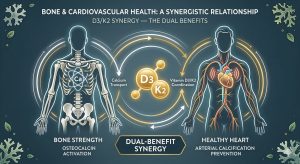
Vitamin D3 increases calcium absorption from the gut. This is beneficial for bone mineralisation, but it also raises circulating calcium levels — and calcium deposited in the wrong places (arterial walls, soft tissues) is actively harmful. Vitamin K2 activates two key proteins that direct this calcium appropriately: osteocalcin, which deposits calcium into bone matrix, and matrix Gla protein (MGP), which prevents calcium from depositing in arterial walls and soft tissues.
Without adequate K2, vitamin D3-driven calcium absorption can contribute to arterial calcification — a significant cardiovascular risk factor. This is the mechanistic basis for the D3 + K2 combination: D3 drives calcium absorption, K2 ensures that calcium goes where it should (bones) rather than where it should not (arteries).
The specific form of K2 matters. MK7 (menaquinone-7) is the long-chain form of K2 with the highest bioavailability and longest half-life in the body — meaning it remains active in circulation for days rather than hours, providing more consistent activation of osteocalcin and MGP. MK4 (menaquinone-4) is a shorter-chain form with lower bioavailability and shorter half-life, requiring multiple daily doses to maintain effective levels. MK7 at 100mcg daily is the most clinically supported form and dose for supplementation.
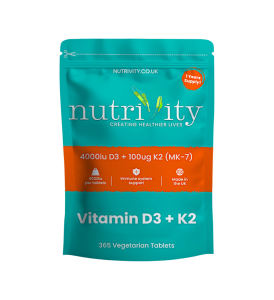
Nutrivity’s D3 + K2 provides 100mcg of MK7 per tablet — the form and dose used in the research supporting K2’s cardiovascular and bone health benefits.
Why D3 and K2 Work Better Together
The D3 + K2 combination is not marketing — it is biochemistry. The two nutrients operate in the same calcium regulation pathway, and the safety and efficacy of D3 supplementation is materially improved by adequate K2 status.
Population research has found that higher vitamin K2 intake is associated with reduced arterial calcification, lower cardiovascular mortality, and improved bone density. The Rotterdam Study — a large longitudinal cohort study — found that high dietary K2 intake was associated with a 57% reduction in cardiovascular mortality and a significant reduction in aortic calcification compared to low K2 intake, with no such relationship found for K1.
For people supplementing with vitamin D3 at doses of 1000 IU or above — doses that meaningfully increase calcium absorption — ensuring adequate K2 intake is clinically sensible. At 4000 IU per tablet, Nutrivity’s formulation is at the higher end of the standard therapeutic range and is paired with 100mcg MK7 specifically to support appropriate calcium distribution.
Who Needs Vitamin D3 + K2?
The combination is relevant for a broad range of adults, but particularly relevant for specific groups.
Adults over 40. Bone density loss accelerates from the forties, vitamin D synthesis efficiency declines with age, and cardiovascular calcification risk increases. The D3 + K2 combination addresses all three through a single supplement.
People with limited sun exposure. This covers the majority of UK adults for a significant portion of the year, as well as those who cover their skin or who have darker skin tones that reduce UV-driven D3 synthesis. The NHS recommends supplementation for all UK adults from October to March at minimum.
Postmenopausal women. Oestrogen plays a significant role in bone density maintenance, and the rapid bone loss that follows menopause makes vitamin D and K2 status particularly important. Both nutrients support bone mineralisation through complementary mechanisms.
People concerned about cardiovascular health. Arterial calcification is a key cardiovascular risk factor. Adequate K2 status is associated with reduced calcification in research, and people with established cardiovascular risk should ensure adequate K2 intake alongside any vitamin D supplementation.
Vegans and vegetarians. Dietary K2 is found primarily in fermented foods (particularly natto, a Japanese fermented soybean product) and animal products. Most UK vegans and vegetarians have low dietary K2 intake. Combined with the vitamin D synthesis limitations of UK living, supplementation with a vegan-suitable D3 + K2 product is particularly relevant.
Vitamin D3 + K2 Dosage
The NHS recommends 400 IU (10mcg) of vitamin D daily as a minimum for adults during winter months — a dose designed to prevent severe deficiency rather than to optimise vitamin D status. Many vitamin D researchers and clinicians consider this too low for meaningful health benefit and recommend 1000–4000 IU daily for most adults, with 4000 IU being the safe upper level for unsupervised supplementation.
Nutrivity’s D3 + K2 provides 4000 IU of lichen-derived D3 per tablet — at the higher end of the standard therapeutic range, appropriate for adults with established deficiency, limited sun exposure, or who want to optimise rather than merely prevent deficiency. For K2, 100mcg of MK7 per day is the dose most consistently associated with benefits in bone and cardiovascular research.
Both D3 and K2 are fat-soluble and are best absorbed when taken with a fat-containing meal. A single tablet daily with the largest meal of the day is the most practical and effective approach.
Summary — Vitamin D3 + K2 in the UK
Vitamin D3 and K2 are the two most important fat-soluble nutrients for bone, cardiovascular, and immune health in UK adults — and two that the majority of the population are not obtaining adequately from diet and sunlight alone. Their combination is mechanistically justified: D3 drives calcium absorption, K2 directs it correctly. Taking one without adequate levels of the other leaves part of the calcium metabolism picture unaddressed.
For UK adults — particularly those over 40, with limited sun exposure, postmenopausal women, vegans, and those with cardiovascular concerns — a daily D3 + K2 supplement at 4000 IU D3 and 100mcg MK7 K2 is one of the most evidence-based, broadly relevant additions to a supplement routine available. For vegan consumers, ensuring lichen-derived D3 is the critical additional check.
For full product information and to purchase, visit Nutrivity’s Vitamin D3 4000 IU + K2 MK7 product page.
Frequently Asked Questions
Why take D3 and K2 together?
Vitamin D3 increases calcium absorption from the gut, which is beneficial for bone mineralisation. Vitamin K2 activates the proteins that direct this calcium into bones and away from arterial walls. Without adequate K2, D3-driven calcium absorption can contribute to arterial calcification. The combination ensures calcium goes where it should rather than where it should not.
What does vitamin D3 do?
Vitamin D3 regulates calcium absorption, supports bone mineralisation, modulates immune function, influences muscle strength, and regulates the expression of hundreds of genes. It functions more like a hormone than a vitamin. Deficiency is linked to increased risk of bone fractures, immune dysfunction, fatigue, and increased susceptibility to respiratory infections.
What does vitamin K2 do?
Vitamin K2 activates osteocalcin (which deposits calcium into bone) and matrix Gla protein (which prevents calcium from depositing in arterial walls). Its primary role is directing calcium to appropriate tissues. Population research associates higher K2 intake with reduced arterial calcification and reduced cardiovascular mortality.
Is vitamin D3 + K2 vegan?
It depends on the D3 source. Most D3 supplements use lanolin from sheep’s wool — not vegan. Lichen-derived D3 is the fully plant-based alternative. Nutrivity’s Vitamin D3 4000 IU + K2 MK7 uses lichen-derived D3 in a compressed vegan tablet — no gelatine, no lanolin, fully vegan-suitable and halal-suitable.
How much vitamin D3 should I take?
The NHS minimum recommendation is 400 IU (10mcg) daily during winter months to prevent deficiency. Many clinicians recommend 1000–4000 IU daily for adults wanting to optimise vitamin D status rather than merely prevent deficiency. 4000 IU is the recognised safe upper level for unsupervised adult supplementation. Always consult your GP if you have a health condition affecting vitamin D metabolism.
What is the best form of vitamin K2?
MK7 (menaquinone-7) is the most bioavailable and longest-acting form of K2, remaining active in circulation for days and providing consistent activation of osteocalcin and matrix Gla protein. MK4 has a shorter half-life and requires multiple daily doses to maintain effective blood levels. 100mcg of MK7 daily is the dose most supported by the bone and cardiovascular research.