



Vitamin D3 vs D2 — What’s the Difference and Which Should You Take?
-
By Chris Jones
Written by Chris Jones, Social Media Manager at Nutrivity with 7+ years in the supplement industry.
Vitamin D3 vs D2 — What’s the Difference and Which Should You Take?
Walk into any pharmacy or health food shop and you will find both vitamin D3 and vitamin D2 supplements on the shelf. Many people assume they are equivalent — both are “vitamin D,” both are widely sold, and both are recommended for the same conditions. They are not equivalent. The research is clear that D3 is more effective at raising and maintaining serum vitamin D levels than D2, and the difference has practical significance for UK adults supplementing to address deficiency or maintain adequate levels.
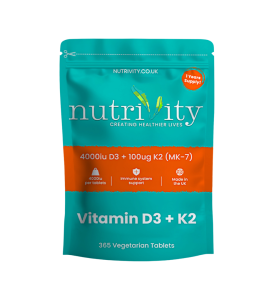
This guide covers what D3 and D2 are, how they differ in the body, what the research shows on effectiveness, and the special consideration for vegan consumers. For a full overview of vitamin D3 and K2 supplementation, see our guide to what is vitamin D3 + K2. For full product information on Nutrivity’s lichen-derived D3 + K2 tablets, visit our Vitamin D3 4000 IU + K2 MK7 product page.
What Is Vitamin D3?
Vitamin D3 (cholecalciferol) is the form of vitamin D that the human body produces naturally when UVB sunlight strikes the skin. It is also found in animal-derived foods — oily fish, egg yolks, and liver — in modest amounts. In supplement manufacturing, D3 is most commonly derived from lanolin (sheep’s wool grease), though a plant-based alternative — lichen-derived D3 — is available and used by manufacturers committed to vegan-suitable formulations.
D3 is the body’s preferred form of vitamin D. Once absorbed, it is converted in the liver to 25(OH)D3 (calcifediol), the storage form measured in blood tests. The efficiency of this conversion and the stability of D3 in storage are both greater than for D2, contributing to its superior performance in raising and maintaining vitamin D levels.
What Is Vitamin D2?
Vitamin D2 (ergocalciferol) is produced by fungi, yeasts, and plants when exposed to UV light. It is entirely plant-derived, making it the default vegan form of vitamin D and the form used in many fortified plant foods — plant milks, fortified cereals, and vegan multivitamins commonly use D2 rather than D3.
D2 was the first form of vitamin D to be produced synthetically and used in medical supplementation, and it remains widely used in prescription vitamin D preparations in the UK. It has been used effectively to prevent and treat vitamin D deficiency for decades.
Which Is More Effective?
 The research on D3 versus D2 effectiveness is now sufficiently consistent to draw a clear conclusion: D3 is more effective at raising and maintaining serum 25(OH)D levels at equivalent doses.
A landmark meta-analysis published in the American Journal of Clinical Nutrition examined the comparative effectiveness of D3 and D2 supplementation across multiple studies and found that D3 was significantly more effective at raising 25(OH)D levels — with D3 producing approximately 87% higher blood levels than an equivalent dose of D2. The reasons include D3’s higher affinity for vitamin D-binding protein, its longer half-life in the circulation, and more efficient conversion to the storage form 25(OH)D in the liver.
This means that if you are supplementing with vitamin D to address deficiency or maintain adequate levels, a given dose of D3 will achieve more than the same dose of D2. At the standard supplementation doses of 400–4000 IU, the practical consequence is that D3 is the more appropriate choice for effectiveness.
D2 and the Vegan Question
Until relatively recently, vegan consumers faced a genuine dilemma: D3 was more effective but derived from lanolin (sheep’s wool) — not vegan. D2 was vegan but less effective. This was a real trade-off.
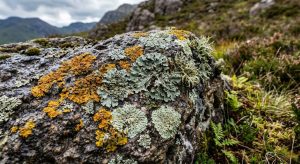
Lichen-derived D3 resolves this dilemma. Certain species of lichen naturally produce vitamin D3 when exposed to UV light — making lichen the only plant-based source of D3. Lichen-derived D3 is chemically identical to lanolin-derived D3 and equally effective. It is fully vegan-suitable and halal-suitable. Nutrivity’s Vitamin D3 4000 IU + K2 MK7 uses lichen-derived D3, providing D3 efficacy in a fully plant-based formulation. For more on vitamin D deficiency and who is at risk, see our guide to vitamin D deficiency UK.
When D2 Might Still Be Chosen
D2 remains appropriate in a small number of contexts. NHS prescriptions for vitamin D deficiency treatment sometimes use D2 — this is a cost and availability consideration rather than an efficacy one, and the doses used in prescribed treatment are typically high enough to compensate for D2’s lower potency. Some fortified foods use D2 because it is cheaper to produce and stable in food manufacturing. For consumers relying on food fortification as their primary vitamin D source, D3-fortified products are preferable to D2-fortified where available.
Summary — Vitamin D3 vs D2
D3 is the more effective form of vitamin D for supplementation — more efficiently absorbed, longer-lasting in circulation, and more reliably converting to the storage form measured in blood tests. For vegan consumers, lichen-derived D3 provides D3 efficacy without any animal-derived ingredients, resolving the historical trade-off between efficacy and dietary ethics. For most UK adults supplementing for deficiency or health maintenance, D3 — ideally lichen-derived — is the clear choice.
For full product information and to purchase, visit Nutrivity’s Vitamin D3 4000 IU + K2 MK7 product page.
Frequently Asked Questions
Is D3 better than D2?
Yes, for supplementation purposes. D3 is more effective at raising and maintaining serum vitamin D levels at equivalent doses, with research showing approximately 87% higher blood levels achieved with D3 compared to an equal dose of D2. D3 is the recommended form for supplementation in UK adults.
Is vitamin D2 vegan?
Yes. Vitamin D2 (ergocalciferol) is derived from fungi and plants and is entirely vegan-suitable. It has historically been the only vegan option for vitamin D supplementation. Lichen-derived D3 is now available as a more effective vegan alternative.
What is lichen-derived D3?
Lichen is a composite organism — part fungus, part algae — that naturally produces vitamin D3 when exposed to UV light. Lichen-derived D3 is chemically identical to lanolin-derived D3 and equally effective, but is entirely plant-based — vegan-suitable and halal-suitable. It is the preferred form of D3 for consumers who want D3 efficacy without animal-derived ingredients.
Does the NHS prescribe D2 or D3?
The NHS prescribes both D2 and D3 depending on the specific formulation and clinical context. For over-the-counter supplementation, D3 is the preferred form based on effectiveness. If you are prescribed vitamin D by your GP, follow the prescription — the dose used in treatment protocols is typically sufficient regardless of form.
Is Nutrivity's vitamin D3 lanolin-free?
Yes. Nutrivity’s Vitamin D3 4000 IU + K2 MK7 uses lichen-derived D3 — no lanolin, fully plant-based, vegan-suitable and halal-suitable. Full ingredients are published on the product page.