





Vitamin D in Winter UK — Why You Need to Supplement and When to Start
-
By Chris Jones
Written by Chris Jones, Social Media Manager at Nutrivity with 7+ years in the supplement industry.
Vitamin D in Winter UK — Why You Need to Supplement and When to Start
The NHS recommends that everyone in the UK considers taking a vitamin D supplement during autumn and winter. This is not a precautionary suggestion — it reflects the straightforward reality that the UK’s geographic position makes adequate vitamin D synthesis through sunlight impossible for around half the year. Between October and late March, UVB radiation in the UK is not of sufficient intensity to trigger vitamin D production in skin, regardless of how much time you spend outdoors. Whatever vitamin D you have in October is what you will be working through until March — and for most UK adults, it is not enough.
This guide covers the science behind the UK’s seasonal vitamin D problem, when to start and stop supplementing, who needs to supplement year-round, and what dose makes sense. For a full guide to who is most at risk of vitamin D deficiency, see our guide to vitamin D deficiency UK. For full product information on Nutrivity’s D3 + K2 tablets, visit our Vitamin D3 4000 IU + K2 MK7 product page.
Why UK Sunlight Is Not Enough
Vitamin D3 is produced in the skin when UVB radiation of wavelength 290–315 nanometres strikes 7-dehydrocholesterol in skin cells. The intensity of UVB radiation at the Earth’s surface depends on the angle of the sun — specifically, how much atmosphere the UVB must pass through before reaching the skin. At high solar angles (summer, midday), UVB intensity is sufficient for vitamin D synthesis. At low solar angles (winter, early morning, late afternoon), the longer atmospheric path absorbs most UVB before it reaches the skin.
At the UK’s latitude of 50–61° north, the solar angle is too low for effective vitamin D synthesis from approximately late September to late March. During this period, spending any amount of time outdoors produces no meaningful vitamin D synthesis. The only sources of vitamin D between October and March are diet (limited — few foods contain significant amounts), and supplementation.
This is why the NHS recommends supplementation for all UK adults in autumn and winter. It is not about individual health status or diet quality — it is about the physics of sunlight at northern latitudes.
When to Start and Stop
 When to start: Early October is the practical starting point for most UK adults. By this time, the sun’s angle is already too low for reliable vitamin D synthesis on most days, and starting in October allows levels to be maintained as the winter progresses rather than allowing them to decline first. Waiting until December or January — when deficiency is already developing — means spending several weeks replenishing before adequate levels are restored.
When to stop: Late March to early April, when UVB radiation becomes sufficient for synthesis again on sunny days. In practice, supplementing through April is sensible given the unreliability of UK spring sunshine. Many vitamin D researchers recommend year-round supplementation for UK adults regardless of season, particularly for those in high-risk groups, given the combination of unpredictable UK summer weather and widespread indoor working.
Who should supplement year-round: Adults with darker skin tones (South Asian, Black African, Black Caribbean), adults over 65, people who cover most of their skin year-round, people who work predominantly indoors, people who are obese, and anyone with a medical condition affecting vitamin D metabolism should supplement year-round rather than seasonally. For these groups, summer sunlight alone is insufficient to build and maintain adequate vitamin D stores. For dosage guidance, see our vitamin D dosage UK guide.
What Dose for Winter Supplementation?
The NHS minimum recommendation is 400 IU (10mcg) daily — a dose designed to prevent severe clinical deficiency. Most vitamin D researchers and clinicians consider this too low to maintain adequate serum vitamin D levels through the UK winter for most adults, particularly those starting with borderline insufficient levels in October.
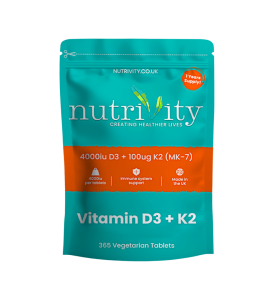
For most UK adults, 1000–4000 IU daily through the winter months is appropriate. At 4000 IU, Nutrivity’s Vitamin D3 + K2 is at the higher end of the standard safe range and is appropriate for adults wanting to optimise vitamin D status rather than merely prevent severe deficiency. For adults with established deficiency identified through blood testing, higher doses may be appropriate under medical supervision.
Summary — Vitamin D in the UK Winter
The UK’s latitude makes vitamin D supplementation from October to March a practical necessity for the entire population — not a niche health intervention. The NHS acknowledges this with its universal winter supplementation recommendation. The question is not whether to supplement, but at what dose and with what formulation. For most UK adults, 1000–4000 IU of D3 daily throughout the winter months, paired with K2 MK7, is the evidence-based approach to maintaining the vitamin D levels that support bone health, immune function, muscle strength, and mood through the darker months.
For full product information and to purchase, visit Nutrivity’s Vitamin D3 4000 IU + K2 MK7 product page.
Frequently Asked Questions
Do I need vitamin D supplements in the UK winter?
Yes — for effectively everyone in the UK. Between October and March, UVB radiation is insufficient for vitamin D synthesis at UK latitudes regardless of how much time you spend outdoors. The NHS recommends supplementation for all UK adults during this period. Diet provides very little vitamin D, making supplementation the only reliable way to maintain adequate levels through winter.
When should I start taking vitamin D in the UK?
Start in early October, before vitamin D levels have declined significantly from summer. Starting earlier rather than later means maintaining levels rather than needing to replenish them. Continue supplementing through to late March or April when UVB synthesis becomes reliable again.
Can I get enough vitamin D from the UK sun in summer?
Most people can build adequate vitamin D stores during the UK summer if they spend time outdoors with skin exposed between 11am and 3pm on sunny days. However, this is not reliable — UK summers are frequently overcast, and modern lifestyles mean many people spend limited time outdoors during peak synthesis hours. Year-round supplementation is appropriate for many adults regardless of season.
What is the best vitamin D supplement for winter in the UK?
Vitamin D3 (not D2 — D3 is more effective) at 1000–4000 IU daily, paired with vitamin K2 MK7 at 100mcg to ensure appropriate calcium direction. Lichen-derived D3 is the vegan-suitable option. Nutrivity’s Vitamin D3 4000 IU + K2 MK7 provides both nutrients in a single daily vegan-suitable, halal-suitable tablet.
Is Nutrivity's D3 + K2 suitable for winter supplementation?
Yes. One tablet daily from October through to late March or April provides 4000 IU of lichen-derived D3 and 100mcg of MK7 K2 — the full D3 + K2 combination at therapeutic doses, in a single convenient tablet. Fully vegan-suitable and halal-suitable, with full ingredient transparency on the product page.