


Vegan Supplements for Children and Families in the UK — A Parent’s Guide
-
By Chris Jones
Written by Chris Jones, Social Media Manager at Nutrivity with 7+ years in the supplement industry.
Vegan Supplements for Children and Families in the UK — A Parent’s Guide
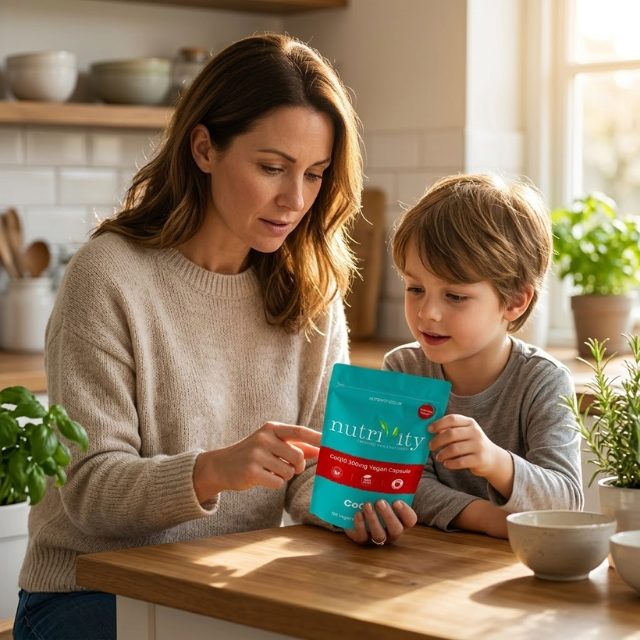
Choosing supplements for children on a vegan or plant-based diet requires more care than choosing for adults — and the formats designed to appeal to children are precisely the ones most likely to contain non-vegan ingredients. Gummy vitamins, chewable tablets, and brightly coloured liquids rely on gelatine, carmine, and other animal-derived ingredients to achieve their texture, colour, and palatability. For vegan families, the challenge is finding effective supplements in formats that are both child-friendly and genuinely plant-based.
This guide covers the supplements most important for children on vegan or plant-based diets, the specific vegan compliance issues in children’s supplement formats, and how to make informed purchasing decisions. For a full guide to reading supplement labels as a vegan consumer, see our guide to how to read supplement labels as a vegan. For Nutrivity’s complete range of vegan-suitable supplements, visit our vegan supplements guide.
Why Children’s Supplements Are a Particular Vegan Challenge
Children’s supplements present more vegan compliance problems than adult supplements. The formats designed to be enjoyable for children are the formats that introduce the most non-vegan ingredients.
Gummy vitamins are almost universally not vegan. The gummy texture requires a gelling agent, and the UK market default is gelatine — almost always animal-derived. Brands rarely disclose the gelatine source on packaging. The child-friendly format that makes gummies popular is built on an ingredient incompatible with a vegan diet. There are a small number of gummy vitamins using plant-based gelling agents such as pectin, but they are not the mainstream and require explicit verification.
Chewable tablets frequently contain carmine. The red, pink, orange, and purple colours in chewable tablets are commonly achieved using carmine (E120) — derived from crushed cochineal insects. It appears on labels as E120, carmine, cochineal, or carminic acid and is not vegan. Many children’s multivitamins and chewable vitamin C products contain it.
Liquid vitamins may contain non-vegan ingredients. Some liquid vitamin formulations use lanolin-derived D3, gelatine-derived compounds, or animal-derived flavour carriers. Liquid formats require the same ingredient checking as capsule formats — the liquid delivery method does not reduce the risk of non-vegan ingredients.
Children’s omega-3 products carry the same soft gel problem as adult products. Fish oil gummies for children combine the gelatine gummy format with a fish-derived oil — failing the vegan standard twice. Algae-based omega-3 in appropriate child-suitable dosing is the only genuinely vegan-suitable source of direct EPA and DHA for children.
The Most Important Supplements for Vegan Children
 Vitamin B12 — Non-Negotiable for All Vegans
Vitamin B12 is found almost exclusively in animal products and cannot be reliably obtained from plant foods. For children on a vegan diet, B12 supplementation is not optional — deficiency in children causes irreversible neurological damage and developmental impairment if left untreated. B12 in tablet or HPMC capsule format is straightforward for vegan compliance. Cyanocobalamin and methylcobalamin are both effective vegan forms. Dosage should be age-appropriate — consult your GP or paediatric dietitian for specific guidance.
Vitamin D3 — NHS Recommended for All Children
The NHS recommends vitamin D supplementation for all children from birth to five years old, and for older children with limited sun exposure. For vegan families, the D3 source is the critical issue — most children’s vitamin D supplements use lanolin-derived D3 from sheep’s wool, which is not vegan. The vegan alternative is lichen-derived D3, chemically identical and equally effective. For a full explanation of the D3 source issue, see our guide to is vitamin D3 vegan.
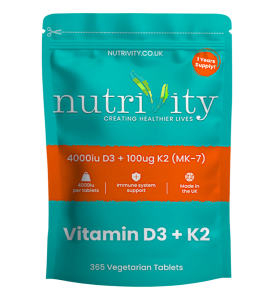
Nutrivity’s Vitamin D3 4000 IU + K2 MK7 uses lichen-derived D3 — fully plant-based, no lanolin. Note that this is an adult-strength formulation. For children, a lower-strength lichen-derived D3 product is appropriate — consult your GP or paediatric dietitian for age-specific dosage guidance.
Iodine — Commonly Low in Vegan Diets
Iodine is essential for thyroid function and brain development in children. It is found primarily in dairy products, fish, and seafood — all absent from a vegan diet. Seaweed provides iodine but at highly variable levels that make it unreliable as a consistent source. Iodine supplementation is increasingly recommended for vegan children and is one of the most commonly overlooked nutritional gaps in plant-based diets for young people. Iodine in tablet format is generally straightforward for vegan compliance.
Omega-3 (EPA and DHA) — Brain Development
DHA is particularly important for brain development in children, and EPA supports inflammatory and cardiovascular health. Standard fish oil supplements are not vegan. Algae-derived omega-3 is the only vegan source of direct EPA and DHA and is available in age-appropriate formats. For a full breakdown of vegan omega-3 options, see our guide to vegan omega-3 supplements UK.
Iron — For Children at Risk of Deficiency
Iron deficiency is the most common nutritional deficiency in children globally. Vegan children face additional risk because plant-based iron (non-haem iron) is less readily absorbed than haem iron from meat. Taking vitamin C alongside iron significantly improves non-haem iron absorption. Iron supplementation is not required for all vegan children but should be considered where dietary intake is low or deficiency has been identified. Plain iron tablet formats are generally lower risk for vegan compliance than gummy or liquid formats.
Choosing Vegan-Suitable Children’s Supplement Formats
For vegan families, format selection is the primary consideration when choosing children’s supplements. The safest formats for vegan compliance are plain tablets (check for coatings and colourings), HPMC hard capsules (appropriate for older children who can swallow capsules), and liquid formats where the full ingredient list has been verified.
Gummy vitamins require explicit confirmation that the gelling agent is pectin or another plant-based alternative rather than gelatine — and this must be stated by the brand, not assumed from a vegan label claim. Chewable tablets require checking for carmine (E120) in any product with red, pink, orange, or purple colouring. Soft gel capsules should be assumed to contain gelatine unless explicitly stated otherwise.
When in doubt, contact the brand before purchasing. Ask: What is the gelling agent in this gummy? Does this product contain carmine or shellac? Is the vitamin D3 lanolin-derived or lichen-derived? Is the omega-3 fish-derived or algae-derived? Any brand manufacturing specifically for vegan families will answer these questions clearly and immediately.
Summary — Vegan Supplement Choices for Families in the UK
Children’s supplements and vegan compliance are frequently at odds — the formats most appealing to children are the ones most likely to contain gelatine, carmine, and other animal-derived ingredients. For vegan parents, the practical approach is to prioritise format over brand: plain tablets and HPMC capsules are the safest starting points, gummies require explicit plant-based gelling agent confirmation, and all coloured products need carmine checking.
The nutritional priorities for vegan children — B12, lichen-derived D3, iodine, algae omega-3, and iron where needed — all have genuinely vegan-suitable supplement options available in the UK. The challenge is finding them in appropriate child-suitable formats with full ingredient transparency. Choose brands that answer your questions clearly. If a brand cannot confirm the gelling agent, D3 source, or colouring origin on a children’s product, choose a brand that can.
Browse Nutrivity’s complete vegan supplements range, with full ingredient transparency on every product page and UK GMP-certified manufacturing throughout.
Frequently Asked Questions
Are children's gummy vitamins vegan?
Most are not. Gummy vitamins require a gelling agent, and the UK market default is animal gelatine. Unless a brand explicitly states it uses pectin or another plant-based gelling agent, children’s gummy vitamins should be treated as not vegan-suitable. A small number of vegan gummy vitamins are available from specialist brands using pectin — check the ingredient list specifically for the gelling agent.
What vitamins do vegan children need?
The non-negotiable supplements for children on a vegan diet are vitamin B12 and vitamin D3 (lichen-derived). Iodine is commonly low in vegan diets and increasingly recommended. Algae-based omega-3 provides EPA and DHA for brain development. Iron supplementation should be considered where dietary intake is low or deficiency has been identified. Dosage for all of these should be age-appropriate — consult a GP or paediatric dietitian for specific guidance.
Is vitamin D3 vegan for children?
It depends on the source. Lichen-derived D3 is fully plant-based and vegan. Lanolin-derived D3 comes from sheep’s wool and is not vegan. Most children’s vitamin D supplements on the UK market use lanolin-derived D3. Always confirm the D3 source with the brand before purchasing — labels typically say vitamin D3 or cholecalciferol without specifying the origin.
Can vegan children get enough omega-3 from diet alone?
Children can obtain ALA from plant foods such as flaxseed, hemp seeds, chia, and walnuts. However, the conversion of ALA to DHA — which is particularly important for brain development — is low and unreliable. Algae-based omega-3 providing direct DHA is the most reliable way for vegan children to maintain adequate DHA levels, particularly during developmental years.
Are Nutrivity supplements suitable for children?
Nutrivity’s products are formulated and dosed for adults. They are not specifically formulated for children and most are at adult-strength dosages. The ingredient standards — HPMC vegetable capsules, alcohol-free extraction, vegetable-derived flow agents, lichen-derived D3, no carmine, no shellac — represent the benchmark that children’s supplements should also meet. Always consult a GP or paediatric dietitian before giving any supplement to a child.
What should I look for on a children's supplement label?
Check the gelling or capsule material first — look for HPMC, pectin, or vegetable capsule rather than gelatine. Check for E120, carmine, cochineal, or carminic acid in any coloured product. Check whether vitamin D3 is lichen-derived or lanolin-derived. Check whether any omega-3 is algae-derived rather than fish-derived. These four checks cover the vast majority of vegan compliance concerns in children’s supplements.