



Vegan Collagen Alternatives in the UK — A Complete Guide
-
By Chris Jones
Written by Chris Jones, Social Media Manager at Nutrivity with 7+ years in the supplement industry.
Vegan Collagen Alternatives in the UK — A Complete Guide
Collagen supplements have become one of the fastest-growing categories in the UK supplement market. Marketed for skin elasticity, joint health, hair strength, and anti-ageing, they are sold in powders, capsules, and liquids — and almost every one of them is animal-derived. Collagen is an animal protein. It cannot be extracted from plants. There is no such thing as a vegan collagen supplement in the literal sense — and products marketed as “vegan collagen” deserve careful scrutiny.
What does exist is a well-evidenced range of plant-based supplements that support the body’s own collagen production — providing the specific nutrients the body uses to synthesise collagen internally. This guide explains why collagen supplements are not vegan, what the body actually needs to produce collagen, and which vegan-suitable supplements address the skin, joint, and connective tissue health goals that collagen products are sold for. For Nutrivity’s complete range of vegan-suitable supplements, visit our vegan supplements guide.
Why Collagen Supplements Are Not Vegan
Collagen is the most abundant protein in the human body — the structural framework of skin, joints, tendons, ligaments, bones, and blood vessels. In supplement form, it is extracted from animal sources: bovine collagen from cattle hides and bones, marine collagen from fish skin and scales, and chicken collagen from poultry cartilage. All three are animal-derived. All three involve animal slaughter.
Collagen peptides — the hydrolysed form used in most supplements — are produced by breaking down animal collagen into shorter peptide chains for easier absorption. The source remains animal regardless of the processing method. There is no plant-based equivalent because plants do not produce collagen. Algae, fungi, bacteria, and plant cells use entirely different structural proteins.
Products marketed as “vegan collagen boosters” or “plant-based collagen” are not providing collagen — they are providing the precursor nutrients that the body uses to make its own collagen. This is a meaningful distinction: these products can genuinely support collagen synthesis, but they work through a different mechanism to animal collagen supplements, and the marketing language used to sell them is frequently misleading.
What Vegan Collagen Supplements Actually Are
 The body produces collagen through a synthesis process that requires specific nutrients as raw materials. The key ones are vitamin C (essential for the hydroxylation of proline and lysine, the amino acids that form the collagen helix), zinc (required for the enzymes that process collagen), glycine and proline (the primary amino acids in collagen, obtainable from plant sources), and silicon (supports connective tissue structure).
A well-formulated vegan collagen support supplement provides these precursors at levels that support the body’s endogenous collagen synthesis. This approach relies on the body producing its own collagen — a process that declines with age, is impaired by nutritional deficiencies, and is accelerated by UV exposure, smoking, and poor diet. Supporting collagen synthesis through nutrition is a valid approach to maintaining skin elasticity and joint health, and the evidence for vitamin C and zinc in this context is well-established.
What these supplements cannot do is directly replace collagen peptides in the way that animal collagen supplements claim to. The physiological mechanisms are different. Whether animal collagen supplements themselves work as marketed is a separate debate — the evidence is mixed — but the point for vegan consumers is that plant-based collagen support works through endogenous synthesis rather than direct peptide delivery.
The Best Vegan Supplements for Skin, Joint, and Connective Tissue Health
Vitamin C — The Cornerstone of Collagen Synthesis
Vitamin C is directly required for collagen synthesis — it acts as a cofactor for the enzymes that stabilise the collagen triple helix structure. Without adequate vitamin C, collagen production is impaired regardless of other nutritional factors. Vitamin C from plant sources — ascorbic acid derived from fruit, acerola cherry, or synthetic ascorbic acid — is fully vegan-suitable. Check the capsule material on any vitamin C supplement for HPMC rather than gelatine.
Devils Claw — Joint Pain and Connective Tissue Support
Devils claw is a well-researched herbal supplement for joint pain, inflammation, and musculoskeletal discomfort — the same health outcomes that joint collagen supplements target. Rather than providing collagen directly, it addresses the inflammatory component of joint discomfort through its active iridoid glycoside compounds. For vegan women and athletes managing joint health, it is one of the most evidence-supported plant-based options available. For more on how it fits into a vegan women’s supplement routine, see our guide to vegan supplements for women UK.
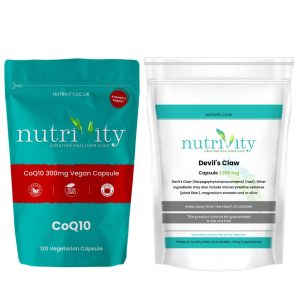
Nutrivity’s Devils Claw 2200mg Vegan Capsules use HPMC plant-based capsules and alcohol-free extraction — fully vegan-suitable at one of the highest available strengths in the UK market.
CoQ10 — Cellular Health and Skin Protection
CoQ10 acts as an antioxidant at the cellular level, reducing oxidative stress that degrades collagen in the skin. It also plays a central role in mitochondrial energy production — relevant to the cellular repair processes that maintain skin and connective tissue integrity. For vegan athletes and those focused on skin health alongside energy and recovery, CoQ10 addresses multiple goals simultaneously. For more on CoQ10 in the context of vegan athletic performance, see our guide to vegan supplements for athletes UK.
Nutrivity’s CoQ10 300mg uses HPMC vegetable capsules and naturally fermented ubiquinone — fully vegan-suitable and one of the highest-strength CoQ10 supplements available in the UK.
Vitamin D3 + K2 — Bone and Connective Tissue Foundation
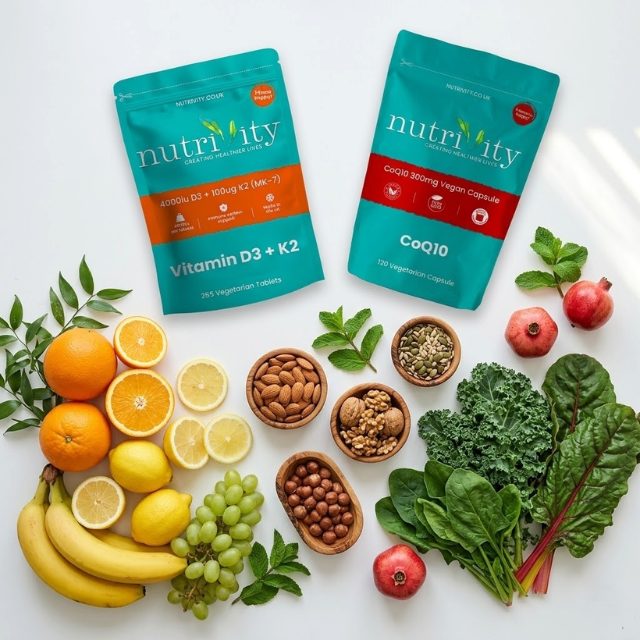
Vitamin D3 and K2 support the bone and connective tissue matrix that collagen helps to maintain. D3 supports calcium absorption and bone mineralisation; K2 directs calcium to bones rather than soft tissues. For vegan consumers concerned about long-term structural health — bone density, joint integrity, connective tissue resilience — D3 + K2 forms the foundation of a well-evidenced supplement routine. Nutrivity’s Vitamin D3 4000 IU + K2 MK7 uses lichen-derived D3 — fully plant-based, no lanolin.
What to Avoid — Non-Vegan Collagen Products and Marketing Claims
Standard collagen powders and capsules — bovine, marine, and chicken collagen are all animal-derived. No vegan alternative exists that provides collagen peptides directly.
“Vegan collagen booster” products — check the ingredient list carefully. Genuine vegan collagen support products provide vitamin C, zinc, and other synthesis precursors. Some products use this marketing language while containing animal-derived ingredients. Do not assume “vegan collagen” on the label means the product is either vegan or that it contains anything that directly provides collagen.
Collagen-infused beauty supplements — these commonly combine collagen peptides with other beauty ingredients. The collagen component is animal-derived by definition. The additional ingredients may individually be vegan-suitable, but the product as a whole is not.
Bone broth supplements — marketed alongside collagen for joint and gut health, bone broth is derived from animal bones and is not vegan by any standard.
Summary — Vegan Collagen Support in the UK
Collagen supplements are not vegan and cannot be made vegan — collagen is an animal protein with no plant equivalent. The vegan approach to skin, joint, and connective tissue health is to support the body’s own collagen synthesis through the precursor nutrients it requires, and to address the inflammatory and oxidative processes that degrade collagen through well-evidenced plant-based supplements.
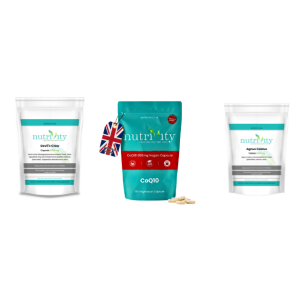
Devils claw for joint pain and inflammation, CoQ10 for cellular protection and energy, vitamin C for collagen synthesis, and D3 + K2 for the structural bone and connective tissue foundation collectively cover the health goals that drive collagen supplement sales — without any animal involvement at any stage. These are the supplements that vegan consumers concerned about skin, joint, and connective tissue health should be looking at.
Browse Nutrivity’s complete vegan supplements range, with full ingredient transparency on every product page and UK GMP-certified manufacturing throughout.
Frequently Asked Questions
Is there a vegan collagen supplement?
There is no supplement that provides vegan collagen directly — collagen is an animal protein and cannot be derived from plants. Products marketed as “vegan collagen” are providing the precursor nutrients the body uses to synthesise its own collagen, not collagen itself. These products can genuinely support collagen production through endogenous synthesis, but they work through a different mechanism to animal collagen supplements.
Can vegans support collagen production without animal supplements?
Yes. The body synthesises collagen from dietary amino acids using vitamin C and zinc as essential cofactors. Providing adequate vitamin C, zinc, and a complete amino acid intake from plant protein sources supports the body’s own collagen production. This is the mechanism through which vegan collagen support supplements work, and the evidence for vitamin C in collagen synthesis is well-established.
What is the best vegan alternative to collagen supplements for joints?
Devils claw is the most evidence-supported plant-based supplement for joint pain and musculoskeletal discomfort — the primary health goals that joint collagen supplements target. Vitamin C supports collagen synthesis in cartilage. Vitamin D3 and K2 support the broader bone and connective tissue matrix. This combination addresses joint health through multiple complementary mechanisms without any animal-derived ingredients.
Is marine collagen vegan?
No. Marine collagen is derived from fish skin and scales — it is an animal product and not vegan-suitable. It is sometimes presented as a more ethical or sustainable alternative to bovine collagen, but it remains animal-derived by any standard.
Are collagen capsules vegan?
No. Collagen capsules contain animal-derived collagen as the active ingredient, regardless of what the capsule shell is made from. Even if the capsule shell is HPMC (vegan-suitable), the collagen content itself is animal-derived.
Are Nutrivity supplements suitable for vegan collagen support?
Yes. Nutrivity’s Devils Claw 2200mg, CoQ10 300mg, and Vitamin D3 4000 IU + K2 MK7 collectively address the joint health, cellular protection, and connective tissue support goals that collagen supplements target — through fully vegan-suitable, plant-based formulations. All use HPMC vegetable capsules with full ingredient transparency on every product page.