

Is Gelatin in Supplements Halal? A Complete UK Guide
-
By Chris Jones
Why Gelatine Is the Biggest Halal Problem in Supplements
If you’ve ever turned over a supplement bottle and read the word “gelatine” in the ingredients, you’ve encountered the most common halal issue in the supplement industry. Gelatine is used in the vast majority of soft gel capsules and many hard capsules sold in the UK — and unless the label specifically states otherwise, that gelatine almost certainly comes from pork.
This guide explains exactly what gelatine is, why it’s used so widely in supplements, how to identify whether it’s halal-suitable, and what to look for when buying vitamins and supplements as a Muslim consumer in the UK.
What Is Gelatine and Why Is It Used in Supplements?
Gelatine is a protein derived from the collagen found in animal skin, bones, and connective tissue. In supplement manufacturing, it serves two main purposes:
Soft gel capsules — the oval, liquid-filled capsules used for oils like fish oil, cod liver oil, vitamin E, and CoQ10 — are made almost entirely from gelatine. The gelatine forms a flexible shell that encases the liquid or semi-liquid fill. Without gelatine, soft gel capsules cannot be made using standard equipment.
Hard shell capsules — the two-piece capsules used for powders and granules — are also commonly made from gelatine, though plant-based alternatives exist and are increasingly used by specialist manufacturers.
Pork-derived gelatine dominates supplement manufacturing for one reason: cost. It is cheap, widely available, and has reliable physical properties for encapsulation. Most mainstream supplement brands use it without disclosure because UK labelling law requires ingredients to be listed, but does not require the animal source of gelatine to be specified.
Browse our full range Halal Supplements range to see every product with complete ingredient transparency.
Is Gelatine in Supplements Halal?
Gelatine derived from pork is haram. This is unambiguous — pork and pork derivatives are explicitly prohibited in Islamic dietary law, and gelatine made from pig collagen carries that prohibition regardless of the form it takes.
Gelatine derived from beef (bovine gelatine) is more complex. Bovine gelatine can be halal, but only if the cattle were slaughtered according to Islamic requirements. Bovine gelatine from animals not slaughtered in accordance with halal principles is not considered halal by most Islamic scholars.
Gelatine derived from fish is generally considered halal by most schools of Islamic jurisprudence, though scholars differ on which species are permissible. Fish gelatine is used in some specialist supplement products.
Plant-based capsules — typically made from hydroxypropyl methylcellulose (HPMC) or pullulan — contain no animal-derived ingredients and are halal-suitable without any qualification. They are also vegan.
How to Tell If Supplement Capsules Are Halal
UK labelling law does not require supplement brands to specify the source of gelatine. A label that says “gelatine” in the ingredients tells you nothing about whether that gelatine is halal. You need to look for additional information.
What to look for on the label:
“Vegetable capsule” or “HPMC capsule” — this means the capsule shell is plant-based. HPMC (hydroxypropyl methylcellulose) is derived from plant cellulose and is halal-suitable. Any product listing this is safe.
“Halal gelatine” — some brands explicitly state that their gelatine is halal-certified. This is worth checking against a named certification body where possible.
“Bovine gelatine” with no further detail — this tells you the source animal but not the slaughter method. Without a halal certification, bovine gelatine cannot be assumed to be halal.
“Gelatine” with no source specified — assume pork-derived unless the brand explicitly states otherwise. The majority of undisclosed gelatine in UK supplement manufacturing is pork-derived.
“Softgel” or “soft gel capsule” with no further information — soft gels are almost universally gelatine-based. If the brand doesn’t clarify the gelatine source, treat with caution.
 Which Types of Supplements Most Commonly Contain Pork Gelatine?
Certain supplement formats and categories are much more likely to contain pork-derived gelatine than others.
Highest risk — soft gel capsules: Fish oil, cod liver oil, omega-3, vitamin E, CoQ10 softgels, evening primrose oil, blackcurrant seed oil, castor oil, olive oil supplements. Soft gel manufacturing almost always uses gelatine, and pork gelatine is the industry default.
High risk — standard hard capsules: The majority of powdered supplements in two-piece hard capsules also use gelatine shells unless specifically labelled as vegetable capsules. This includes many herbal supplements, vitamin D, vitamin B complex, and mineral supplements in capsule form.
Lower risk — tablets: Compressed tablets do not require a capsule shell and therefore often contain no gelatine. However, some tablet coatings use shellac (an insect-derived resin) or other animal-derived binders, so it’s still worth checking the full ingredients list.
Lower risk — gummies and chewables: Ironically, gummy vitamins — which appear the most processed — are sometimes gelatine-free, as some manufacturers use pectin (a plant-derived gelling agent) instead. However, many gummies do use pork gelatine, so this category requires the same vigilance.
What Nutrivity Uses in Its Capsules
At Nutrivity, we manufacture two types of products: hard capsule supplements and soft gel supplements.
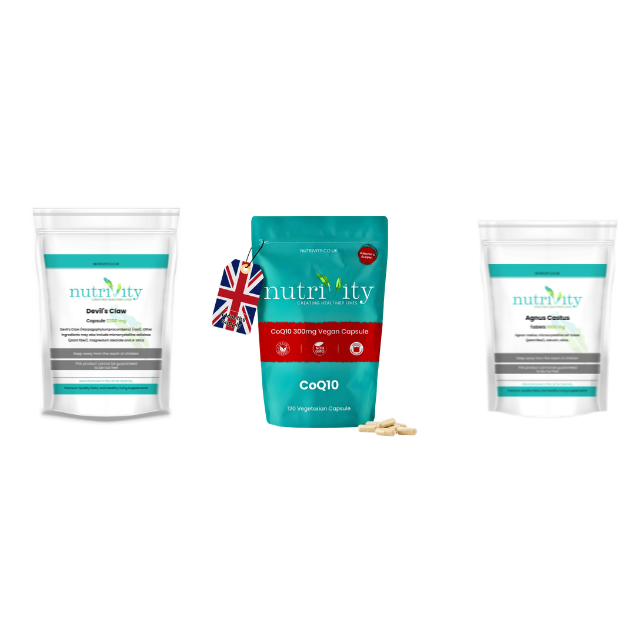
Our hard capsule products — including our CoQ10 300mg, Agnus Castus, Devils Claw, Damiana Extract, Dandelion Root, Cilantro, Sea Buckthorn, Black Cohosh, and Echinacea supplements — use HPMC vegetable capsules. These contain no animal-derived ingredients and are suitable for both halal and vegan consumers.
Our soft gel products — including our Cod Liver Oil & Glucosamine, Castor Oil, Virgin Olive Oil, and Blackcurrant Seed Oil supplements — use soft gel capsules with halal-permissible gelatine. The gelatine used is not pork-derived. These products are halal-suitable but are not vegan.
Our Vitamin D3 + K2 supplement uses compressed vegan tablets, not capsules. There is no gelatine in this product.
Every product page on nutrivity.co.uk lists the full ingredients, including the capsule or tablet shell materials, so you can verify this for any product in our range.
Beyond Gelatine — Other Halal Concerns in Supplements
Gelatine is the most significant halal issue in supplements, but it isn’t the only one. Other ingredients worth checking include:
Vitamin D3 from lanolin: Most vitamin D3 supplements are derived from lanolin, a wax extracted from sheep’s wool. There is ongoing scholarly debate about whether lanolin-derived D3 is halal-permissible. Nutrivity’s Vitamin D3 + K2 uses lichen-derived D3, which is plant-based and removes this question entirely. For more detail on this specific issue, see our guide to whether vitamin D3 is halal.
Alcohol-based herbal extracts: Some herbal supplement manufacturers use ethanol as a solvent during extraction. Even if the final product contains only trace alcohol, this is a concern for observant Muslims. Nutrivity does not use alcohol-based extraction in any of its herbal formulations.
Carmine (E120): A red colouring made from crushed cochineal insects, used in some coated tablets and gummy vitamins. None of our products contain carmine.
Shellac (E904): A resin secreted by lac bugs, sometimes used as a tablet coating. We do not use shellac in any of our products.
Magnesium stearate: A common flow agent in tablet and capsule manufacturing that can be derived from either animal fat or vegetable sources. Our magnesium stearate is always of vegetable origin.

Summary — What to Check Before Buying Supplements as a Muslim Consumer
When buying any supplement in the UK, run through these checks:
1. Does the capsule type say “vegetable capsule” or “HPMC”? If yes, no gelatin concern.
2. If it’s a soft gel or standard capsule, does the label specify the gelatin source? If not, contact the manufacturer directly.
3. For vitamin D3, is the source specified as lichen (plant-based) or lanolin (sheep’s wool derivative)?
4. For herbal supplements, does the manufacturer disclose whether alcohol-based extraction was used?
5. Does the brand list complete ingredients including flow agents like magnesium stearate, and their sources?
Brands that are genuinely committed to halal-suitable manufacturing will be transparent about all of these points without requiring you to ask. If a brand can’t answer these questions, that tells you something too.
Browse Nutrivity’s full halal supplements range with complete ingredient transparency on every product page.
Frequently Asked Questions
Is gelatine in supplements always from pork?
Not always, but in the UK supplement market it most commonly is. Pork gelatin is the cheapest option and the industry default. Unless a brand explicitly states otherwise, undisclosed gelatin in UK supplements should be assumed to be pork-derived.
What is HPMC and is it halal?
HPMC stands for hydroxypropyl methylcellulose. It is a plant-derived polymer made from cellulose, commonly used as a vegetable capsule shell. It contains no animal-derived ingredients and is halal-suitable without qualification. It is also vegan.
Is bovine gelatine halal?
Bovine gelatine can be halal, but only if the cattle were slaughtered according to Islamic requirements and the gelatine production process meets halal standards. Bovine gelatine without a halal certification cannot be assumed to be halal-permissible.
Are all vegetarian supplements halal?
Not necessarily. “Vegetarian” means the product contains no meat or fish, but some vegetarian-labelled supplements may still contain animal-derived ingredients such as shellac, carmine, or lanolin-derived vitamin D3. Halal compliance requires checking beyond the vegetarian label.
Are vegan supplements automatically halal?
In most cases yes, but not always. A vegan supplement avoids all animal-derived ingredients, which covers most halal concerns. However, some vegan herbal supplements use alcohol-based extraction, which may not be acceptable for observant Muslims. At Nutrivity, our vegan products are also halal-suitable because we avoid alcohol-based processing entirely.
Do UK supplement labels have to state the source of gelatine?
No. UK labelling law requires gelatine to be listed as an ingredient, but does not require the animal source to be specified. This is why consumers cannot rely on the ingredient list alone and must seek additional disclosure from the manufacturer.
What capsules does Nutrivity use?
Our hard capsule products use HPMC vegetable capsules — plant-based, halal-suitable, and vegan. Our soft gel products use gelatine capsules with halal-permissible gelatine sourced from non-pork origins. Full ingredients are listed on every product page.