




How Long Does Devils Claw Take to Work? A Realistic Timeline
-
By Chris Jones
Written by Chris Jones, Social Media Manager at Nutrivity with 7+ years in the supplement industry.
How Long Does Devils Claw Take to Work? A Realistic Timeline
This is one of the most commonly asked questions about devils claw, and the honest answer requires distinguishing between different types of pain and different patient expectations. Devils claw is not a fast-acting pain reliever in the way that ibuprofen is. It builds its anti-inflammatory effect through consistent daily dosing over days and weeks — a gradual process that reflects its mechanism of action rather than a limitation of the supplement.
This guide provides a realistic timeline for different conditions, explains why the timeframe varies, and clarifies what to expect at each stage. For a full overview of what devils claw is and how it works, see our guide to what is devils claw. For full product information on Nutrivity’s high-strength vegan devils claw, visit our Devils Claw 2200mg Vegan Capsules product page.
Why Devils Claw Doesn’t Work Like a Painkiller
Conventional painkillers — NSAIDs, paracetamol, codeine — act through mechanisms that produce rapid symptom relief: inhibiting prostaglandin synthesis within an hour, blocking pain receptors, or reducing central pain processing. They provide symptomatic relief that begins and ends with each dose.
Devils claw works differently. Harpagoside’s suppression of COX-2, lipoxygenase, and the NF-κB pathway reduces the inflammatory environment in affected tissues over time. It does not provide immediate prostaglandin inhibition in the way that an ibuprofen dose does — it gradually shifts the inflammatory balance in chronically inflamed tissue. This is why consistent daily dosing is essential and why the research demonstrating meaningful benefit uses treatment periods of 4–12 weeks rather than measuring results over 24–48 hours.
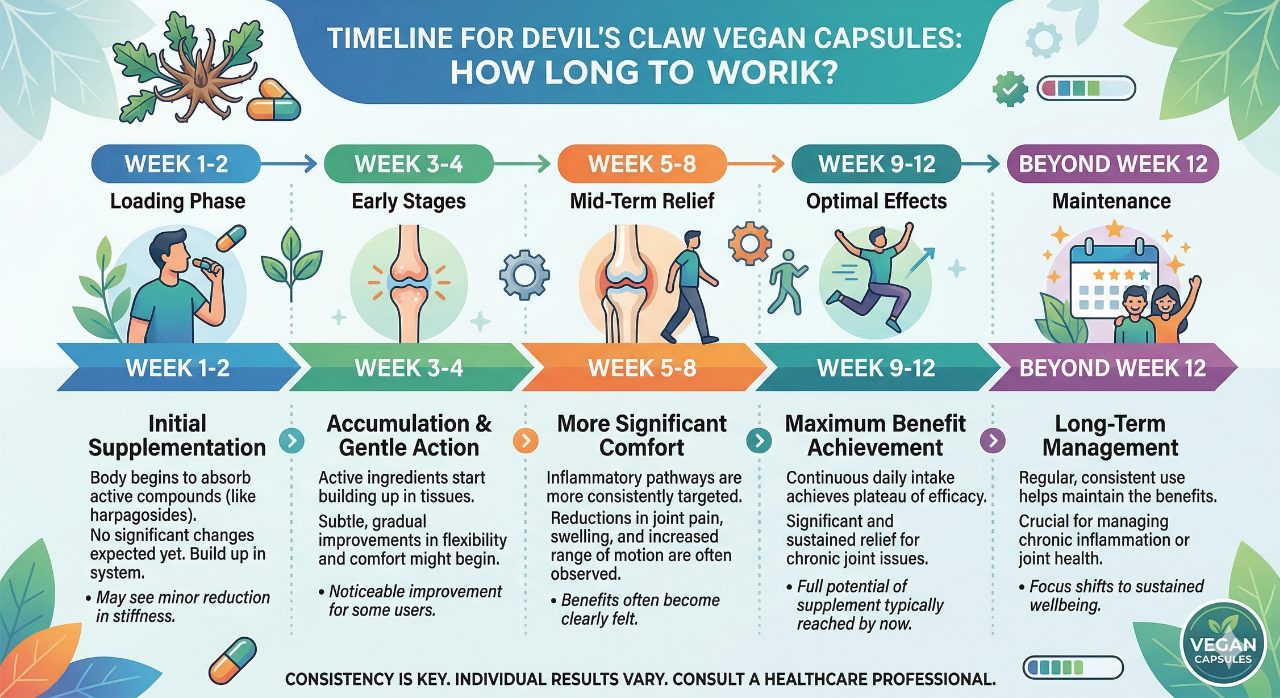
Week by Week Timeline

Week 1–2
Most people do not notice significant change in the first two weeks. Some individuals with acute inflammatory pain or recent onset of symptoms may notice mild early reduction in stiffness or discomfort from around day 7–10, particularly if their condition involves a significant acute inflammatory component. For most people with chronic conditions, this period is primarily about establishing consistent supplementation.
Week 2–4
This is the period where early responders typically begin to notice change — reduced morning stiffness, slightly improved range of motion, or a subtle reduction in the intensity of baseline pain. For back pain specifically, some clinical trials have recorded statistically significant improvements at four weeks. These changes are often gradual and may not feel dramatic — keep a simple symptom diary if you want to track change objectively rather than relying on day-to-day impression.
Week 4–8
For most conditions, 4–8 weeks is the core assessment window. The Chrubasik back pain trial — one of the pivotal clinical trials — ran for four weeks and recorded significant benefit. Most OA trials run for 8–16 weeks. By week 6–8 of consistent daily use, the anti-inflammatory effect should be at or near its established level, and a meaningful assessment of whether devils claw is working can be made.
Week 8–12 and Beyond
For osteoarthritis and other chronic conditions, benefit typically continues to build or consolidate through weeks 8–12. Some people report that the most significant improvements come in the second and third month rather than the first. For chronic conditions requiring ongoing pain management, continued daily supplementation beyond the initial assessment period is appropriate if benefit has been established.
Acute vs Chronic — How the Condition Affects Timeline
Acute exacerbations of chronic back pain tend to respond faster than purely chronic OA — the acute inflammatory component has more rapid dynamics, and response may be noticeable within 2–3 weeks.
Osteoarthritis of hip or knee involves chronic low-grade inflammation in established degenerative joint disease — a more entrenched inflammatory environment that responds more gradually. Expect 8–12 weeks before full assessment.
Muscle pain and general musculoskeletal discomfort may respond more quickly than joint-specific arthritis, particularly where the pain is primarily inflammatory in character.
Dose Matters for Speed of Response
The dose of harpagoside is directly relevant to both the speed and magnitude of response. The Chrubasik trial found that the 100mg harpagoside group showed significantly better results than the 50mg harpagoside group at four weeks — suggesting a dose-response relationship. Supplements providing inadequate harpagoside content will produce slower and weaker responses. For the dosage discussion, see our devils claw dosage UK guide.

Summary — Devils Claw Timeline
Devils claw requires consistent daily dosing for 4–12 weeks before its full anti-inflammatory benefit is established. The timeline varies by condition — acute back pain tends to respond faster, while osteoarthritis requires longer. The key variables are consistency of daily supplementation and adequate harpagoside dose. Setting realistic expectations from the outset — and tracking symptoms week by week rather than day by day — is the most effective approach to assessing whether devils claw is working for you.
For full product information and to purchase, visit Nutrivity’s Devils Claw 2200mg Vegan Capsules product page.
Frequently Asked Questions
How quickly does devils claw work for back pain?
Clinical trials have shown meaningful back pain reduction within four weeks of consistent daily supplementation at 100mg harpagoside. Some people notice early changes within 1–2 weeks, particularly for acute exacerbations of chronic back pain. The full benefit typically establishes over 4–8 weeks.
How long does devils claw take to work for joint pain?
For osteoarthritis of the hip or knee, expect 8–12 weeks of consistent daily use before making a full assessment. Early improvement in stiffness may be noticeable from weeks 3–4. The OA clinical trials showing the most significant results ran for 12–16 weeks.
Should I take devils claw every day?
Yes — consistent daily dosing is essential. Devils claw builds its anti-inflammatory effect through accumulated tissue-level changes, not through acute peak-and-trough dosing. Taking it sporadically or only when in pain will not produce the results seen in the clinical trials.
What if devils claw isn't working after 8 weeks?
If you have taken devils claw consistently at an adequate harpagoside dose for 8 weeks and noticed no meaningful improvement, consider: whether the dose is sufficient, whether your specific condition is within the evidence base for devils claw, and whether other factors (structural issues, nutritional deficiencies, other health conditions) are contributing to your pain. Consult your GP for assessment.
Does devils claw work immediately?
No — devils claw does not provide immediate pain relief in the way an NSAID or paracetamol does. It works through gradual anti-inflammatory modulation over consistent daily use. For immediate acute pain relief, pharmaceutical analgesics are faster. For ongoing daily management of chronic pain, devils claw is most appropriately used as a consistent daily supplement.