
Halal vs Vegan Supplements — What’s the Difference and Does It Matter?
-
By Chris Jones
Halal vs Vegan Supplements — What’s the Difference and Does It Matter?
Halal and vegan are two of the most searched terms in the UK supplement market, and they are frequently confused. Many consumers assume they mean the same thing, or that one automatically satisfies the other. In practice, halal and vegan are distinct standards with different underlying principles, different focuses, and — critically — different areas where they can diverge.
Understanding the relationship between these two standards helps Muslim consumers make more informed purchasing decisions and helps anyone looking for clean, ethically produced supplements understand what they are actually buying.
For a full overview of how Nutrivity approaches halal-suitable manufacturing, visit our halal supplements guide.
What Does Halal Mean in the Context of Supplements?
Halal is an Arabic word meaning “permissible.” In Islamic dietary law, halal defines what Muslims are permitted to consume. For supplements, halal compliance requires that:
No pork-derived ingredients are present. This includes pork gelatine (used in capsule shells), porcine-derived glycerine, and any other ingredient derived from pigs or pigs’ by-products.
Any animal-derived ingredients come from animals slaughtered according to Islamic requirements. Bovine gelatine, for example, can be halal — but only if the cattle were slaughtered in accordance with halal principles and the gelatine production process is free from cross-contamination with non-halal materials.
No alcohol is present or used in processing. Ethanol used as an extraction solvent in herbal supplements is a concern for many observant Muslims, even if no residual alcohol remains in the final product.
No insect-derived ingredients are present. Carmine (E120) from cochineal insects and shellac (E904) from lac bugs are considered impermissible by most Islamic scholars.
Halal is fundamentally a religious standard, rooted in Islamic jurisprudence. It says nothing about animal welfare practices beyond the slaughter method, nothing about environmental impact, and nothing about whether a product is plant-based.
What Does Vegan Mean in the Context of Supplements?
Vegan means the product contains no animal-derived ingredients and no animal by-products whatsoever. In supplement manufacturing, this means:
No gelatine of any kind — whether pork, bovine, or fish-derived. All capsule shells must be plant-based, typically HPMC (hydroxypropyl methylcellulose) or pullulan.
No lanolin-derived vitamin D3. Most vitamin D3 is derived from lanolin, a substance extracted from sheep’s wool. A vegan vitamin D3 must use an alternative source — currently lichen is the only commercially available plant-based source of D3.
No carmine, shellac, beeswax, or other animal-derived additives.
No fish-derived omega-3. Vegan omega-3 supplements use algae-derived DHA and EPA rather than fish oil.
Vegan is an ethical standard, rooted in the principle of avoiding animal exploitation. It says nothing about religious permissibility, nothing about slaughter methods, and nothing about alcohol used in processing.
Where Halal and Vegan Overlap
The two standards share significant common ground, which is why many people treat them as interchangeable. In practice, a supplement that is genuinely vegan will satisfy most halal requirements automatically:
A vegan product uses no animal-derived ingredients, which means it avoids pork gelatine, bovine gelatine, lanolin, carmine, shellac, and beeswax by definition. These cover the majority of the most common halal concerns in supplement manufacturing.
This means that for most standard supplement types — vitamins, minerals, and herbal products in HPMC capsules or plain tablets — a product that is genuinely vegan-certified is also likely to be halal-suitable in practice.
For Muslim consumers who want simplicity, a well-certified vegan supplement from a transparent brand removes most of the guesswork. You can verify the vegan claim and the absence of animal derivatives provides the foundation for halal suitability.
Where Halal and Vegan Diverge
Despite the overlap, there are specific areas where a product can be vegan but not halal, or halal but not vegan. These are the areas that require careful attention.
 Alcohol-Based Extraction — Vegan but Potentially Not Halal
This is the most significant divergence. Some herbal supplement manufacturers use ethanol as a solvent during the extraction of plant compounds. Ethanol is entirely plant-derived — it is produced by fermentation of plant sugars — which means its use is consistent with vegan standards. However, the use of alcohol in processing is a concern for many observant Muslims regardless of whether residual alcohol remains in the final product.
A vegan herbal supplement could therefore use alcohol-based extraction and carry a vegan certification while not meeting the standards of halal-conscious consumers who avoid alcohol in any form.
At Nutrivity, our herbal supplements use alcohol-free extraction across the entire range. This means our vegan products are also halal-suitable — the two standards are not in conflict in our formulations.
Soft Gel Capsules with Halal Gelatine — Halal but Not Vegan
Some supplement formats — particularly oil-based products like cod liver oil, castor oil, and vitamin E — are most practically delivered in soft gel capsules. Soft gel manufacturing requires gelatine as a capsule material; HPMC cannot currently be used for soft gel production at commercial scale.
A soft gel product using halal-certified bovine gelatine or halal-certified fish gelatine is halal-suitable but not vegan — it contains animal-derived gelatine, even though it is not pork-derived.
Nutrivity’s soft gel products — including our Cod Liver Oil & Glucosamine, Castor Oil, Virgin Olive Oil, and Blackcurrant Seed Oil — use halal-permissible gelatine. They are halal-suitable but are not vegan, and they are not listed in our vegan category.
Lanolin-Derived Vitamin D3 — Potentially Halal but Not Vegan
Most vitamin D3 supplements are derived from lanolin, extracted from sheep’s wool. As discussed in our article on whether vitamin D3 is halal, some scholars consider lanolin-derived D3 permissible because the sheep are not harmed in the process. Under this interpretation, lanolin D3 could be halal-suitable. It is, however, not vegan — it is derived from an animal by-product.
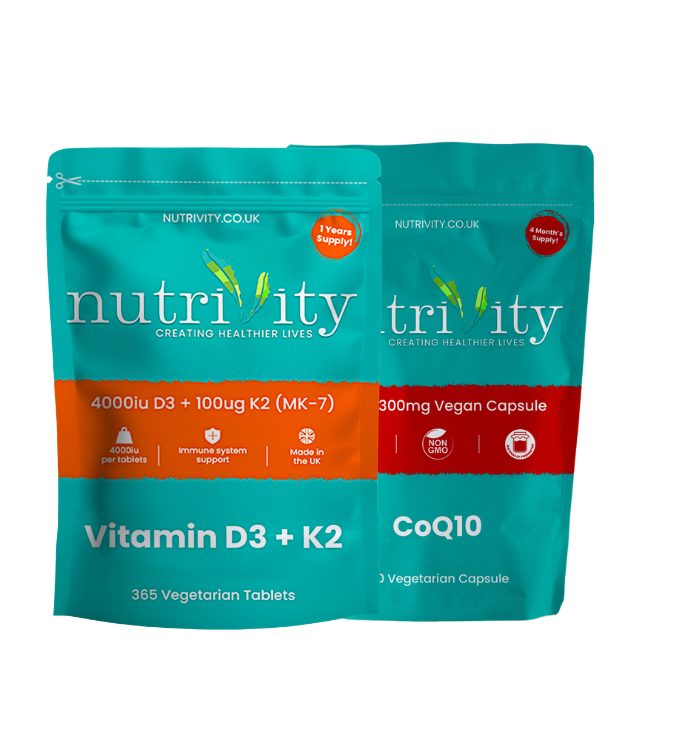
Lichen-derived D3, as used in Nutrivity’s Vitamin D3 4000 IU + K2 MK7, is both vegan and halal-suitable without any qualification from either standard.
Fish-Derived Ingredients — Halal for Most, Not Vegan
Fish and seafood are generally considered halal by most Islamic schools of thought without requiring specific slaughter methods. Fish-derived omega-3, marine collagen, and fish gelatine are therefore halal-suitable for most Muslim consumers. None of these are vegan.
Which Standard Should Muslim Consumers Prioritise?
The honest answer is that halal is the relevant religious standard, and vegan is an additional indicator — not a substitute for halal verification.
Using “vegan” as a proxy for “halal” works well in most cases because the overlap is substantial. But it breaks down specifically on the alcohol extraction issue, which is a genuine divergence that vegan certification does not address.
The most reliable approach is to look for products that are both vegan-suitable and explicitly address the alcohol extraction question. Brands that manufacture for halal-conscious consumers will confirm alcohol-free extraction on their product pages without you needing to ask.
Nutrivity’s vegan products meet both standards simultaneously: HPMC plant-based capsules, no animal-derived ingredients, and alcohol-free extraction throughout the herbal range.
A Practical Decision Framework
When assessing any supplement against halal and vegan standards, work through these questions:
Is the capsule shell plant-based (HPMC)? If yes — no gelatine concern for either standard. If it’s a soft gel or standard capsule with no “vegetable capsule” claim — check gelatine source for halal; treat as non-vegan.
For vitamin D3 — is the source specified as lichen? If yes — suitable for both standards. If no specification — likely lanolin (not vegan; halal status debated).
For herbal supplements — is extraction alcohol-free? This matters for halal; vegan certification does not cover it.
Does the ingredients list contain E120 (carmine) or E904 (shellac)? If yes — not suitable for either halal or vegan.
Is magnesium stearate or glycerine listed? Check source — vegetable-derived is fine for both standards; animal-derived requires halal verification and is not vegan.
 Summary — Two Standards, One Decision
Halal and vegan are not the same standard, but for most practical supplement purchasing decisions, a product that is genuinely vegan and uses alcohol-free extraction will satisfy both. The key is not to use one as a lazy shortcut for the other, but to understand where they diverge — specifically on alcohol extraction for halal, and on halal-certified animal-derived gelatine for vegan — and make purchasing decisions accordingly.
For Muslim consumers who also care about plant-based formulations, the sweet spot is a brand whose vegan products are simultaneously halal-suitable — not by accident, but because the manufacturing standards were designed with both in mind. That is the approach Nutrivity takes across our entire hard capsule range.
Browse our full halal supplements range — every product page lists complete ingredients with full transparency on capsule materials, gelatine sources, and extraction methods.
Frequently Asked Questions
Is vegan the same as halal?
No, but there is significant overlap. A vegan supplement avoids all animal-derived ingredients, which covers most halal concerns. The main gap is alcohol-based extraction in herbal supplements — this is consistent with vegan standards but is a concern for observant Muslims. Halal also permits certain animal-derived ingredients (such as halal-certified gelatine) that vegan standards prohibit.
Can a supplement be halal but not vegan?
Yes. Soft gel capsules containing halal-certified bovine or fish gelatine are halal-suitable but not vegan. Fish oil supplements are halal but not vegan. Any product containing animal-derived ingredients that are permissible under Islamic law — but still animal-derived — will be halal without being vegan.
Can a supplement be vegan but not halal?
Yes, in specific circumstances. A vegan herbal supplement that uses alcohol-based extraction may not meet the standards of observant Muslims who avoid alcohol in any form, even if no residual alcohol remains in the finished product. This is the most practical real-world example of a vegan product that is not halal-suitable for all Muslim consumers.
Should I trust a "vegan" label as evidence of halal suitability?
It is a useful indicator but not sufficient on its own. A vegan product from a transparent brand that also confirms alcohol-free extraction is likely to be halal-suitable in practice. A vegan certification alone, without information about extraction methods, does not confirm full halal compliance.
Does Nutrivity make products that are both halal and vegan?
Yes. All of our hard capsule products use HPMC vegetable capsules, contain no animal-derived ingredients, and use alcohol-free extraction for all herbal formulations. These products meet both vegan and halal standards simultaneously. Our soft gel products use halal-permissible gelatine and are halal-suitable but are not vegan.
Which certification matters more — halal or vegan?
This depends on your priorities. For Muslim consumers, halal certification from a recognised certification body is the relevant religious standard. Vegan certification from an organisation such as The Vegan Society is the relevant ethical standard. For consumers who prioritise both, looking for products that meet both criteria — as Nutrivity’s hard capsule range does — provides the most comprehensive assurance