




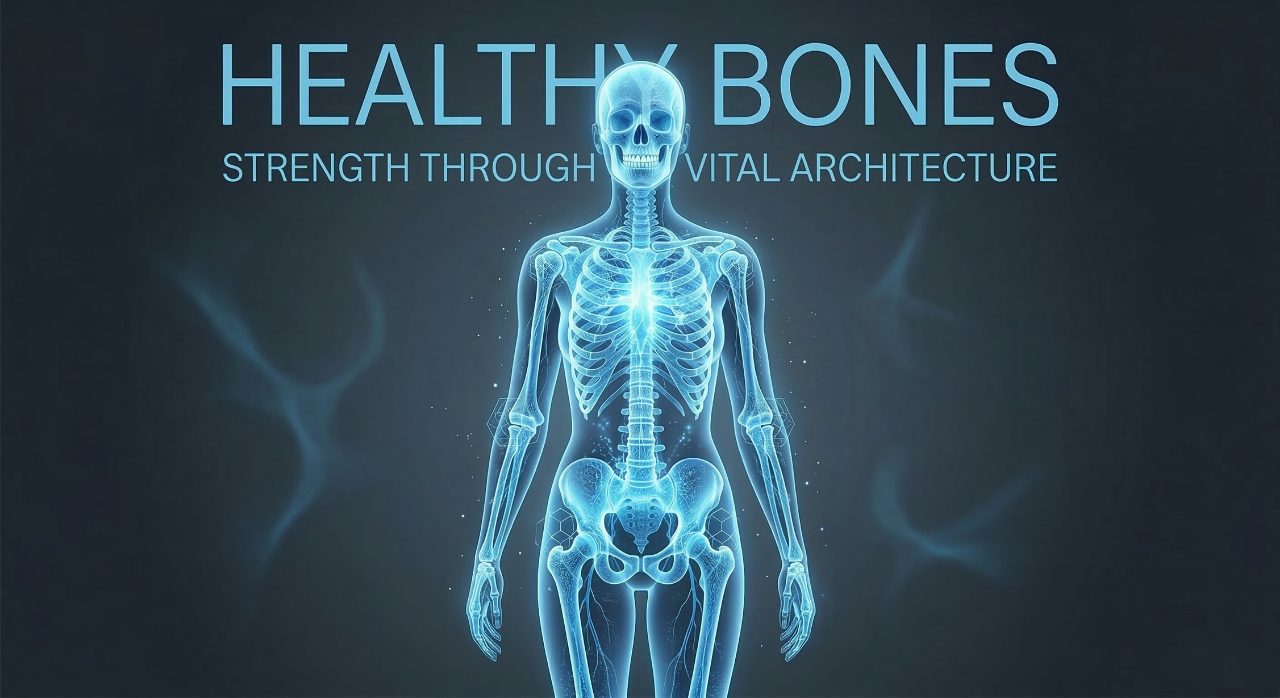
Vitamin D and Bone Health UK — What the Evidence Shows
-
By Chris Jones
Written by Chris Jones, Social Media Manager at Nutrivity with 7+ years in the supplement industry.
Vitamin D and Bone Health UK — What the Evidence Shows
Bone health is one of the most well-established applications for vitamin D supplementation, and one where the consequences of deficiency are most visible and clinically significant. Osteoporosis affects an estimated three million people in the UK, causes over 500,000 fragility fractures annually, and is responsible for significant disability, loss of independence, and healthcare costs. Vitamin D deficiency is one of the most modifiable risk factors for poor bone health — and for UK adults, where sun-driven vitamin D synthesis is unreliable for half the year, supplementation is a straightforward and evidence-based intervention.
This guide covers how vitamin D supports bone health, how K2 MK7 works alongside it, the research on supplementation and fracture prevention, and what UK adults concerned about bone health should know. For a full overview of the D3 + K2 combination, see our guide to what is vitamin D3 + K2. For full product information on Nutrivity’s D3 + K2 tablets, visit our Vitamin D3 4000 IU + K2 MK7 product page.
How Vitamin D Supports Bone Health
Vitamin D’s role in bone health is primarily through calcium absorption. Without adequate vitamin D, only 10–15% of dietary calcium is absorbed from the gut. With sufficient vitamin D, absorption rises to 30–40%. Calcium is the primary mineral in bone, and its adequate absorption is fundamental to bone mineralisation — the process by which calcium and phosphate are deposited into the bone matrix to create the hardened, load-bearing structure of the skeleton.
Beyond calcium absorption, vitamin D has direct effects on bone cells. It regulates osteoblast (bone-forming cell) activity and influences the balance between bone formation and bone resorption. Vitamin D receptors are present in both osteoblasts and osteoclasts (bone-resorbing cells), and vitamin D signalling influences the activity of both. Vitamin D deficiency tips this balance toward bone loss.
Vitamin D also plays a role in muscle strength and neuromuscular function — which affects bone health indirectly through fall prevention. Falls are the primary cause of fragility fractures in older adults, and muscle weakness associated with vitamin D deficiency increases fall risk. Research has shown that vitamin D supplementation reduces fall risk in older adults — an important benefit for fracture prevention that goes beyond the direct bone mineralisation effect.
How Vitamin D3 and K2 Work Together for Bones
 Vitamin D3 drives calcium absorption — essential for bone mineralisation. Vitamin K2 activates osteocalcin, the protein that deposits calcium into bone matrix. Without K2, the calcium absorbed under vitamin D’s influence cannot be efficiently incorporated into bone. This is the mechanistic basis for the D3 + K2 combination for bone health specifically.
Research has shown that K2 supplementation with MK7 improves bone mineral density and bone strength markers in postmenopausal women — a population at high risk of osteoporosis due to oestrogen-driven acceleration of bone loss after menopause. A three-year RCT published in Osteoporosis International found significant improvements in bone strength and density in women taking 180mcg of MK7 daily compared to placebo. For a full breakdown of K2 MK7 and its mechanisms, see our guide to vitamin K2 MK7 benefits UK.
The D3 + K2 combination addresses bone health through two complementary mechanisms: D3 ensures calcium is available, K2 ensures that calcium is deposited where it is needed. Neither alone is as effective as both together for optimising bone mineralisation.
Who Is Most at Risk of Poor Bone Health in the UK?
Postmenopausal women. Oestrogen plays a critical role in maintaining bone density by inhibiting osteoclast activity. The rapid oestrogen decline after menopause removes this inhibition, leading to accelerated bone resorption. In the first five years after menopause, women can lose 2–3% of bone density annually. Adequate vitamin D and K2 status are important components of bone health management through this period alongside other interventions.
Older adults generally. Bone density loss accelerates with age in both men and women. Vitamin D synthesis efficiency in skin declines with age, dietary calcium and vitamin D intake often falls, and renal activation of vitamin D is less efficient. Falls risk also increases with age, making the muscle-protective benefits of vitamin D particularly relevant.
People with vitamin D deficiency. Chronic vitamin D deficiency directly impairs bone mineralisation. Adults with established deficiency — common in the UK, particularly in winter and in at-risk groups — have measurably lower bone density than vitamin D-sufficient adults.
People with limited dairy intake. Dairy products are the primary dietary calcium source for most UK adults. Vegans and those with lactose intolerance or dairy avoidance need to ensure calcium intake from other sources (fortified plant milks, leafy greens, legumes, nuts) and adequate vitamin D to maximise calcium absorption from non-dairy sources.
What the Research Shows on Vitamin D and Fracture Prevention
The evidence on vitamin D and fracture prevention is more nuanced than a simple “vitamin D prevents fractures” statement, and it is worth being precise about what the research actually supports.
In vitamin D-deficient older adults, supplementation at adequate doses significantly reduces fracture risk. The effect is most pronounced in people with established deficiency and is less clear in people who are already vitamin D-sufficient at baseline. This is consistent with the biology — correcting a deficiency that is impairing bone mineralisation would be expected to reduce fracture risk; adding more vitamin D to already-adequate levels may not.
For fall prevention — which is relevant to fracture risk — multiple meta-analyses have found that vitamin D supplementation reduces fall frequency in older adults, with effects most pronounced at doses of 700 IU or above and in people with deficiency at baseline.
The dose for bone health benefit in research has generally been 800–2000 IU daily. At 4000 IU, Nutrivity’s formulation is at the higher end and is appropriate for adults with established deficiency, limited sun exposure, or those wanting to optimise rather than merely maintain vitamin D status. For detailed dosage guidance, see our vitamin D dosage UK guide.
Summary — Vitamin D and Bone Health in the UK
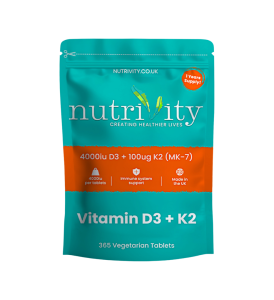
Vitamin D is fundamental to bone health through calcium absorption and bone cell regulation, and vitamin K2 MK7 is its essential partner in ensuring that absorbed calcium reaches bone rather than soft tissue. For UK adults — particularly postmenopausal women, older adults, and those with established deficiency — adequate D3 and K2 status is one of the most important and modifiable aspects of long-term bone health. At 4000 IU D3 and 100mcg MK7, taken daily with food, Nutrivity’s Vitamin D3 + K2 tablet provides the nutrients at the doses used in the research.
For full product information and to purchase, visit Nutrivity’s Vitamin D3 4000 IU + K2 MK7 product page.
Frequently Asked Questions
Does vitamin D strengthen bones?
Yes — through two mechanisms. Vitamin D increases calcium absorption from the gut, providing the mineral building blocks for bone mineralisation. It also directly regulates bone cell activity. Vitamin D deficiency is associated with impaired bone mineralisation, reduced bone density, and increased fracture risk. Supplementation in deficient individuals improves bone health markers and reduces fracture risk.
Should I take vitamin D and K2 for bone health?
Yes — the combination addresses bone mineralisation more completely than either alone. Vitamin D3 increases calcium absorption. Vitamin K2 MK7 activates osteocalcin, which deposits calcium into bone matrix. Without adequate K2, the calcium absorbed under D3’s influence cannot be optimally incorporated into bone. The D3 + K2 combination is the evidence-based approach to optimising bone mineralisation.
What is the best supplement for bone density in the UK?
Vitamin D3 (at 1000–4000 IU daily) with vitamin K2 MK7 (at 100mcg daily) is the most evidence-based supplement combination for bone density support. Calcium supplementation in people with adequate dietary calcium is less clearly beneficial and some evidence suggests potential cardiovascular risk from high-dose calcium supplements — K2 is more important than additional calcium for most adults with reasonable dietary intake.
Can vitamin D prevent osteoporosis?
Vitamin D is one of several factors that contribute to bone density maintenance and osteoporosis prevention. It cannot prevent osteoporosis on its own, but adequate vitamin D status is necessary for normal bone mineralisation, and deficiency is a risk factor for poor bone density. Alongside adequate calcium intake, weight-bearing exercise, not smoking, and moderate alcohol consumption, vitamin D and K2 supplementation contributes to a comprehensive bone health strategy.
Is Nutrivity's D3 + K2 good for bone health?
Yes. Nutrivity’s Vitamin D3 4000 IU + K2 MK7 provides 4000 IU of lichen-derived D3 and 100mcg of MK7 K2 per tablet — both nutrients at doses supported by the bone health research, in a single daily vegan-suitable, halal-suitable tablet.