





How Long Does Agnus Castus Take to Work? A Realistic Timeline
-
By Chris Jones
Written by Chris Jones, Social Media Manager at Nutrivity with 7+ years in the supplement industry.
How Long Does Agnus Castus Take to Work? A Realistic Timeline
This is the question most women ask before starting agnus castus, and the honest answer requires managing expectations clearly. Agnus castus is not a fast-acting supplement. It does not provide acute PMS symptom relief in the way that ibuprofen relieves period pain or an antihistamine relieves hay fever. It works by influencing pituitary signalling over multiple menstrual cycles — and the timeline for seeing meaningful results reflects this mechanism.
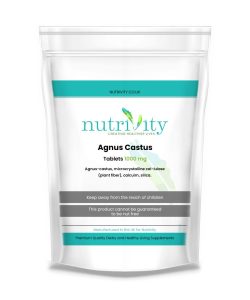
This guide covers what to realistically expect at each stage, what signs of progress look like, and when it makes sense to reassess. For a full overview of how agnus castus works, see our guide to what is agnus castus. For full product information on Nutrivity’s agnus castus tablets, visit our Agnus Castus 1000mg Vegan Tablets product page.
Why Agnus Castus Takes Time
Agnus castus works through pituitary dopamine receptors to suppress prolactin and indirectly support the hormonal balance of the menstrual cycle. This is a regulatory mechanism — it influences the signalling environment of the cycle rather than providing a hormone or blocking one acutely. For this regulation to translate into observable changes in symptoms, the cycle itself needs to respond and adapt — which takes time, measured in cycles rather than days.
This is why all clinical trials on agnus castus for PMS use treatment periods of three or more menstrual cycles. The ZE 440 trial — the pivotal study — ran for three cycles and found significant symptom improvement at that endpoint. Studies that have run longer (up to six months) have generally found that benefit continues to accumulate with extended use.
A Realistic Timeline — What to Expect Month by Month
 Month 1 (Cycle 1)
Most women do not notice significant changes in the first cycle. You are establishing the baseline of consistent daily supplementation, and the pituitary signalling changes that agnus castus drives have not yet had time to influence a full cycle’s hormonal environment. Some women report no change. A minority report mild initial symptom changes — either slight improvement or, rarely, a temporary worsening in the first cycle that resolves subsequently. Do not assess effectiveness at this stage.
Month 2 (Cycle 2)
Some women begin to notice changes in cycle 2 — often subtle at first. Breast tenderness may be slightly reduced, mood changes in the premenstrual phase may be less pronounced, or the cycle length may begin to normalise if irregularity was an issue. These are early signals that the mechanism is beginning to have an effect. Do not stop at this point even if change is minimal — cycle 3 is where the clinical evidence shows the clearest response.
Month 3 (Cycle 3)
This is the minimum assessment point in clinical research and the point at which most women who respond to agnus castus notice meaningful symptom improvement. The ZE 440 trial found that 52% of women in the agnus castus group rated their overall PMS as “much better” or “very much better” at three months. If you have used agnus castus consistently through three full cycles and noticed no change whatsoever, it is reasonable to reassess whether it is the right intervention for your specific hormonal pattern.
Months 4–6
For women who do respond, benefit typically continues to accumulate with extended use. Some women report that the most significant improvements come in months 4–6 rather than at the three-month mark. THR-licensed agnus castus products state that if symptoms persist or worsen after three months, you should consult a healthcare practitioner — but this does not mean stopping is necessary if you are seeing partial improvement.
Signs That Agnus Castus Is Working
The changes to look for are gradual rather than dramatic. PMS symptom scores across cycles are the most useful measure — tracking symptoms each cycle in a simple diary allows you to compare cycle 1 against cycle 3 objectively rather than relying on memory. Signs of response include reduced breast tenderness in the premenstrual phase, less pronounced mood changes or emotional lability, reduced bloating, more regular cycle length, and improved overall premenstrual wellbeing.
Dose and Consistency — Why They Matter for Timing
Agnus castus must be taken every day continuously — not just in the premenstrual phase. The pituitary signalling mechanism operates throughout the cycle, not only in the symptomatic phase. Missing doses or taking breaks within the three-month assessment period reduces the likelihood of observing a response and effectively resets the regulatory process. For the full dosage discussion, see our agnus castus dosage UK guide.
Summary — Agnus Castus Timeline
Agnus castus requires consistent daily use for a minimum of three menstrual cycles before effectiveness can be fairly assessed. The mechanism — pituitary dopamine receptor activity and prolactin suppression — builds over multiple cycles. Most clinical trial evidence demonstrates significant benefit at three months, with continued improvement in extended use. Setting realistic expectations from the outset — and tracking symptoms cycle by cycle rather than day by day — is the most useful approach to assessing whether agnus castus is working for you.
For full product information and to purchase, visit Nutrivity’s Agnus Castus 1000mg Vegan Tablets product page.
Frequently Asked Questions
How long does agnus castus take to work for PMS?
Clinical research uses three menstrual cycles (approximately three months) as the standard assessment period. Most women who respond to agnus castus notice meaningful symptom improvement by the end of cycle 3. Some notice subtle changes from cycle 2 onwards. The first cycle typically shows little noticeable change as the pituitary signalling mechanism establishes its effect.
Can agnus castus work faster than three months?
Some women report changes from the second cycle, particularly for symptoms like breast tenderness and mood changes. However, the evidence-based assessment point is three months — assessing effectiveness before this may lead to premature discontinuation before the full effect has developed.
What if agnus castus hasn't worked after three months?
If you have taken agnus castus consistently through three complete menstrual cycles at the recommended dose and noticed no improvement, it is reasonable to consider that the specific hormonal mechanism agnus castus addresses may not be the primary driver of your symptoms. Consult your GP — blood testing for prolactin, thyroid function, and hormonal profiles can help identify whether a different approach is more appropriate.
Should I take agnus castus every day or just before my period?
Every day — this is important. Agnus castus works through pituitary signalling that operates throughout the menstrual cycle, not only in the premenstrual phase. Taking it only before your period is inconsistent with the evidence-based dosing protocol and is unlikely to produce the results seen in clinical trials.
How long should I take agnus castus for?
Most women who respond continue taking agnus castus for as long as it is providing benefit, typically through their reproductive years where PMS or cycle irregularity is an ongoing concern. There is no established maximum duration — clinical research has followed women for up to six months without safety concerns, and longer-term use in traditional medicine has a long history. Reassess periodically with your GP.