





Cod Liver Oil for Joint Health UK
-
By Chris Jones
Written by Chris Jones, Social Media Manager at Nutrivity with 7+ years in the supplement industry.
Cod Liver Oil for Joint Health UK — What the Evidence Shows
Cod liver oil has been used for joint health in Britain for well over two centuries — long before clinical trials, omega-3 fatty acids, or prostaglandins were identified. The fact that it remains one of the most popular joint supplements in the UK today reflects both its cultural familiarity and a genuine evidence base that has developed considerably since its days as a Victorian health tonic. Understanding the specific mechanisms through which cod liver oil benefits joint health — and what the clinical research actually demonstrates — helps UK adults make informed decisions about whether it belongs in their daily supplement routine.
This guide covers the specific mechanisms through which cod liver oil supports joint health, what the clinical research shows, and how it fits into a comprehensive joint support approach alongside glucosamine. For a full overview of both ingredients and how they work together, see our guide to what is cod liver oil and glucosamine. For full product information, visit our Cod Liver Oil and Glucosamine product page.
The Omega-3 Mechanism — How It Helps Joints
The primary mechanism through which cod liver oil benefits joint health is its omega-3 fatty acid content — specifically EPA (eicosapentaenoic acid) and DHA (docosahexaenoic acid). These long-chain polyunsaturated fatty acids are incorporated into cell membranes throughout the body, including in synovial membrane cells and chondrocytes (cartilage cells) in joints. The process of incorporation takes weeks of consistent daily supplementation — which is why cod liver oil is a long-term daily supplement rather than an acute pain remedy.
Once incorporated into cell membranes, EPA and DHA competitively inhibit the metabolism of arachidonic acid — an omega-6 fatty acid that is the precursor to the most pro-inflammatory prostaglandins (PGE2) and leukotrienes. In a diet with a high omega-6 to omega-3 ratio — typical of Western diets — arachidonic acid dominates cell membranes, and the inflammatory signalling cascade it generates is highly active. By displacing arachidonic acid in cell membranes, EPA and DHA shift the balance of eicosanoid production away from strongly pro-inflammatory mediators toward less inflammatory alternatives. The result is a measurable reduction in the prostaglandin and leukotriene-driven inflammation that causes joint pain, swelling, and stiffness.
This mechanism is gradual rather than immediate — unlike an NSAID that inhibits prostaglandin synthesis within 30–60 minutes of a dose, the omega-3 anti-inflammatory shift requires 4–8 weeks of consistent daily supplementation to establish itself in cell membranes. This is why people who take cod liver oil expecting immediate pain relief similar to ibuprofen are often disappointed in the first few weeks, and why consistent long-term use is where the clinical evidence demonstrates benefit.
Vitamin D and Joint Health
Cod liver oil is one of the very few natural food sources that contains significant quantities of vitamin D alongside omega-3 — a combination that makes it uniquely relevant for joint health beyond the omega-3 mechanism alone.
Vitamin D receptors are present in synovial membrane cells, chondrocytes, and osteoblasts throughout the musculoskeletal system. Low vitamin D status is consistently associated with increased joint pain sensitivity in observational research — people with deficient or insufficient vitamin D levels report higher pain scores for the same degree of joint degeneration compared to those with adequate levels. The mechanism involves vitamin D’s role in modulating the sensitivity of pain receptors and its direct anti-inflammatory effects in joint tissue through the vitamin D receptor signalling pathway.
Beyond pain sensitivity, vitamin D supports muscle strength and neuromuscular function — both critically relevant to joint health. Weak muscles around a joint increase the mechanical stress on the joint surface itself. Vitamin D deficiency is associated with reduced muscle strength, particularly in the proximal muscle groups of the thighs and upper arms that provide crucial support for the knee and hip joints. Supplementing with cod liver oil addresses both the omega-3 anti-inflammatory mechanism and the vitamin D musculoskeletal support mechanism in a single daily product.
For UK adults, the vitamin D benefit of cod liver oil is particularly relevant given that approximately one in five adults has low vitamin D levels, and the UK’s northern latitude makes sun-driven vitamin D synthesis impossible for around six months of the year. For most people managing joint conditions in the UK, ensuring adequate vitamin D through cod liver oil addresses two significant nutritional needs simultaneously.
What the Clinical Research Shows
The clinical evidence for cod liver oil in joint health is more developed than for most natural joint supplements, with well-designed randomised controlled trials producing meaningful results.
The most significant piece of direct evidence is the Cardiff University cod liver oil trial, published in the peer-reviewed journal Rheumatology. The trial examined cod liver oil capsules versus placebo in patients with hip and knee osteoarthritis over 24 weeks. The cod liver oil group showed significant reductions in the enzymes responsible for cartilage matrix breakdown — aggrecanases and collagenases — compared to placebo. These enzymes are responsible for the progressive degradation of cartilage in OA, and their reduction suggests that cod liver oil may slow the structural progression of OA, not merely reduce symptomatic pain. Pain scores were also significantly reduced in the cod liver oil group at the trial endpoint.
For rheumatoid arthritis — the autoimmune form where immune-driven joint inflammation is the primary problem — the evidence for omega-3 supplementation is particularly robust. Multiple randomised controlled trials have demonstrated that fish oil and cod liver oil supplementation reduces morning stiffness duration, tender joint count, and the requirement for NSAIDs in RA patients. Several systematic reviews and meta-analyses confirm these effects across multiple populations. The effect size for morning stiffness reduction is particularly consistent — a 2012 meta-analysis in Annals of the Rheumatic Diseases found significant improvements across all key RA outcome measures in omega-3 supplementation groups versus placebo. The mechanism is the same prostaglandin and leukotriene reduction described above — particularly relevant in RA where inflammatory signalling is chronically elevated.
For non-specific joint discomfort and age-related joint wear without a formal RA or OA diagnosis, the evidence is primarily from population studies. Multiple large cohort studies have found associations between higher habitual omega-3 intake and lower rates of joint pain, stiffness, and reported mobility problems in older adults — consistent with the mechanistic evidence but not confirming causation.
Cod Liver Oil vs Standard Fish Oil for Joint Health
For joint health specifically, cod liver oil has a meaningful advantage over standard fish oil: vitamin D. As discussed above, vitamin D status independently affects joint pain sensitivity and muscle strength around joints. Standard fish oil provides omega-3 but no vitamin D. Cod liver oil provides both.
There is also a practical dosing consideration. Standard concentrated fish oil products often provide higher EPA and DHA per capsule than cod liver oil — making them more efficient for achieving very high therapeutic omega-3 doses. However, for the general joint health maintenance doses that most people are using — in the range of 400–800mg EPA+DHA daily — cod liver oil provides adequate omega-3 alongside the vitamin D and vitamin A benefits that fish oil lacks. For a full comparison, see our guide to cod liver oil vs fish oil.
Cod Liver Oil and Glucosamine Together
Cod liver oil’s anti-inflammatory omega-3 mechanism is complementary to glucosamine’s structural cartilage support mechanism in a way that makes the combination clinically more useful than either ingredient alone.
Osteoarthritis — the most common joint condition in the UK — involves both an inflammatory component (prostaglandin-driven pain and stiffness in the synovial tissue) and a structural component (progressive cartilage matrix degradation reducing the joint’s cushioning capacity). Cod liver oil addresses the inflammatory component directly through the omega-3 mechanism. Glucosamine sulphate addresses the structural component by providing substrate for glycosaminoglycan synthesis in cartilage. Neither mechanism is redundant with the other — they operate through entirely different pathways at different levels of joint biology.
This complementary approach is consistent with how rheumatologists and nutritional medicine practitioners approach OA management: addressing both the inflammatory pain that limits function day to day and the structural degradation that drives long-term progression. For the evidence on glucosamine specifically, see our guide to glucosamine for joints UK. For the arthritis-specific evidence on the combination, see our guide to cod liver oil and glucosamine for arthritis UK.
How Long Before Cod Liver Oil Helps Joints?
Most people notice some reduction in joint stiffness and discomfort within 4–8 weeks of consistent daily cod liver oil supplementation. This reflects the timeline for meaningful changes in cell membrane fatty acid composition — the biological prerequisite for the omega-3 anti-inflammatory shift. Some individuals with significant inflammation may notice early changes at 2–3 weeks; others with more chronic, established inflammation may take 6–8 weeks to notice meaningful benefit.
The key is consistency. Taking cod liver oil daily without breaks produces progressive improvements in the omega-3 to omega-6 ratio in cell membranes. Stopping and restarting frequently prevents this gradual shift from establishing and is why people who take cod liver oil erratically often report no benefit.

Summary — Cod Liver Oil for Joint Health
Cod liver oil supports joint health through two primary and distinct mechanisms: omega-3 fatty acids EPA and DHA that reduce the prostaglandin and leukotriene-driven inflammation causing joint pain and stiffness, and vitamin D that supports muscle function, bone density, and joint pain sensitivity. The clinical evidence is more developed than for most natural joint supplements — the Cardiff University OA trial demonstrating reductions in cartilage degradation enzymes, and multiple meta-analyses confirming omega-3 effectiveness for rheumatoid arthritis, provide a meaningful evidence base. Combined with glucosamine sulphate for structural cartilage support, cod liver oil forms one half of the most comprehensive natural approach to daily joint health available in the UK.
For full product information and to purchase, visit Nutrivity’s Cod Liver Oil and Glucosamine product page.
Frequently Asked Questions
Does cod liver oil help with joint pain?
Yes — cod liver oil’s omega-3 fatty acids (EPA and DHA) reduce the production of pro-inflammatory prostaglandins and leukotrienes that drive joint pain and stiffness. Clinical research has found reductions in cartilage degradation enzymes and pain scores in osteoarthritis patients taking cod liver oil versus placebo.
How long does cod liver oil take to work for joints?
Omega-3 fatty acids build their anti-inflammatory effect gradually as they are incorporated into cell membranes. Meaningful reduction in joint stiffness and discomfort typically develops over 4–8 weeks of consistent daily supplementation. Full benefit is usually established at 8–12 weeks.
Is cod liver oil better than fish oil for joints?
For joint health specifically, cod liver oil offers the advantage of providing vitamin D alongside omega-3. Vitamin D deficiency is associated with increased joint pain sensitivity and reduced muscle strength around joints. Standard fish oil provides omega-3 but no vitamin D. Combined with glucosamine, cod liver oil addresses joint health more comprehensively than fish oil alone.
How much cod liver oil should I take for joint pain?
One softgel daily with food is the standard and clinically used dose. The Cardiff University OA trial that found reductions in cartilage degradation enzymes used daily cod liver oil supplementation at standard capsule doses. Do not exceed the recommended dose.
Can I take cod liver oil with arthritis medication?
Cod liver oil can be taken alongside most arthritis medications, but if you take warfarin or anticoagulant medication, inform your GP before starting — omega-3 has mild antiplatelet effects. If you take any prescribed arthritis medication, always inform your GP and pharmacist of all supplements you take.
Is Nutrivity's cod liver oil and glucosamine good for joints?
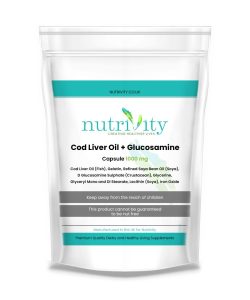
Yes — Nutrivity’s combined formula provides 400mg cod liver oil, 400mg omega-3 fish oil, and 400mg glucosamine sulphate per softgel, addressing joint health through both the anti-inflammatory omega-3 mechanism and glucosamine’s cartilage structural support. UK manufactured, GMP certified, halal suitable.