





Best Time to Take Vitamin D3 — A Practical UK Guide
-
By Chris Jones
Written by Chris Jones, Social Media Manager at Nutrivity with 7+ years in the supplement industry.
Best Time to Take Vitamin D3 — A Practical UK Guide
Vitamin D3 is one of the most commonly asked-about supplements for timing. Unlike some supplements where timing significantly affects the experience or efficacy, vitamin D3 does not produce an immediate effect — it works by gradually building tissue levels over weeks. The timing questions that actually matter for vitamin D3 are about maximising absorption consistently, not about feeling a particular way at a particular time of day.
This guide covers the evidence on vitamin D3 timing — with food versus fasting, morning versus evening, and alongside other supplements — and provides practical guidance for building a consistent daily routine. For a full understanding of vitamin D dosage, see our vitamin D dosage UK guide. For full product information on Nutrivity’s D3 + K2 tablets, visit our Vitamin D3 4000 IU + K2 MK7 product page.
The Most Important Rule — Take Vitamin D3 With Food
Vitamin D3 is a fat-soluble vitamin. Like vitamins A, E, and K, it requires dietary fat in the gut for proper absorption into the bloodstream. Research comparing vitamin D3 absorption taken with a fat-containing meal versus fasting has consistently found substantially higher absorption in the fed state. One study found that taking vitamin D3 with a fat-containing meal increased absorption by approximately 50% compared to fasting.
The practical guidance is to take vitamin D3 with the meal most likely to contain fat — typically lunch or dinner for most people. A meal does not need to be high in fat for adequate vitamin D absorption — a moderate fat content from olive oil, nuts, avocado, oily fish, eggs, or dairy is sufficient to meaningfully improve bioavailability.
This same principle applies to vitamin K2, which is also fat-soluble. Taking the D3 + K2 combination with a fat-containing meal maximises the absorption of both nutrients simultaneously.
Morning vs Evening — Does It Matter?

For most people, there is no clinically meaningful difference between taking vitamin D3 in the morning versus the evening, provided it is taken with food containing fat. Vitamin D does not have a circadian-dependent mechanism of action — it is not a sleep hormone or a cortisol regulator. Its effects on calcium absorption, immune function, and bone mineralisation operate continuously at the cellular level regardless of time of day.
One caveat worth noting: some people report difficulty sleeping when they take vitamin D3 late in the evening. This is not consistently demonstrated in clinical research and appears to be an individual response. If you notice this, taking vitamin D3 with breakfast or lunch rather than dinner resolves it without affecting efficacy.
The practical recommendation is to take vitamin D3 at whichever meal you are most likely to remember consistently. Consistency over weeks and months is far more important than the specific time of day.
Taking D3 and K2 Together
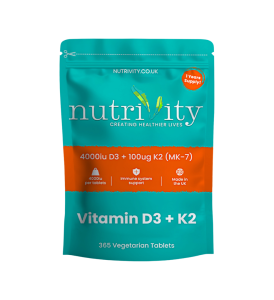
Vitamin D3 and K2 MK7 are both fat-soluble and both benefit from co-administration with food. Taking them together at the same meal is entirely appropriate and convenient — there is no interaction between the two that would make separation necessary. Nutrivity’s Vitamin D3 4000 IU + K2 MK7 combines both in a single tablet, making the timing question moot — one tablet, one meal, once daily.
Vitamin D3 and Other Supplements — Timing Considerations
Vitamin D3 and K2 can be taken alongside most other supplements without timing concerns. Taking them with omega-3 supplements is particularly practical — omega-3 products contain fat themselves and therefore improve D3 and K2 absorption while providing their own cardiovascular and anti-inflammatory benefits. CoQ10, another fat-soluble compound, can also be taken at the same meal.
Calcium supplements, if you take them, should ideally not be taken at the same time as vitamin D3 and K2 if you are taking high-dose calcium — though for most people with reasonable dietary calcium intake, calcium supplementation is not necessary and the interaction is minor. Magnesium is involved in vitamin D metabolism and is best taken in the evening with food if you take it separately.
Summary — When to Take Vitamin D3
The single most important timing rule for vitamin D3 is to take it with a fat-containing meal. Morning or evening makes no meaningful difference for most people — choose the meal that fits your daily routine and take it consistently every day. Nutrivity’s Vitamin D3 4000 IU + K2 MK7 combines both nutrients in a single daily tablet, making the routine as simple as possible. The variable that matters most is not when you take it — it is whether you take it every day, consistently, throughout the UK winter and beyond.
For full product information and to purchase, visit Nutrivity’s Vitamin D3 4000 IU + K2 MK7 product page.
Frequently Asked Questions
Should I take vitamin D3 in the morning or at night?
Either is fine for most people — the key variable is taking it with a fat-containing meal, not the time of day. Choose whichever meal you are most consistent with. If evening D3 causes sleep disturbance, switch to morning or lunchtime.
Can I take vitamin D3 on an empty stomach?
You can, but absorption will be significantly lower. Vitamin D3 is fat-soluble and requires dietary fat in the gut for proper absorption. Taking it with a fat-containing meal improves absorption by around 50% compared to fasting. Always take vitamin D3 with food.
Should I take D3 and K2 together?
Yes — they can and should be taken together. Both are fat-soluble and benefit from food co-administration. Taking the D3 + K2 combination with one meal once daily is the most practical approach. Nutrivity’s Vitamin D3 4000 IU + K2 MK7 combines both in a single tablet for maximum convenience.
How long does vitamin D3 take to work?
Blood vitamin D levels begin rising within days of starting supplementation, but meaningful increases in serum 25(OH)D typically require 4–8 weeks of consistent daily supplementation. The biological effects on bone mineralisation, immune function, and other outcomes follow from sustained adequate levels rather than a single dose. Consistency over months is what produces the health outcomes associated with adequate vitamin D status.
Can I take vitamin D3 with other supplements?
Yes. Vitamin D3 and K2 are compatible with most supplements. Taking them alongside omega-3 is particularly practical as omega-3 provides fat that improves D3 absorption. CoQ10, also fat-soluble, can be taken at the same meal. If you take warfarin, note that K2 interacts with anticoagulation — inform your GP before starting K2 supplementation.