




Agnus Castus for Hormonal Balance — How It Works and Who It Helps
-
By Chris Jones
Written by Chris Jones, Social Media Manager at Nutrivity with 7+ years in the supplement industry.
Agnus Castus for Hormonal Balance — How It Works and Who It Helps
“Hormonal balance” is one of the most overused phrases in the women’s supplement market, applied to products with little mechanistic justification. Agnus castus is an exception — its role in hormonal regulation is specific, well-understood, and backed by clinical research. It does not directly provide hormones or block them. It influences the pituitary gland’s signalling, which has downstream effects on the hormonal environment of the menstrual cycle.
This guide covers the specific hormonal mechanisms of agnus castus, what it means in practice for women’s health, and who is most likely to benefit. For a full overview of what agnus castus is, see our guide to what is agnus castus. For full product information, visit our Agnus Castus 1000mg Vegan Tablets product page.
The Hormonal Mechanism — Prolactin and the Pituitary
Agnus castus’s primary hormonal mechanism operates through the pituitary gland — the master hormonal regulator at the base of the brain that coordinates the body’s hormonal output. Specifically, agnus castus acts on dopamine D2 receptors in the pituitary’s anterior lobe, mimicking the action of dopamine and thereby suppressing the release of prolactin.
Prolactin is a hormone with multiple functions, including breast milk production in lactating women. In non-lactating women, chronically elevated prolactin (hyperprolactinaemia) disrupts the signalling cascade that regulates the menstrual cycle. Specifically, excess prolactin suppresses the release of GnRH (gonadotrophin-releasing hormone) from the hypothalamus, which in turn reduces LH and FSH from the pituitary — the hormones that drive follicle development, ovulation, and luteal phase progesterone production.
The result of elevated prolactin in non-lactating women can include: shortened or defective luteal phases, reduced progesterone in the second half of the cycle, relative oestrogen dominance, irregular or absent ovulation, menstrual irregularity, and the symptom cluster associated with PMS. By normalising prolactin through dopaminergic activity, agnus castus supports the downstream hormonal balance of the cycle.
Oestrogen Dominance — What It Means and How Agnus Castus Relates
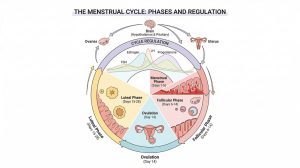 The term “oestrogen dominance” refers to a state where oestrogen’s effects are disproportionate to progesterone’s — typically not because oestrogen is excessively high in absolute terms, but because progesterone is relatively low in the luteal phase. This imbalance is associated with PMS symptoms, heavy or irregular periods, breast tenderness, mood changes, and weight gain around the hips and thighs.
Agnus castus does not directly raise progesterone or lower oestrogen. Its effect on the oestrogen-progesterone relationship is indirect — by supporting luteal phase hormone production through prolactin normalisation, it may support a more adequate progesterone output in the second half of the cycle. Research has found improvements in luteal phase progesterone levels in women taking agnus castus compared to placebo, consistent with this mechanism. For the implications for PMS, see our guide to agnus castus for PMS UK.
Who Has Hormonally Imbalanced Cycles?
The women most likely to benefit from agnus castus’s hormonal modulating effects are those with specific patterns of hormonal disruption — not all women experiencing hormonal symptoms will have the pattern that agnus castus addresses.
Women with high prolactin. Mildly elevated prolactin is more common than many women realise and can occur without obvious cause. Symptoms include irregular periods, PMS, galactorrhoea (inappropriate breast milk discharge), and difficulty conceiving. Blood testing for prolactin is available through GPs. Where mild hyperprolactinaemia is identified without a pituitary tumour (which requires medical treatment), agnus castus is a clinically justified intervention.
Women with short luteal phases. A luteal phase shorter than ten days is associated with inadequate progesterone production and is a recognised cause of cycle irregularity, PMS, and fertility difficulties. Research on agnus castus has shown improvements in luteal phase length in women with documented defects.
Women with PMS symptoms in the luteal phase. Given that PMS arises in the luteal phase and reflects the hormonal environment of this phase, any woman with significant PMS may be experiencing a degree of luteal phase hormonal imbalance that agnus castus’s mechanism can address.
Perimenopausal women. As the ovarian reserve declines, hormonal fluctuations become more pronounced and irregular. Agnus castus may help moderate some of these fluctuations through pituitary modulation, though the evidence base for perimenopause is less developed than for PMS. For more on this specific application, see our guide to agnus castus for perimenopause UK.
What Agnus Castus Cannot Do
Being precise about limitations is as important as describing benefits. Agnus castus does not directly raise progesterone — it may indirectly support progesterone production by improving pituitary-ovarian signalling, but it is not a progesterone supplement. It does not lower oestrogen directly. It does not address causes of hormonal imbalance that originate outside the pituitary-gonadal axis — conditions like PCOS (where the primary issue is insulin resistance and androgen excess), endometriosis (where the issue is ectopic endometrial tissue), or hypothyroidism (where thyroid dysfunction affects cycle regularity) require specific treatment rather than pituitary modulation.
Agnus castus is not appropriate for women taking hormonal contraception or HRT, as interactions may affect hormonal contraceptive efficacy and the combined hormonal environment. Always consult your GP before starting agnus castus if you take any prescription medication.
Summary — Agnus Castus for Hormonal Balance
Agnus castus supports hormonal balance through a specific and well-understood mechanism: dopaminergic activity at the pituitary gland, leading to prolactin suppression and downstream support of the menstrual cycle’s hormonal environment. This mechanism is most relevant for women with PMS, short luteal phases, mildly elevated prolactin, or irregular cycles where the disruption originates in the pituitary-gonadal axis. It is not a universal hormonal regulator and is not appropriate for all causes of hormonal imbalance — but for the specific pattern of luteal phase insufficiency and prolactin-related disruption, it is one of the most evidence-supported herbal interventions available.
For full product information and to purchase, visit Nutrivity’s Agnus Castus 1000mg Vegan Tablets product page
Frequently Asked Questions
Does agnus castus balance hormones?
Agnus castus influences hormone balance indirectly through pituitary dopamine receptor activity, which suppresses prolactin release. Lower prolactin supports the hormonal signalling cascade that regulates the menstrual cycle, particularly the luteal phase production of progesterone. It does not directly provide or block any hormone — its effects are mediated through pituitary signalling.
Does agnus castus raise progesterone?
Not directly. Agnus castus may indirectly support progesterone production in the luteal phase by improving pituitary-ovarian signalling through prolactin suppression. Research has found improvements in luteal phase progesterone levels in women taking agnus castus compared to placebo, but it is not a progesterone supplement.
Does agnus castus lower oestrogen?
Not directly. Agnus castus’s effect on the oestrogen-progesterone relationship is indirect — by supporting luteal phase progesterone production, it may improve the relative balance between the two hormones. It does not directly block or reduce oestrogen production or activity.
Can agnus castus help with oestrogen dominance?
Agnus castus may help where oestrogen dominance reflects a relative progesterone deficiency in the luteal phase associated with elevated prolactin or luteal phase defects. It is not appropriate where oestrogen dominance reflects other causes such as excess body fat (which converts androgens to oestrogen) or environmental oestrogen exposure. Identifying the cause of hormonal imbalance through blood testing is the most reliable approach before choosing interventions.
How long does agnus castus take to balance hormones?
The clinical research uses three menstrual cycles (approximately three months) as the minimum assessment period. Hormonal regulation through pituitary signalling builds over consistent use — agnus castus is not an acute intervention and does not produce rapid hormonal changes within days or weeks of starting.
Is Nutrivity's agnus castus good for hormonal balance?
Yes — Nutrivity’s Agnus Castus 1000mg provides a therapeutic dose of whole agnus castus herb in a vegan tablet, taken once daily. Fully vegan-suitable and halal-suitable, with an 8-month supply at approximately 10.4p per day.