



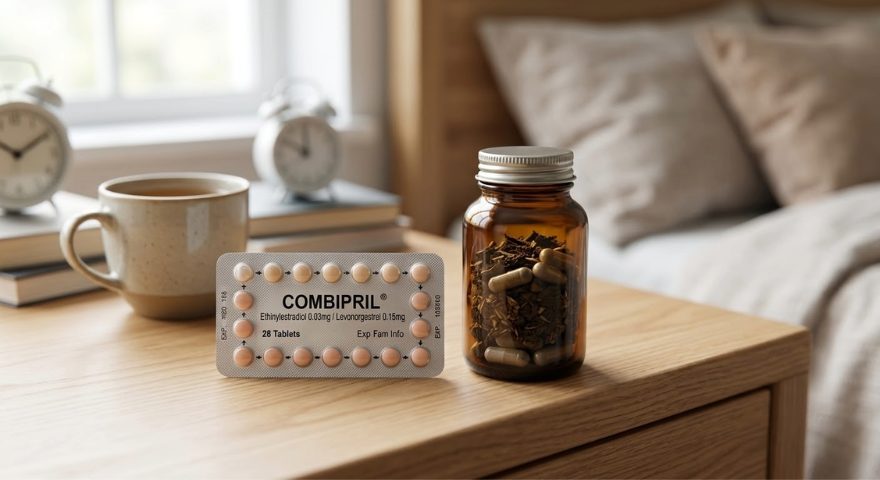
Agnus Castus and the Contraceptive Pill — What You Need to Know
-
By Chris Jones
Written by Chris Jones, Social Media Manager at Nutrivity with 7+ years in the supplement industry.
The interaction between agnus castus and hormonal contraception is one of the most commonly asked questions about this supplement and one of the least clearly answered. The concern is real and the caution is warranted — but the specific nature of the interaction and its practical implications deserve more nuance than a simple “don’t take them together.” This guide covers what is known, what is theoretical, and what decisions women taking the contraceptive pill should consider.
For a full overview of agnus castus safety and interactions, see our guide to agnus castus side effects UK. For a full overview of what agnus castus is, see our guide to what is agnus castus. For full product information, visit our Agnus Castus 1000mg Vegan Tablets product page.
The Theoretical Concern
Agnus castus acts on pituitary dopamine receptors, suppressing prolactin release and indirectly influencing the hormonal signalling cascade that regulates the menstrual cycle. The combined oral contraceptive pill (COCP) works by providing synthetic oestrogen and progestogen that suppress the hypothalamic-pituitary-ovarian axis — preventing ovulation and altering the uterine environment to prevent conception.
The theoretical concern about combining agnus castus with the pill is bidirectional. First, agnus castus’s pituitary modulating effects could theoretically alter the hormonal environment in which the pill operates, potentially affecting its efficacy. Second, the pill’s suppression of the hypothalamic-pituitary-ovarian axis may reduce or eliminate the very mechanism through which agnus castus achieves its effects — pituitary prolactin regulation in a cyclically functioning system.
In practical terms, the second concern is more relevant: women taking the combined pill do not have a natural menstrual cycle — their cycle is pill-driven, not pituitary-driven. The hormonal fluctuations that agnus castus is used to regulate are suppressed by the pill. This means agnus castus is likely to be ineffective for its primary applications (PMS relief, cycle regulation) in women taking the combined pill, because the cycle it is designed to regulate is not present.
Is There an Established Interaction?
The honest answer is that specific interaction data is limited. No large clinical trial has directly examined the combination of agnus castus and the combined oral contraceptive pill. The warnings about this combination in product information and herbal medicine guidance are based on the theoretical mechanisms above and on the general principle of caution around herbs that affect hormonal signalling when combined with hormonal medications.
There is no published evidence of serious adverse events from combining agnus castus with the contraceptive pill. However, the absence of evidence of harm is not the same as evidence of safety, and the regulatory guidance — from MHRA and European herbal medicine bodies — consistently advises against combining agnus castus with hormonal contraception without medical supervision.
The Progesterone-Only Pill (POP/Mini-Pill)
The progesterone-only pill operates differently from the combined pill — it primarily works through thickening cervical mucus rather than suppressing ovulation in all users, and some women on the POP continue to ovulate. The interaction considerations are different from the COCP. However, because the POP still involves exogenous progestogen affecting the hormonal environment, the same general caution applies: consult your GP before taking agnus castus alongside any hormonal contraception.
If You Take the Pill and Have PMS — What Are Your Options?
Women taking the contraceptive pill who experience pill-associated mood symptoms, breakthrough bleeding, or other cycle-related symptoms face a specific challenge: agnus castus is designed for the natural hormonal cycle, not for pill-driven cycles. Pill-associated symptoms may have a different mechanism from natural-cycle PMS.
Options include discussing symptoms with a GP who may recommend switching pill type, pill formulation, or contraceptive method. For women who want to try agnus castus for its primary applications (PMS, cycle regulation), discontinuing hormonal contraception and allowing natural cycles to resume under a different contraceptive method is the approach that makes agnus castus’s mechanism relevant. This is a significant decision that should be made with medical guidance and with reliable non-hormonal contraception in place.
Summary — Agnus Castus and the Contraceptive Pill
The interaction between agnus castus and the contraceptive pill is primarily theoretical but real enough to warrant GP discussion before combining the two. More practically, agnus castus is unlikely to be effective for its primary applications in women taking the combined pill, because the natural hormonal cycle that it regulates is suppressed by the pill’s mechanism. Women using non-hormonal contraception who have natural cycles are the appropriate population for agnus castus supplementation. For women on hormonal contraception experiencing cycle-related symptoms, GP discussion about contraceptive options and symptom management is the right starting point rather than adding agnus castus alongside current hormonal medication.
For full product information and to purchase, visit Nutrivity’s Agnus Castus 1000mg Vegan Tablets product page.
Frequently Asked Questions
Can I take agnus castus with the contraceptive pill?
The regulatory guidance advises against combining agnus castus with hormonal contraception without medical supervision. The practical concern is that the combined pill suppresses the natural hormonal cycle that agnus castus is designed to regulate, making it likely to be ineffective for PMS or cycle regulation in pill users — and the theoretical interaction with the pill’s efficacy, while not established in clinical data, justifies caution. Consult your GP before combining the two.
Will agnus castus affect the contraceptive pill's effectiveness?
There is no clinical evidence demonstrating that agnus castus reduces the efficacy of the contraceptive pill. The theoretical concern exists because both act on the hormonal signalling pathway, but specific interaction data is not available. As a precautionary measure, women relying on the pill for contraception should not take agnus castus without GP advice and should not rely on agnus castus as any form of contraception.
I take the mini-pill — can I take agnus castus?
The same caution applies to the progesterone-only pill as to the combined pill. Consult your GP before combining agnus castus with any hormonal contraception. The mechanism of the POP is different but the general principle of caution around herbs with hormonal activity and exogenous hormonal medications applies.
Can I take agnus castus if I use non-hormonal contraception?
Yes — women using non-hormonal contraception (barrier methods, copper IUD, natural family planning) do not have the same interaction concern. Agnus castus is appropriate for women using non-hormonal contraception who have natural menstrual cycles and are experiencing PMS, cycle irregularity, or other hormonal symptoms that fall within agnus castus’s mechanism.
I stopped the pill — how long before I can start agnus castus?
Most GPs recommend allowing at least one to two natural cycles to return after stopping hormonal contraception before starting agnus castus — both to allow the natural cycle to re-establish and to have a baseline for assessing agnus castus’s effects. Cycle return after the pill varies — some women resume regular cycles within one month, others take several months. Agnus castus’s cycle-regulating mechanism is most relevant once natural cycles have begun to return.