



Agnus Castus Side Effects UK — Safety, Interactions and Who Should Avoid It
-
By Chris Jones
Written by Chris Jones, Social Media Manager at Nutrivity with 7+ years in the supplement industry.
Agnus castus has a generally favourable safety profile in clinical research, with most trials reporting low rates of adverse effects and good tolerability over three to six month treatment periods. That said, no herbal supplement is entirely risk-free, and agnus castus has specific contraindications and drug interactions that are more significant than for many supplements — because it acts on hormonal signalling, the consequences of inappropriate use are more clinically relevant than for a simple vitamin or mineral.
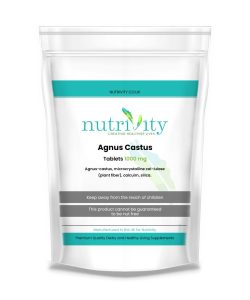
This guide covers the known side effects, who should not take agnus castus, the drug interactions that matter most, and what to do if you experience problems. For a full overview of agnus castus and its applications, see our guide to what is agnus castus. For dosage guidance, see our agnus castus dosage UK guide. For full product information, visit our Agnus Castus 1000mg Vegan Tablets product page.
Common Side Effects — What Clinical Research Shows
In clinical trials, agnus castus is well-tolerated by the majority of women. The most commonly reported side effects are mild and include nausea, headache, gastrointestinal upset (bloating, stomach discomfort), acne, and skin reactions (rash, itching). These effects are generally mild, transient, and resolve on discontinuation. The rate of adverse events in agnus castus groups in RCTs is comparable to placebo groups in most studies, confirming the overall good tolerability profile.
A small number of women report initial cycle changes in the first month of use — altered cycle length, timing shifts, or temporary changes in flow — as the pituitary signalling adjusts. These typically resolve with continued use in the second and third cycle.
Who Should Not Take Agnus Castus
Pregnant women. Agnus castus is not appropriate during pregnancy. While some traditional European herbal use has included agnus castus in specific early-pregnancy contexts, this is not supported by modern evidence standards and should not be attempted without specialist medical supervision. Women taking agnus castus while trying to conceive should discontinue immediately upon confirmed pregnancy.
Breastfeeding women. Agnus castus suppresses prolactin — the primary hormone driving breast milk production. Taking it while breastfeeding would directly undermine milk supply. It is contraindicated in lactating women.
Women with hormone-sensitive cancers. Women who have had oestrogen-receptor positive breast cancer, ovarian cancer, uterine cancer, or other hormone-sensitive cancers should not take agnus castus without specialist oncology guidance. The herb’s activity on the hormonal signalling pathway creates a theoretical risk that requires expert assessment in this context.
Women with pituitary disorders. Agnus castus acts on pituitary dopamine receptors. Women with pituitary tumours — including prolactinomas — or other pituitary disorders should not take agnus castus without endocrinological supervision, as it may interfere with the management of the underlying condition.
Women under 18. Agnus castus is not licensed or recommended for girls under 18. Adolescent hormonal cycles are still establishing and should not be subject to herbal pituitary modulation without medical guidance.

Drug Interactions — The Most Important Ones
Dopamine agonists and antagonists. Because agnus castus acts on dopamine D2 receptors, it may interact with medications that also affect dopaminergic signalling. Dopamine agonists (bromocriptine, cabergoline — used to treat elevated prolactin and Parkinson’s disease) and dopamine antagonists (metoclopramide, domperidone, antipsychotics) may have their effects altered by concurrent agnus castus use. Do not take agnus castus alongside these medications without medical supervision.
Combined oral contraceptive pill. The interaction between agnus castus and the contraceptive pill is theoretical rather than clinically established, but it is significant enough to warrant caution. Agnus castus’s effect on pituitary signalling could theoretically affect the hormonal environment in which the pill operates. For a full discussion of this specific interaction, see our guide to agnus castus and the contraceptive pill.
HRT and other hormonal medications. As with the contraceptive pill, the interaction with HRT is theoretical but warrants GP discussion before combining agnus castus with any prescribed hormonal medication.
Summary — Agnus Castus Safety
Agnus castus has a good safety and tolerability profile in clinical research for most women of reproductive age without contraindications. The specific contraindications — pregnancy, breastfeeding, hormone-sensitive cancers, pituitary disorders — are more significant than for many supplements because of the herb’s pituitary-hormonal mechanism. The drug interactions with dopaminergic medications and hormonal contraception warrant GP discussion before combining agnus castus with these treatments. For healthy women of reproductive age using agnus castus for PMS or cycle irregularity without contraindications, the safety profile supports appropriate use at recommended doses.
For full product information and to purchase, visit Nutrivity’s Agnus Castus 1000mg Vegan Tablets product page.
Frequently Asked Questions
What are the side effects of agnus castus?
The most commonly reported side effects in clinical trials are mild: nausea, headache, gastrointestinal discomfort, acne, and skin reactions. Initial cycle changes in the first month are also reported by some women. Serious side effects are rare. If you experience significant side effects, discontinue and consult your GP.
Can agnus castus cause weight gain?
Weight gain is not a reported side effect in agnus castus clinical trials. Bloating is occasionally reported as a mild side effect and may be confused with weight gain, but it is typically transient. Agnus castus does not act on the metabolic pathways associated with weight change.
Can agnus castus cause depression?
Depression is not a reported side effect in agnus castus trials. The herb is used specifically for mood symptoms associated with PMS, and clinical research has shown improvements in mood-related symptoms. If you experience worsening mood after starting agnus castus, discontinue and consult your GP — while unlikely to be caused by the supplement, any new mood change warrants medical assessment.
Can agnus castus affect fertility negatively?
Agnus castus is generally used to support rather than impair fertility in appropriate candidates. However, it should be discontinued immediately upon confirmed pregnancy and should not be used in women with conditions where prolactin suppression is contraindicated. In the specific context of breastfeeding, prolactin suppression directly impairs milk production.
How do I know if agnus castus is not right for me?
If you have any of the contraindications listed above — pregnancy, breastfeeding, hormone-sensitive cancer, pituitary disorder, age under 18 — agnus castus is not appropriate. If you take dopamine agonists, antagonists, hormonal contraception, or HRT, consult your GP before starting. If you experience significant side effects in the first cycle that do not resolve, discontinue and seek medical assessment.