




Agnus Castus for Fertility UK — What the Evidence Shows
-
By Chris Jones
Written by Chris Jones, Social Media Manager at Nutrivity with 7+ years in the supplement industry.
Agnus castus has been used in traditional herbal medicine as a fertility aid for centuries, and the modern research offers some support for specific fertility-related applications — particularly for women with cycle irregularity, luteal phase defects, or mildly elevated prolactin that may be impairing conception. However, it is not a direct fertility treatment and is not appropriate for all causes of fertility difficulties. Understanding where its mechanism is relevant and where it is not is essential for making an informed decision.
This guide covers the fertility research on agnus castus, when it is and is not appropriate, and what UK women trying to conceive should know. For a full overview of agnus castus and how it works, see our guide to what is agnus castus. For the context of irregular periods, see our guide to agnus castus for irregular periods UK. For full product information, visit our Agnus Castus 1000mg Vegan Tablets product page.
Why Prolactin and Luteal Phase Health Matter for Fertility
Two of the mechanisms through which agnus castus acts are directly relevant to fertility: prolactin normalisation and luteal phase support.
Elevated prolactin in non-lactating women suppresses the GnRH-LH-FSH signalling cascade that drives follicle development and ovulation. Even mildly elevated prolactin — not high enough to cause complete amenorrhoea or galactorrhoea — can produce subtle disruptions to ovulation timing and frequency, making cycle prediction and conception more difficult. Prolactin normalisation through agnus castus may restore more regular ovulation in women with this pattern.
Luteal phase defects — where the second half of the cycle is shorter than ten days or where progesterone production in the luteal phase is insufficient — directly impair implantation by shortening the window in which a fertilised egg can implant in the uterine lining. Research has demonstrated improvements in luteal phase length and mid-luteal progesterone in women taking agnus castus, which is directly relevant to implantation success.
What the Research Shows
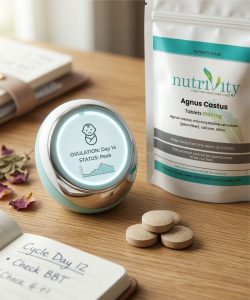
The most frequently cited fertility study on agnus castus is a randomised trial examining women with fertility difficulties attributed to secondary amenorrhoea, luteal phase defects, or corpus luteum insufficiency. Women receiving agnus castus extract over three months showed improvements in hormonal parameters including mid-luteal progesterone and prolactin levels, and a higher proportion achieved pregnancy during the study period compared to the placebo group.
A further study examining a combination supplement including agnus castus found improved pregnancy rates in women with infertility attributed to hormonal factors compared to placebo. These results are promising but should be interpreted carefully — the studies are relatively small, and the women included had specific hormonal patterns (elevated prolactin, luteal phase defects) rather than representing all causes of fertility difficulties.
When Agnus Castus Is and Is Not Appropriate for Fertility
Appropriate: Women with irregular cycles, particularly where irregularity is associated with mildly elevated prolactin or short luteal phases. Women with confirmed luteal phase defects where progesterone support in the second half of the cycle is a clinical concern. Women with unexplained fertility difficulties and no other identified cause, where hormonal optimisation is part of the preconception approach.
Not appropriate: Women trying to conceive with PCOS as the primary fertility barrier (insulin resistance and androgen management are the priority). Women with tubal factor infertility. Women with male factor infertility (agnus castus has no role in sperm quality). Women whose fertility difficulties are attributed to causes requiring medical treatment. Women already taking fertility medications including clomiphene, letrozole, or gonadotrophins — potential interactions require medical supervision.
Agnus Castus and Pregnancy — A Critical Safety Point
Agnus castus should be discontinued as soon as pregnancy is confirmed. There is no evidence that agnus castus is safe during pregnancy, and its effects on pituitary signalling are not appropriate during a pregnancy that requires a different hormonal environment. Some traditional herbalists have used agnus castus in early pregnancy in specific contexts, but this is not recommended without specialist medical supervision. If you are taking agnus castus while trying to conceive, have a plan for immediate discontinuation upon confirmed pregnancy. For the full safety picture, see our agnus castus dosage UK guide.
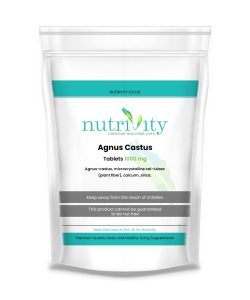
Summary — Agnus Castus for Fertility
Agnus castus has a specific and well-mechanised role in fertility support for women whose conception difficulties are associated with mildly elevated prolactin, luteal phase defects, or irregular cycles attributable to pituitary-gonadal axis disruption. The clinical evidence, while not definitive, is supportive of its use in these specific populations. It is not a universal fertility treatment and should not substitute for medical investigation of fertility difficulties. Discontinuation immediately upon confirmed pregnancy is essential. For all women with fertility concerns, GP assessment and — where appropriate — specialist fertility consultation is the essential starting point.
For full product information and to purchase, visit Nutrivity’s Agnus Castus 1000mg Vegan Tablets product page.
Frequently Asked Questions
Can agnus castus help you get pregnant?
Agnus castus may support fertility in women with specific hormonal patterns — particularly mildly elevated prolactin, short luteal phases, or irregular cycles where these factors are impairing conception. It is not a direct fertility treatment and is not appropriate for all causes of fertility difficulties. A GP or fertility specialist assessment is the appropriate starting point for any woman with fertility concerns.
How long does agnus castus take to improve fertility?
Clinical research uses three menstrual cycles as the minimum assessment period. Hormonal normalisation through agnus castus builds over multiple cycles — cycle regulation, luteal phase improvement, and prolactin normalisation all take time to establish and translate into improved fertility outcomes.
Should I stop taking agnus castus when pregnant?
Yes — agnus castus should be discontinued as soon as pregnancy is confirmed. Its effects on pituitary signalling are not appropriate during pregnancy. Have a plan for immediate discontinuation in place before you start taking it if you are actively trying to conceive.
Can agnus castus be taken with folic acid?
Yes — folic acid (or methylfolate) supplementation for preconception and pregnancy is compatible with agnus castus. There are no known interactions between the two. Both are commonly recommended as part of a preconception supplement routine.
Is agnus castus safe to take when trying to conceive?
Agnus castus is generally considered safe at standard supplement doses for women trying to conceive who do not have hormone-sensitive conditions or fertility medications. It should be discontinued immediately upon confirmed pregnancy. Always consult your GP or fertility specialist before starting any supplement while trying to conceive, particularly if you have an identified fertility condition or take any prescription medication.