



Agnus Castus for PMS UK — What the Clinical Evidence Shows
-
By Chris Jones
Written by Chris Jones, Social Media Manager at Nutrivity with 7+ years in the supplement industry.
Agnus Castus for PMS UK — What the Clinical Evidence Shows
Premenstrual syndrome affects an estimated 80% of women of reproductive age to some degree, with around 20–30% experiencing symptoms severe enough to affect daily life and relationships. Despite its prevalence, PMS is frequently undertreated — partly because of the range of symptoms involved, and partly because conventional treatment options are limited to hormonal interventions, antidepressants, and lifestyle measures. Agnus castus occupies a well-evidenced position in the PMS treatment landscape as the herbal option with the most robust clinical trial data.
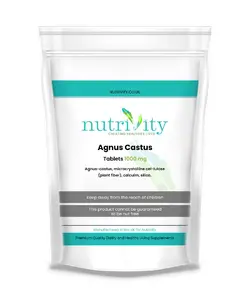
This guide covers what the research shows for agnus castus and PMS, which symptoms it is most effective for, how it compares to other approaches, and what UK women should know before starting it. For a full overview of what agnus castus is and how it works, see our guide to what is agnus castus. For full product information on Nutrivity’s agnus castus tablets, visit our Agnus Castus 1000mg Vegan Tablets product page.
What Is PMS?
Premenstrual syndrome describes the physical and psychological symptoms that occur in the luteal phase of the menstrual cycle — typically the 5–14 days before menstruation — and resolve with or shortly after the onset of bleeding. Symptoms span a broad range: mood changes (irritability, anxiety, low mood, tearfulness), physical symptoms (breast tenderness, bloating, headache, fatigue, food cravings), and in severe cases, the condition is classified as premenstrual dysphoric disorder (PMDD), which involves significant mood disruption including depression and impaired functioning.
The underlying cause of PMS is not fully understood, but the leading hypothesis involves aberrant neurobiological responses to the normal hormonal fluctuations of the menstrual cycle — particularly fluctuations in progesterone metabolites and their effects on the GABA system. Elevated prolactin, which disrupts luteal phase hormone balance, is a recognised contributing factor in a subgroup of women with PMS.
The Clinical Evidence — What the Trials Show
 The evidence base for agnus castus in PMS is more developed than for most herbal supplements. The pivotal trial is the ZE 440 study — a randomised, double-blind, placebo-controlled trial of 178 women with confirmed PMS diagnosis. Women received either one agnus castus extract tablet daily or placebo for three menstrual cycles. The results were significant: 52% of the agnus castus group rated their overall improvement as “much better” or “very much better” compared to 24% in the placebo group. Symptom scores for irritability, mood change, anger, headache, and breast fullness all showed statistically significant reductions in the treatment group.
A second major trial — the Agnolyt study — examined agnus castus versus vitamin B6 (pyridoxine) for PMS and found agnus castus to be at least as effective as 200mg of pyridoxine daily, with both treatments significantly outperforming placebo. A Cochrane-style systematic review concluded that the evidence supports agnus castus use for PMS and PMDD with generally good tolerability.
Which PMS Symptoms Respond Best?
The clinical research has found the strongest evidence for agnus castus on the following PMS symptoms: irritability, mood changes and emotional lability, breast tenderness and fullness, bloating, and headache. These are consistent across multiple trials. The effects on mood-related symptoms may reflect agnus castus’s partial opioid receptor activity alongside its prolactin-suppressing mechanism.
Evidence is weaker for food cravings, fatigue, and sleep disturbance — these symptoms are less consistently addressed in the trial data. For women whose primary PMS symptoms are mood and emotional symptoms alongside physical symptoms like breast tenderness and bloating, agnus castus is most likely to be beneficial. For women whose PMS is dominated by fatigue or sleep disruption, the evidence is less directly applicable.
Agnus Castus vs Other PMS Approaches
Agnus castus occupies a specific position in the PMS treatment landscape — it is the herbal option with the most consistent RCT evidence, positioned above dietary supplements with weaker evidence (evening primrose oil, calcium, magnesium — all of which have some but less consistent support) and below prescription interventions (SSRIs, hormonal contraception) which are used for more severe PMS and PMDD.
For women with mild to moderate PMS who prefer a non-hormonal, non-pharmaceutical approach, agnus castus is the most evidence-supported starting point. For women with severe PMDD significantly affecting daily functioning, prescription treatment under medical supervision is more appropriate. For the full picture on dosage, see our agnus castus dosage UK guide.
How to Use Agnus Castus for PMS
Agnus castus for PMS is taken continuously — not just in the premenstrual phase. The herb works by modulating pituitary signalling throughout the cycle rather than providing acute relief at the point of symptoms. Taking it only in the week before your period is not consistent with how the evidence-based dosing protocols work.
The timeline for response is three menstrual cycles minimum. Most clinical trials have run for three months, and this is the period consistently recommended before assessing whether agnus castus is working. Stopping and starting within this period reduces the likelihood of observing a response. For the full discussion of timing and what to expect, see our guide to how long does agnus castus take to work.
Summary — Agnus Castus for PMS
Agnus castus is the best-evidenced herbal supplement for PMS, with multiple RCTs demonstrating significant reductions in the core PMS symptom cluster — irritability, mood changes, breast tenderness, bloating, and headache. For UK women with mild to moderate PMS who want a non-hormonal, evidence-based intervention, it is the most appropriate starting point in the herbal supplement category. The key practical requirements are consistent daily use and a minimum three-month trial period.
For full product information and to purchase, visit Nutrivity’s Agnus Castus 1000mg Vegan Tablets product page.
Frequently Asked Questions
Does agnus castus help PMS?
Yes — agnus castus has more RCT evidence for PMS relief than any other herbal supplement. The ZE 440 trial showed significant reductions in irritability, mood changes, breast tenderness, bloating, and headache compared to placebo. It is most effective when taken continuously for at least three menstrual cycles.
Which PMS symptoms does agnus castus help most?
The strongest evidence is for irritability, mood changes, breast tenderness, bloating, and headache. Evidence for fatigue, food cravings, and sleep disturbance is less consistent. Women whose PMS is primarily mood and physical (breast, bloating) in character are most likely to respond.
How long does agnus castus take to work for PMS?
Clinical trials have used three-month (three menstrual cycle) treatment periods, and this is the recommended minimum before assessing whether it is working. Agnus castus does not provide acute symptom relief — it works through cycle regulation that builds over consistent use.
Can agnus castus make PMS worse?
A small number of women report initial worsening of symptoms in the first cycle, which typically resolves with continued use. This is not well-documented in controlled trials but is reported anecdotally. If symptoms significantly worsen and do not improve in the second cycle, discontinue and consult your GP.
Is agnus castus better than evening primrose oil for PMS?
The evidence base for agnus castus in PMS is stronger than for evening primrose oil. Multiple RCTs support agnus castus for PMS symptom reduction. Evening primrose oil has evidence primarily for breast tenderness specifically, with less consistent support across the broader PMS symptom profile. The two can be taken alongside each other as they work through different mechanisms.
Is Nutrivity's agnus castus suitable for PMS?
Yes. Nutrivity’s Agnus Castus 1000mg provides 1000mg of whole agnus castus herb per vegan tablet, taken once daily. It is fully vegan-suitable and halal-suitable with no gelatine or lactose. At approximately 10.4p per day with an 8-month supply, it is the most cost-effective agnus castus option for a recommended 3-month course in the UK market.