




Vitamin K2 MK7 — What It Does and Why You Need It
-
By Chris Jones
Written by Chris Jones, Social Media Manager at Nutrivity with 7+ years in the supplement industry.
Vitamin K2 is one of the most underappreciated nutrients in UK health. Most people have heard of vitamin K — typically in the context of blood clotting — but vitamin K2 is a distinct form with a distinct biological role that is more relevant to long-term cardiovascular and bone health than to clotting. The specific form MK7 (menaquinone-7) is the most bioavailable and best-researched form of K2, and it is the form that makes the most clinical difference at the doses available in supplements.
This guide covers what vitamin K2 MK7 is, what it does in the body, the research on bone and cardiovascular outcomes, and why it is paired with vitamin D3. For a full overview of the D3 + K2 combination, see our guide to what is vitamin D3 + K2. For full product information on Nutrivity’s D3 + K2 tablets, visit our Vitamin D3 4000 IU + K2 MK7 product page.
What Is Vitamin K2?
Vitamin K exists in two main forms: K1 (phylloquinone) and K2 (menaquinone). K1 is found in leafy green vegetables and is primarily involved in blood coagulation. K2 is found in fermented foods and animal products and is primarily involved in calcium regulation — a distinct and clinically important role.
Vitamin K2 itself exists in several subtypes, designated MK4 through MK13 (menaquinone-4 through menaquinone-13) depending on the length of their side chains. MK7 and MK4 are the two forms most studied in supplementation research. MK7 is produced by bacterial fermentation — notably in the Japanese fermented soybean food natto, which is the richest dietary source — and is the form used in most high-quality K2 supplements. MK4 is found in animal products and can also be synthesised in the body from K1.
What Does K2 MK7 Do in the Body?
Vitamin K2’s primary role is activating vitamin K-dependent proteins that regulate calcium distribution in the body. Two of these proteins are particularly important for health.
Osteocalcin. Osteocalcin is a protein produced by bone-forming cells (osteoblasts) that is responsible for binding calcium and incorporating it into bone matrix. In its inactive form — which is what it is without adequate K2 — osteocalcin cannot bind calcium effectively, and bone mineralisation is impaired. K2 carboxylates osteocalcin, activating it and enabling it to perform its calcium-binding function. Activated osteocalcin is directly measured in blood tests as a marker of bone formation activity.
Matrix Gla Protein (MGP). MGP is found in vascular smooth muscle cells and is the most potent known inhibitor of arterial calcification. Like osteocalcin, MGP requires K2 for activation through carboxylation. Without adequate K2, MGP remains inactive and cannot prevent calcium from depositing in arterial walls. Inactive (undercarboxylated) MGP is a direct biomarker of arterial calcification risk, and research has shown that low K2 intake is associated with high levels of inactive MGP and increased arterial calcification.
Together, these two mechanisms explain why K2 is described as directing calcium to bones and away from arteries — it is not metaphorical, it is the biochemical reality of what activated osteocalcin and MGP do.
K2 and Bone Health
The evidence for vitamin K2 in bone health is substantial. Multiple intervention studies have shown that K2 supplementation improves markers of bone formation, reduces markers of bone resorption, and in some studies reduces fracture rates. The largest evidence base is from Japanese research using MK4 at pharmacological doses (45mg daily — far above supplement levels), but growing research using MK7 at supplement doses of 90–200mcg has also shown improvements in bone density and bone quality markers.
A 2013 three-year RCT published in Osteoporosis International found that MK7 supplementation at 180mcg daily significantly improved bone mineral density and bone strength in postmenopausal women compared to placebo. This is the kind of evidence that underpins the clinical case for K2 supplementation in populations at risk of bone density loss. For the full picture on vitamin D and bone health, see our guide to vitamin D and bone health UK.
K2 and Cardiovascular Health
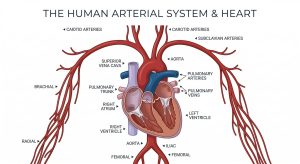 The cardiovascular evidence for vitamin K2 is compelling. The Rotterdam Study — one of the most cited population studies on K2 and cardiovascular health — followed 4,807 Dutch men and women for over seven years and found that the highest third of dietary K2 intake had a 57% lower risk of dying from cardiovascular disease and significantly less aortic calcification compared to those with the lowest K2 intake. Crucially, no such relationship was found for K1 — the effect was specific to K2.
Subsequent research has reinforced this finding. Studies measuring arterial calcification directly have found inverse relationships between K2 intake and calcification scores. Intervention trials using MK7 have shown reductions in arterial stiffness — a key measure of cardiovascular risk — with K2 supplementation compared to placebo.
For people supplementing with vitamin D3 at doses that meaningfully increase calcium absorption, ensuring adequate K2 status is particularly important — D3 without K2 risks driving calcium into soft tissues where it is not wanted.
MK7 vs MK4 — Why MK7 Is the Better Supplement Form
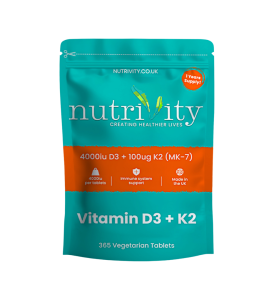
MK7 has two significant pharmacokinetic advantages over MK4 that make it the superior supplement form. First, MK7 has a much longer half-life in the body — it remains active in circulation for days, providing consistent activation of osteocalcin and MGP throughout the week. MK4 has a half-life of only 1–2 hours, requiring multiple daily doses to maintain effective blood levels. Second, MK7 is more bioavailable from supplement doses — it raises blood K2 levels more effectively at the doses available in supplements. Nutrivity’s D3 + K2 provides 100mcg of MK7 per tablet — the dose most consistently associated with bone and cardiovascular benefits in supplement research.
Summary — Vitamin K2 MK7 in the UK
Vitamin K2 MK7 is one of the most important and underappreciated nutrients for long-term cardiovascular and bone health in UK adults. Its role in directing calcium appropriately — to bones and away from arteries — makes it a critical partner to vitamin D3 supplementation rather than an optional add-on. The evidence from population studies, intervention trials, and mechanistic research is consistent: adequate K2 status is associated with reduced arterial calcification, better bone density, and lower cardiovascular mortality. For most UK adults, dietary K2 intake is insufficient, making supplementation with 100mcg of MK7 daily a well-evidenced choice.
For full product information and to purchase, visit Nutrivity’s Vitamin D3 4000 IU + K2 MK7 product page.
Frequently Asked Questions
What does vitamin K2 MK7 do?
Vitamin K2 MK7 activates two key proteins — osteocalcin, which deposits calcium into bone matrix, and matrix Gla protein, which prevents calcium from depositing in arterial walls. Its primary role is directing calcium appropriately: to bones where it strengthens structure, and away from arteries where it causes calcification. Without adequate K2, vitamin D-driven calcium absorption can contribute to arterial calcification rather than bone strength.
What foods contain vitamin K2?
The richest dietary source of K2 MK7 is natto — a Japanese fermented soybean food — which contains extremely high levels. Other fermented foods, hard cheeses, egg yolks, and organ meats contain smaller amounts of various K2 forms. Dietary K2 intake in the UK is generally low because natto is not commonly eaten and other dietary sources contain modest amounts. Supplementation is often the most practical way to ensure adequate K2 intake.
Is K2 MK7 better than MK4?
For supplementation purposes, yes. MK7 has a longer half-life, remains active in circulation for days (compared to 1–2 hours for MK4), and is more bioavailable from supplement doses. A single daily dose of MK7 maintains effective blood levels throughout the day and night. MK4 requires multiple daily doses to maintain comparable levels, making it less practical at supplement doses.
How much vitamin K2 MK7 should I take?
100mcg of MK7 daily is the dose most consistently associated with bone and cardiovascular benefits in supplement research. Nutrivity’s Vitamin D3 4000 IU + K2 MK7 provides exactly 100mcg of MK7 per tablet.
Can I take K2 with blood thinners?
Vitamin K interacts with warfarin (an anticoagulant medication that works by antagonising vitamin K). If you take warfarin, you should not start vitamin K2 supplementation without consulting your GP and having your INR monitored. The interaction is manageable with appropriate monitoring but requires medical supervision. If you take direct oral anticoagulants (DOACs) such as apixaban or rivaroxaban rather than warfarin, the K2 interaction is not significant, but consult your GP to be certain.
Is the K2 in Nutrivity's D3 + K2 vegan?
Yes. The MK7 in Nutrivity’s Vitamin D3 4000 IU + K2 MK7 is produced through bacterial fermentation — not derived from animal sources — and is fully vegan-suitable and halal-suitable. Full ingredients are published on the product page.