



CoQ10 for Heart Health UK — What the Evidence Actually Shows
-
By Chris Jones
Written by Chris Jones, Social Media Manager at Nutrivity with 7+ years in the supplement industry.
CoQ10 for Heart Health UK — What the Evidence Actually Shows
The heart is the organ most dependent on CoQ10. It beats around 100,000 times a day, never rests, and demands a continuous and uninterrupted supply of energy. The cardiac muscle cells that drive this activity are packed with mitochondria — and CoQ10 is the molecule those mitochondria cannot function without. It is not a coincidence that the strongest evidence for CoQ10 supplementation centres on the heart, or that CoQ10 levels in heart muscle decline significantly with age and in the presence of cardiovascular disease.
This guide covers the specific cardiovascular applications of CoQ10, what the clinical research shows, how CoQ10 relates to commonly prescribed heart medications, and what UK adults with cardiovascular concerns should know. For full product information on Nutrivity’s high-strength CoQ10, visit our CoQ10 300mg Vegan Capsules product page.
Why the Heart Depends on CoQ10 More Than Any Other Organ
The heart contains the highest concentration of mitochondria of any tissue in the body — a reflection of its extraordinary and continuous energy demand. Every heartbeat requires the coordinated contraction of cardiac muscle cells, each of which must generate ATP on demand, continuously, for an entire lifetime. CoQ10 is the essential electron carrier that makes this mitochondrial energy production possible.
Research has consistently found that CoQ10 levels in heart muscle tissue decline significantly with age — by as much as 30–40% between young adulthood and middle age, with further decline beyond that. In people with established heart disease, CoQ10 depletion is more pronounced still. Studies have found that CoQ10 levels in the cardiac muscle of patients with heart failure are substantially lower than in healthy controls of the same age, and that the degree of depletion correlates with the severity of cardiac dysfunction. This is not simply an association — it reflects the mechanistic role of CoQ10 in maintaining the energy metabolism that cardiac function depends on.
CoQ10 and Heart Failure — The Q-SYMBIO Evidence
The most compelling clinical evidence for CoQ10 in cardiovascular health comes from research in heart failure — the condition in which the heart cannot pump blood efficiently enough to meet the body’s demands.
The Q-SYMBIO trial is the landmark study in this area. It was a multicentre, randomised, double-blind, placebo-controlled trial involving 420 patients with chronic heart failure across nine countries. Patients received either CoQ10 at 300mg daily (split into three 100mg doses) or placebo, in addition to their standard heart failure medication, for two years. The results were significant: the CoQ10 group showed a statistically significant reduction in major adverse cardiovascular events (43% relative reduction), cardiovascular mortality, and all-cause mortality compared to the placebo group. Hospital admissions for worsening heart failure were also significantly reduced.
These are outcomes that most supplement ingredients cannot demonstrate — a well-powered, properly designed RCT showing reductions in mortality and cardiovascular events. The Q-SYMBIO results have been influential in generating clinical interest in CoQ10 as an adjunctive treatment in heart failure management alongside standard medical therapy.
It is important to be clear about what this evidence means and does not mean. CoQ10 in the Q-SYMBIO trial was used alongside standard heart failure treatment — not as a replacement for it. The results do not suggest that CoQ10 replaces heart failure medication. They suggest that it provides a meaningful additional benefit in patients already receiving optimal medical treatment.

CoQ10 and Blood Pressure
Beyond heart failure, CoQ10 has been studied for its effects on blood pressure. Several meta-analyses of randomised controlled trials have examined CoQ10 supplementation in hypertensive patients and found consistent, modest reductions in both systolic and diastolic blood pressure. Average reductions of around 11mmHg systolic and 7mmHg diastolic have been reported in some analyses — reductions that are clinically meaningful at the population level, though not large enough to replace antihypertensive medication in most patients.
The proposed mechanisms for CoQ10’s blood pressure effect include improvements in vascular endothelial function (the health of the inner lining of blood vessels), reductions in oxidative stress in vascular tissue, and improvements in cardiac efficiency. These mechanisms are plausible given CoQ10’s roles in both mitochondrial energy production and antioxidant protection.
For UK adults with mildly elevated blood pressure who want to support cardiovascular health through lifestyle and supplementation alongside any medical advice they receive, CoQ10 at 200–300mg daily is one of the better-evidenced supplement options.
CoQ10 and Statins — The Cardiovascular Patient’s Dilemma
Many UK adults taking CoQ10 for heart health are also taking statins — the two groups overlap significantly, because statins are prescribed precisely for cardiovascular risk reduction. As covered in our dedicated guide to CoQ10 and statins UK, statins deplete CoQ10 through the mevalonate pathway — the same biochemical route used to produce both cholesterol and CoQ10.
For cardiovascular patients taking statins, this creates a situation where the medication being used to protect the heart is simultaneously reducing levels of a compound the heart depends on. The clinical implication is that CoQ10 supplementation is particularly relevant for statin users with cardiovascular disease — not just for muscle symptoms (the most commonly discussed statin side effect) but for maintaining the cardiac energy metabolism that CoQ10 supports.
CoQ10 and Atrial Fibrillation
Atrial fibrillation (AF) is the most common sustained heart rhythm disorder in the UK, affecting around 1.4 million people. Research on CoQ10 in AF is less developed than in heart failure, but several studies have examined its potential role. Oxidative stress is thought to be a contributing factor in AF pathophysiology, and CoQ10’s antioxidant properties in cardiac tissue provide a rationale for its investigation. Some small studies have shown reductions in AF recurrence in patients supplementing with CoQ10 alongside standard treatment, though larger trials are needed to confirm these findings.
What to Consider When Using CoQ10 for Heart Health
CoQ10 is a supplement, not a medicine. It does not replace cardiac medication, and any changes to existing cardiovascular treatment should be discussed with a cardiologist or GP. CoQ10 may interact with warfarin (a blood thinner) and may potentiate the effects of blood pressure medication — both warrant discussion with your prescribing doctor before starting supplementation.
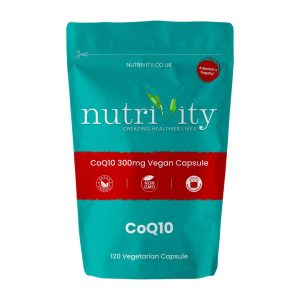
Dose is the most important variable. The Q-SYMBIO trial used 300mg daily — split across three doses of 100mg, though a single 300mg dose is more practical for most people. Many UK CoQ10 supplements provide 30–100mg, far below the dose used in the cardiovascular research. Nutrivity’s CoQ10 300mg provides the full 300mg in a single daily capsule — the dose that matches the clinical evidence.
Summary — CoQ10 for Heart Health in the UK
CoQ10 has the strongest evidence base of any supplement for cardiovascular health. The heart’s extraordinary energy demand makes it uniquely dependent on CoQ10, and the clinical research — particularly the Q-SYMBIO trial in heart failure — demonstrates outcomes that most supplement ingredients cannot approach. For UK adults with cardiovascular disease, elevated blood pressure, or those taking statins, CoQ10 at 300mg daily is a well-evidenced, well-tolerated addition to a heart health strategy. It does not replace cardiovascular medication — it supports the underlying mitochondrial energy metabolism that cardiac function depends on.
For full product information and to purchase, visit Nutrivity’s CoQ10 300mg Vegan Capsules product page.
Frequently Asked Questions
Is CoQ10 good for the heart?
Yes — CoQ10 is particularly well-evidenced for cardiovascular applications. The heart is the organ most dependent on CoQ10 for energy production, and clinical research has demonstrated meaningful benefits in heart failure (including reductions in cardiovascular mortality in the Q-SYMBIO trial) and modest but consistent reductions in blood pressure in hypertensive patients. CoQ10 is best used as an adjunct to, not a replacement for, conventional cardiovascular treatment.
Can CoQ10 improve heart function?
In patients with heart failure, clinical evidence including the Q-SYMBIO trial has shown improvements in cardiac function markers, reductions in cardiovascular events, and reductions in mortality with CoQ10 supplementation at 300mg daily alongside standard treatment. For healthy adults without established heart disease, CoQ10 supports the mitochondrial energy production that cardiac muscle cells depend on and may contribute to long-term cardiovascular health maintenance.
Does CoQ10 lower blood pressure?
Meta-analyses of randomised controlled trials have found consistent, modest reductions in blood pressure in CoQ10-supplemented hypertensive patients — averaging around 11mmHg systolic and 7mmHg diastolic in some analyses. These reductions are meaningful but not large enough to replace antihypertensive medication in most patients. CoQ10 is better viewed as a complementary cardiovascular support measure rather than a standalone blood pressure treatment.
What dose of CoQ10 is recommended for heart health?
The Q-SYMBIO trial — the largest and most significant cardiovascular trial of CoQ10 — used 300mg daily. This is the dose most strongly supported by the cardiovascular research. Many UK supplements provide 30–100mg, which is substantially below this level. Nutrivity’s CoQ10 300mg provides the full 300mg in a single daily capsule.
Can I take CoQ10 with heart medication?
CoQ10 may interact with warfarin and may potentiate the effects of blood pressure medication. Always inform your GP or cardiologist that you intend to take CoQ10 before starting supplementation if you are on cardiovascular medication. CoQ10 does not interfere with the cholesterol-lowering effects of statins.
Is Nutrivity's CoQ10 suitable for heart health?
Yes. Nutrivity’s CoQ10 300mg provides the dose used in the cardiovascular clinical research in a single daily HPMC vegetable capsule with no unnecessary additives — fully vegan-suitable and halal-suitable. Always consult your GP or cardiologist before using any supplement for cardiovascular health support.