

Vegan Supplements for Athletes in the UK — A Complete Guide
-
By Chris Jones
Written by Chris Jones, Social Media Manager at Nutrivity with 7+ years in the supplement industry.
Vegan Supplements for Athletes in the UK — A Complete Guide
Sports nutrition is the supplement category with the worst track record for vegan compliance. Protein powders, pre-workouts, amino acid blends, recovery formulas, and performance supplements are built around marketing claims and proprietary blends — not ingredient transparency. Gelatine capsules, animal-derived amino acids, whey and casein proteins, and alcohol-based herbal extracts are standard across the category, and brands in the sports nutrition space are focused on performance claims rather than ethical sourcing.
This guide covers what vegan athletes in the UK actually need from supplements, the specific compliance issues in the sports nutrition category, and how to build an effective, fully vegan-suitable supplement routine. For a full overview of vegan omega-3 options, see our guide to vegan omega-3 supplements UK. For Nutrivity’s complete range of vegan-suitable supplements, visit our vegan supplements guide.
What Vegan Athletes Actually Need from Supplements
The supplement needs of athletes — vegan or otherwise — are less exotic than the sports nutrition industry would have you believe. The evidence base for performance and recovery supplementation centres on a relatively small number of compounds, most of which are available in fully vegan-suitable forms. The vast majority of the sports supplement market is marketing noise built around compounds with limited evidence and significant vegan compliance problems.
The supplements with the clearest evidence base for athletic performance and recovery, and their vegan status, are as follows.
Creatine monohydrate is the most well-evidenced performance supplement available. It improves high-intensity exercise capacity, supports muscle strength gains, and has a safety record spanning decades of research. Synthetic creatine monohydrate in plain powder form is vegan-suitable — it is produced through chemical synthesis with no animal-derived ingredients. Creatine in capsule format requires capsule material verification.
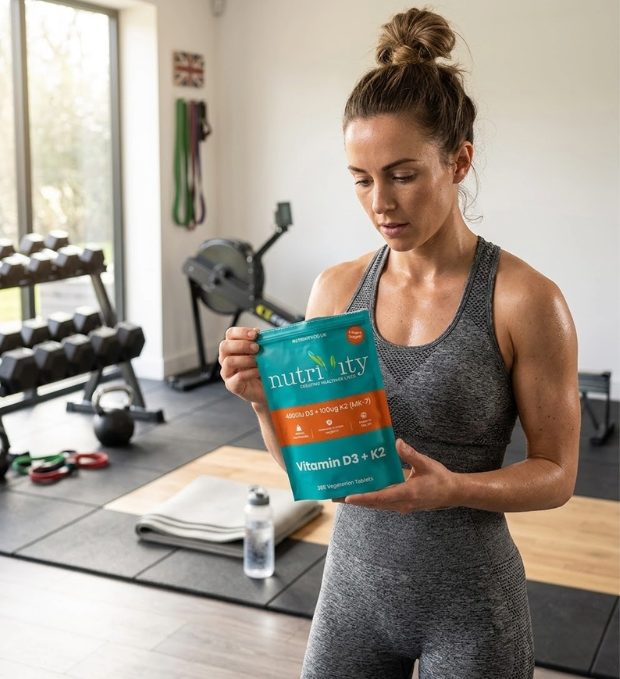
Vitamin D3 supports muscle function, immune health, and bone density — all directly relevant to athletic performance and injury prevention. Vegan athletes should use lichen-derived D3 rather than the lanolin-derived default. For a full explanation of the D3 source issue, see our guide to is vitamin D3 vegan. Nutrivity’s Vitamin D3 4000 IU + K2 MK7 uses lichen-derived D3 in a compressed vegan tablet.
Omega-3 fatty acids (EPA and DHA) reduce exercise-induced inflammation, support cardiovascular function, and contribute to joint health under training load. Standard fish oil supplements are not vegan. Algae-derived omega-3 provides EPA and DHA from a fully plant-based source in HPMC capsule format. For a full breakdown of vegan omega-3 options, see our guide to vegan omega-3 supplements UK.
Vitamin B12 is non-negotiable for all vegans. B12 is essential for red blood cell production, neurological function, and energy metabolism — all directly relevant to athletic performance. Deficiency develops slowly but impairs performance well before clinical symptoms appear. Cyanocobalamin and methylcobalamin are both effective vegan forms in tablet or HPMC capsule format.
Iron is particularly relevant for endurance athletes and for female vegan athletes, where both training volume and dietary pattern can contribute to low iron status. Low iron impairs oxygen transport and significantly reduces endurance performance. Iron supplements in tablet format are generally straightforward for vegan compliance — check for gelatine in capsule formats.
The Core Vegan Supplement Stack for Athletes
 CoQ10 — Energy Production and Recovery
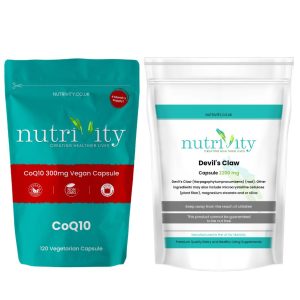
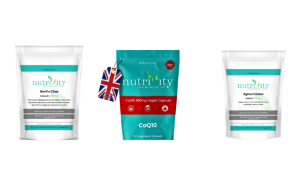
CoQ10 plays a central role in mitochondrial energy production and acts as an antioxidant that reduces oxidative stress from exercise. Athletes generate significantly more oxidative stress than sedentary individuals, and CoQ10 levels are depleted by intense training. Nutrivity’s CoQ10 300mg uses HPMC vegetable capsules and naturally fermented ubiquinone — fully vegan-suitable at one of the highest available strengths in the UK market.
Devils Claw — Joint and Musculoskeletal Recovery
High training loads place significant stress on joints, tendons, and connective tissue. Devils claw is a well-researched herbal supplement for joint pain, inflammation, and musculoskeletal discomfort — relevant for athletes managing training-related joint stress or recovering from injury. Nutrivity’s Devils Claw 2200mg Vegan Capsules use HPMC plant-based capsules and alcohol-free extraction — fully vegan-suitable at high strength.
Dandelion Root — Hydration and Recovery Support
Dandelion root supports liver function and acts as a mild natural diuretic, useful for athletes managing fluid balance, reducing post-training bloating, and supporting general detoxification. Nutrivity’s Dandelion Root 1000mg Veg Capsules use HPMC plant-based capsules and alcohol-free extraction — fully vegan-suitable.
Vegan Compliance Issues in Sports Nutrition
Whey and casein protein are dairy-derived and not vegan. The vegan alternatives — pea, rice, hemp, and soy protein — provide complete or near-complete amino acid profiles and are effective for muscle protein synthesis. Plant-based protein powders are generally lower risk for vegan compliance than capsule supplements, but still require full ingredient checking for flavourings, sweeteners, and flow agents.
Amino acid supplements in capsule format frequently use gelatine capsules and may use animal-derived amino acids. BCAAs (branched-chain amino acids) and individual amino acid supplements sourced from plant fermentation are vegan-suitable; those sourced from animal protein hydrolysis are not. The source is rarely disclosed on the label — contact the brand directly if capsule format and amino acid origin are both concerns.
Pre-workout supplements are among the least vegan-compliant products in the sports nutrition category. They frequently combine multiple herbal extracts (many alcohol-extracted), synthetic caffeine (vegan-suitable), and proprietary blends in gelatine capsules or with animal-derived ingredients. Plain caffeine anhydrous in HPMC capsules is the most reliably vegan-suitable stimulant option. Blended pre-workouts require detailed checking of every ingredient.
Recovery formulas commonly use gelatine, collagen peptides (animal-derived), and fish-derived omega-3 as core ingredients. Collagen supplements are by definition animal-derived — collagen is an animal protein. Vegan recovery formulas that support connective tissue health do so by providing the precursor nutrients (vitamin C, zinc, glycine) that the body uses to produce its own collagen, rather than providing collagen directly.
Electrolyte supplements are generally lower risk for vegan compliance — sodium, potassium, and magnesium from mineral sources are plant-neutral. Check for gelatine in any capsule-format electrolyte supplement and for carmine (E120) in any coloured tablet or liquid.
Summary — Vegan Supplement Choices for Athletes in the UK
Sports nutrition is the category most aggressively marketed and least reliably vegan-compliant in the supplement industry. The practical approach for vegan athletes is to separate the evidence-based from the marketing-driven: creatine, vitamin D3 (lichen-derived), algae omega-3, B12, and iron where needed are the supplements with genuine evidence behind them, and all are available in fully vegan-suitable formulations. CoQ10 and Devils Claw round out a well-evidenced vegan athlete stack for energy, recovery, and joint support.
The sports nutrition category — protein powders, pre-workouts, amino acid blends, recovery formulas — requires the most careful checking. Read the full ingredient list, check every capsule material, and do not assume that “natural” or “clean” marketing language means vegan-suitable.
Browse Nutrivity’s complete vegan supplements range, with full ingredient transparency on every product page and UK GMP-certified manufacturing throughout.
Frequently Asked Questions
What supplements do vegan athletes need?
The most important supplements for vegan athletes are vitamin B12 (non-negotiable for all vegans), lichen-derived vitamin D3 for muscle function and bone health, algae-based omega-3 for EPA and DHA, creatine monohydrate for high-intensity performance, and iron if levels are low or training volume is high. CoQ10 supports energy production and recovery, and Devils Claw addresses joint and musculoskeletal stress from training loads.
Is whey protein vegan?
No. Whey protein is derived from dairy milk and is not vegan. Pea protein, rice protein, hemp protein, and soy protein are the main vegan alternatives. Plant-based protein powders provide effective muscle protein synthesis support when consumed in adequate quantities, though the amino acid profiles and leucine content vary between sources. A combination of pea and rice protein provides a complete amino acid profile comparable to whey.
Are BCAAs vegan?
It depends on the source. BCAAs can be produced from plant fermentation (vegan-suitable) or from animal protein hydrolysis (not vegan). The source is rarely stated on the label. Contact the brand directly and ask whether their BCAAs are plant-fermented or animal-derived before purchasing.
Is creatine vegan?
Synthetic creatine monohydrate is produced through chemical synthesis with no animal-derived ingredients and is vegan-suitable in plain powder format. Creatine in capsule form requires verification of the capsule material. Look for HPMC or vegetable capsule rather than gelatine. Avoid products that combine creatine with additional herbal ingredients unless each ingredient has been individually verified.
Can vegan athletes perform at the same level as non-vegan athletes?
Yes. Athletic performance is determined by training quality, recovery, nutrition adequacy, and individual physiology — not by whether a diet includes animal products. Vegan athletes who plan their nutrition carefully and supplement appropriately for the specific gaps in a plant-based diet (B12, D3, omega-3, iodine, iron where needed) have no inherent performance disadvantage. The evidence base for plant-based performance nutrition has grown significantly in recent years and supports this position.
Are Nutrivity's supplements suitable for vegan athletes?
Yes. All Nutrivity hard capsule products are vegan-suitable — including CoQ10 300mg, Devils Claw 2200mg, Dandelion Root 1000mg, and Vitamin D3 4000 IU + K2 MK7. All use HPMC vegetable capsules, alcohol-free extraction for herbal formulations, and vegetable-derived flow agents. Full ingredients are published on every product page at nutrivity.co.uk.