


Are Capsules Vegan? HPMC vs Gelatine Explained
-
By Chris Jones
Written by Chris Jones, Social Media Manager at Nutrivity with 7+ years in the supplement industry.
Are Capsules Vegan? HPMC vs Gelatine Explained
The capsule shell is the most overlooked ingredient in any supplement. Most people focus entirely on the active ingredient — the vitamin, mineral, or herbal extract — and pay no attention to what it is delivered in. For vegan consumers, this is a significant oversight. The majority of capsule supplements sold in the UK use gelatine shells derived from animal collagen, making them unsuitable for vegans regardless of what the active ingredient is.
This guide explains the two main capsule types, how to identify them on a label, what their vegan status is, and why HPMC vegetable capsules are the standard that vegan supplement consumers should be looking for. For a full overview of hidden non-vegan ingredients across all supplement types, see our guide to are supplements vegan. For Nutrivity’s complete range of vegan-suitable supplements, visit our vegan supplements guide.
The Two Main Capsule Types
Hard Capsules
Hard capsules are the two-piece capsules used for powders, granules, and pellets. They consist of a body and a cap that fit together to enclose the fill material. Hard capsules are the most common format in the supplement industry and are used for the majority of vitamins, minerals, and herbal supplements.
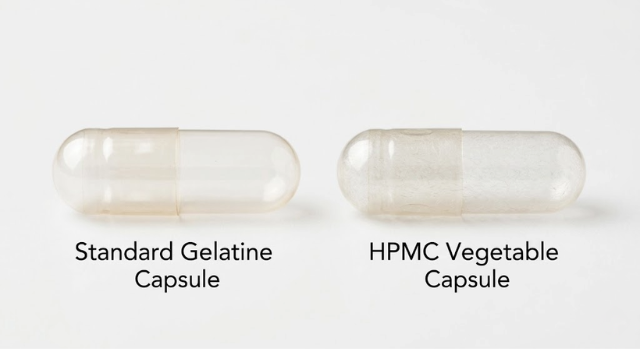
Hard capsules can be made from either gelatine or HPMC (hydroxypropyl methylcellulose). Both formats are widely available, and the manufacturing equipment for both is standard across the industry. The choice between gelatine and HPMC hard capsules is a deliberate one made by the manufacturer — and it is the single most important vegan compliance decision in supplement production.
Soft Gel Capsules
Soft gel capsules are the oval, liquid-filled capsules used for oil-based supplements — fish oil, cod liver oil, vitamin E, CoQ10, evening primrose oil, and similar products. They have a one-piece construction with a flexible shell that encases the liquid fill.
Standard soft gel capsule production requires gelatine. The gelatine provides the flexibility needed to form and seal the soft gel shell using standard manufacturing equipment. Plant-based soft gel technology exists — using modified starch or carrageenan — but it remains rare in the UK market due to higher production costs and more limited manufacturing infrastructure. For practical purposes, the majority of soft gel supplements in the UK are not vegan-suitable unless the brand explicitly states otherwise.
What Is Gelatine and Why Is It Not Vegan?
Gelatine is a protein derived from animal collagen — the connective tissue found in skin, bones, and cartilage. In supplement manufacturing, it is sourced primarily from bovine (cattle) or porcine (pig) origins, though fish gelatine is also used in some products.
Gelatine is not vegan because it is directly derived from animal tissue. It is the by product of slaughter, requiring animal-derived raw materials regardless of which species it comes from. It appears on supplement labels simply as “gelatine” without any indication of the animal source — bovine, porcine, and fish gelatine are all labelled identically under UK law.
Gelatine dominates supplement capsule manufacturing because it is cheap, widely available, and has well-understood physical properties for both hard and soft gel applications. It is the industry default, which means a supplement listing “gelatine” on the label without further qualification should be assumed not vegan-suitable.
What Are HPMC Vegetable Capsules?
HPMC stands for hydroxypropyl methylcellulose — a plant-derived polymer produced from cellulose, the structural material found in plant cell walls. HPMC is used to produce vegetable capsule shells that are functionally similar to gelatine capsules in hard capsule formats — they dissolve at a comparable rate, deliver active ingredients to the digestive system equivalently, and are stable across a wide range of temperatures and humidity levels.
HPMC contains no animal-derived ingredients and is fully vegan-suitable. It is also halal-suitable and kosher. It appears on supplement labels as HPMC, hypromellose, or “vegetable capsule.” Any of these on an ingredient list confirms the capsule shell is plant-based.
HPMC capsules are more expensive to produce than gelatine capsules, which is why they are less common in mainstream mass-market supplements. However, they are standard practice among supplement manufacturers who specifically serve vegan, halal, or health-conscious markets — and the price difference at retail level is minimal.
All of Nutrivity’s hard capsule products use HPMC vegetable capsules. This covers our full herbal extract range including Devils Claw, Agnus Castus, Dandelion Root, Damiana, and all other capsule-format products. Full capsule information is confirmed on every product page.
Pullulan — The Other Vegan Capsule Option
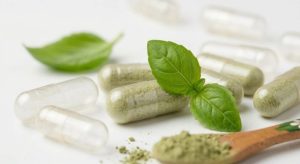
Pullulan is a polysaccharide produced by a fungus and used as an alternative to both gelatine and HPMC for capsule production. It is plant-derived (or more accurately fermentation-derived), fully vegan-suitable, and produces a capsule with a notably low oxygen permeability — making it particularly well suited for oxygen-sensitive ingredients.
Pullulan capsules are less common than HPMC capsules in the UK market and tend to carry a premium price. They appear on labels as “pullulan” or “pullulan capsule.” Where you see this listed, the capsule is vegan-suitable.
How to Check Whether a Supplement Capsule Is Vegan
Check the ingredient list for the capsule shell material. In UK supplements, the capsule shell is listed as an ingredient. Look for HPMC, hypromellose, vegetable capsule, or pullulan for vegan-suitable options. Look for gelatine as the non-vegan indicator. If no capsule material is listed and the product is in capsule format, contact the brand directly.
Do not rely on a vegetarian label to confirm vegan capsules. Many supplements labelled “suitable for vegetarians” use bovine gelatine capsules — bovine gelatine is technically vegetarian. A vegetarian label does not confirm vegan suitability for the capsule shell.
Soft gel format requires explicit confirmation. If a supplement is in soft gel format, assume gelatine unless the brand explicitly states a plant-based alternative. Even vegan-labelled soft gels are worth verifying, as the technology is newer and less standardised.
Look for certified vegan logos. Products carrying the Vegan Society Trademark or equivalent have had their capsule materials verified as part of the certification process. This is the most reliable signal for capsule vegan status.
Does Capsule Type Affect Supplement Effectiveness?
No. HPMC capsules dissolve at a comparable rate to gelatine capsules in the digestive system and deliver active ingredients with equivalent effectiveness. The capsule is the delivery mechanism — it does not interact with the active ingredient or affect its bioavailability in any meaningful way for standard supplements.
There is one minor technical distinction: HPMC capsules have a slightly different moisture content and dissolution profile to gelatine capsules, which can be relevant for certain moisture-sensitive formulations. However, for the vast majority of supplement ingredients, this difference is not clinically meaningful and does not affect the consumer’s experience of the product.
Summary — Choosing Vegan Capsule Supplements in the UK
The capsule shell is the first thing to check on any supplement, and it is the ingredient that mainstream supplement brands are least likely to highlight. Gelatine is the industry default — cheap, widely available, and used without disclosure in the majority of UK supplement capsules. For vegan consumers, the practical approach is to look for HPMC, hypromellose, vegetable capsule, or pullulan on the ingredient list, and to treat any product listing “gelatine” as not vegan-suitable.
For a deeper understanding of vitamin D3 sourcing — the other major vegan compliance issue in supplements — see our guide to is vitamin D3 vegan.
Browse Nutrivity’s complete vegan supplements range, with full ingredient transparency on every product page and UK GMP-certified manufacturing throughout.
Frequently Asked Questions
Are gelatine capsules vegan?
No. Gelatine is derived from animal collagen — skin, bones, and connective tissue from cattle, pigs, or fish. It is a byproduct of slaughter and is not vegan. Any supplement listing gelatine as a capsule material is not suitable for vegans.
What does HPMC mean on a supplement label?
HPMC stands for hydroxypropyl methylcellulose — a plant-derived polymer used to make vegetable capsule shells. It contains no animal-derived ingredients and is fully vegan-suitable. If a supplement lists HPMC, hypromellose, or vegetable capsule as the capsule shell, the capsule itself is vegan.
Are soft gel capsules vegan?
Standard soft gel capsules are not vegan — they require gelatine for the flexible shell. Plant-based soft gel alternatives exist but are rare in the UK market. For oil-based supplements in soft gel format, assume gelatine unless the brand explicitly states a plant-based alternative has been used.
Can I tell from the label whether a capsule is vegan?
Usually yes — UK supplement labels are required to list all ingredients, including the capsule shell material. Look for HPMC, hypromellose, vegetable capsule, or pullulan for vegan-suitable options. If the label lists gelatine, the capsule is not vegan. If no capsule material is listed, contact the brand directly.
Are vegetarian capsules the same as vegan capsules?
Not necessarily. Some products use the term “vegetarian capsule” to describe HPMC capsules, in which case it is equivalent to vegan. However, “vegetarian” on a label does not automatically mean the capsule is vegan — bovine gelatine capsules are technically vegetarian. Always check the specific capsule material listed rather than relying on a vegetarian claim.
What capsules does Nutrivity use?
All Nutrivity hard capsule products use HPMC vegetable capsules — plant-based, vegan-suitable, and halal-suitable. Our soft gel products (Cod Liver Oil, Castor Oil, Olive Oil, Blackcurrant Seed Oil) use halal-permissible gelatine and are not suitable for vegans. Full capsule information is confirmed on every product page at nutrivity.co.uk.