



Halal Supplements for Children and Families in the UK — A Parent’s Guide
-
By Chris Jones
Halal Supplements for Children and Families in the UK — A Parent’s Guide
Choosing supplements for children requires more care than choosing for adults — and for Muslim parents, halal compliance adds a further layer of scrutiny that mainstream children’s supplement brands rarely address. Gummy vitamins, chewable tablets, and liquid supplements marketed at children are among the most likely supplement formats to contain gelatine, carmine, and other non-halal ingredients — often hidden behind appealing packaging and child-friendly marketing.
This guide covers the supplements most important for children at different stages of development, the specific halal compliance issues in children’s supplement formats, and how to make informed purchasing decisions as a Muslim parent in the UK. For Nutrivity’s full range of halal-suitable supplements, visit our halal supplements guide.
Why Children’s Supplements Require Extra Halal Scrutiny
Children’s supplements present more halal compliance problems than adult supplements — not fewer. The formats designed to be palatable for children are precisely the ones that introduce the most non-halal ingredients.
Gummy vitamins are almost always non-halal. Gummy format supplements require a gelling agent to give them their texture. That gelling agent is almost universally gelatine — and in mainstream children’s gummy vitamins, pork-derived gelatine is the default. Brands rarely disclose the gelatine source on packaging. The brightly coloured, bear-shaped format that makes gummies appealing to children is built on an ingredient that Muslim parents cannot use.
Chewable tablets frequently contain carmine. The red, pink, orange, and purple colours in chewable supplement tablets are often achieved using carmine (E120) — a dye derived from crushed cochineal insects. It appears on labels as E120, carmine, cochineal, or carminic acid. Many children’s multivitamins and chewable vitamin C products in the UK contain it.
Liquid vitamins may contain alcohol as a preservative. Some liquid vitamin formulations use ethanol as a preservative or carrier for certain active ingredients. This is not always disclosed clearly on the label. Liquid supplements marketed at infants and young children require ingredient checking beyond the headline vitamins.
Children’s omega-3 products face the same soft gel problem as adult products. Omega-3 and fish oil products for children — whether in soft gel or gummy format — carry the same gelatine issues as adult products, with the additional concern that the gummy format introduces pork gelatine for the texture as well as the capsule.
The Most Important Supplements for Children in Muslim Households
 Vitamin D3 — The NHS-Recommended Foundation
The NHS recommends vitamin D supplementation for all children from birth to five years old, and for older children and adults who have limited sun exposure. This recommendation is particularly relevant for Muslim families in the UK, where cultural dress practices and limited sunlight mean vitamin D deficiency is more common than in the general population.
Vitamin D3 is the preferred form — more effective at raising serum vitamin D levels than D2. However, most vitamin D3 supplements use lanolin-derived D3 from sheep’s wool, and the halal status of lanolin-derived D3 is a point of scholarly debate. The unambiguous halal-suitable alternative is lichen-derived D3, which is plant-based with no animal involvement.
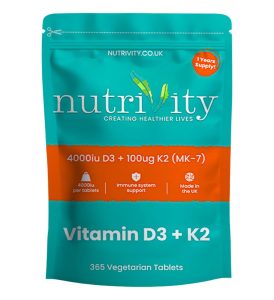
Nutrivity’s Vitamin D3 4000 IU + K2 MK7 uses lichen-derived D3 in a compressed vegan tablet — no gelatine, no lanolin, halal-suitable without qualification. Note that this is an adult-strength formulation at 4000 IU. For children, consult your GP or pharmacist regarding appropriate dosage — a child-specific lower-strength product may be more suitable depending on age.
Omega-3 — Brain Development and Cardiovascular Health
Omega-3 fatty acids — particularly DHA — are important for brain development in children, as well as cardiovascular and inflammatory health across all age groups. For Muslim families, the challenge is finding an omega-3 product that is not in a pork gelatine soft gel or gummy format.
The most practical halal-suitable options are algae-derived omega-3 (which bypasses the fish and gelatine entirely) or a fish oil product that explicitly discloses the use of halal-permissible gelatine. Nutrivity’s Cod Liver Oil & Glucosamine 1000mg uses halal-permissible gelatine — not pork-derived — though this is an adult product. For children, algae-based omega-3 in appropriate child-suitable dosage is the cleanest halal option.
Iron — Particularly Important for Girls and Adolescents
Iron deficiency is among the most common nutritional deficiencies in children in the UK, particularly in girls after puberty and in children following restricted diets. Iron supplementation in liquid or tablet form is generally lower risk for halal compliance than gummy or soft gel formats — iron tablets and liquids typically do not require gelatine. Check for carmine in any coloured chewable or liquid iron product, and for alcohol as a preservative in liquid formulations.
Multivitamins — Format Matters More Than Brand
For a general children’s multivitamin, the format is the primary halal consideration. Hard capsules in HPMC vegetable capsule format are the safest option. Tablets without coatings or with clearly stated coatings are second. Chewable tablets require checking for carmine. Gummy vitamins should be avoided unless the brand explicitly confirms halal-certified gelatine. Liquid multivitamins require checking for alcohol preservatives and carmine.
A Practical Family Approach to Halal Supplements
For most Muslim families in the UK, a practical halal supplement routine covers three priorities: vitamin D for the whole family (NHS-recommended and clearly necessary in the UK climate), omega-3 for brain and cardiovascular health, and a multivitamin for children during developmental years where dietary gaps are most likely.
For adults in the household, Nutrivity’s hard capsule range provides a broad selection of halal-suitable supplements across all health categories — all using HPMC vegetable capsules, alcohol-free extraction on herbal formulations, and vegetable-derived flow agents. For children, the same ingredient principles apply — prioritise HPMC capsule or plain tablet formats, avoid gummies unless gelatine source is confirmed, and check every liquid product for preservatives and colourings before purchasing.
When in doubt about a product for a child, contact the brand directly and ask: What is the gelatine source? Does this product contain carmine or shellac? Does the liquid formulation contain alcohol as a preservative? A brand with nothing to hide will answer these questions immediately.
Summary — Halal Supplement Choices for Muslim Families
Children’s supplements are the area where halal compliance and mainstream product design are most at odds. The formats children enjoy most — gummies, chewable tablets, colourful liquids — are also the formats most likely to contain pork gelatine, carmine, and alcohol. Muslim parents need to look past the child-friendly packaging and apply exactly the same label-reading discipline as they would for adult products.
The practical solution is to prioritise format over brand: HPMC capsule or plain tablet formats are the safest starting point, and the ingredient checklist applies equally whether the product is for a child or an adult. For the NHS-recommended priorities of vitamin D and omega-3, halal-suitable options exist — lichen-derived D3 and algae-based omega-3 solve both the efficacy and halal compliance questions simultaneously.
Browse Nutrivity’s complete halal supplements range, with full ingredient transparency on every product page and UK GMP-certified manufacturing throughout.
Frequently Asked Questions
Are children's gummy vitamins halal?
Most are not. Gummy vitamins require a gelling agent, and the UK market default is pork-derived gelatine. Unless a brand explicitly states it uses halal-certified gelatine and this can be verified, children’s gummy vitamins should be treated as not halal-suitable. There are a small number of halal gummy vitamin products available from specialist brands, but they are not the mainstream.
What vitamin supplements does the NHS recommend for children?
The NHS recommends vitamin D supplementation for all children from birth to five years old, and for all children and adults who have limited sun exposure. Vitamins A and C are also recommended for children from six months to five years old. These recommendations apply regardless of dietary background and are particularly relevant for families in the UK where sunlight-derived vitamin D synthesis is limited for much of the year.
Is vitamin D3 halal for children?
It depends on the source. Lichen-derived vitamin D3 is plant-based and halal-suitable without qualification. Lanolin-derived vitamin D3 — the more common form — is a point of scholarly debate. If you want certainty, choose a product that explicitly states lichen-derived D3. Always check the dosage is appropriate for your child’s age — 4000 IU is an adult dose and a lower strength may be needed for younger children.
Can children take adult supplements at lower doses?
This is a question for your GP or pharmacist, not a general rule. Some adult supplements are appropriate for older children at reduced doses; others contain ingredients or dosages not suitable for children at all. Always consult a healthcare professional before giving adult-formulated supplements to children.
What should I look for on a children's supplement label?
Check the capsule or gummy base first — look for HPMC, hypromellose, or vegetable capsule rather than gelatine. Check for E120, carmine, cochineal, or carminic acid in the colourings. Check for ethanol or alcohol in liquid formulations. Check whether vitamin D3 is lanolin or lichen-derived. These five checks will cover the vast majority of halal compliance concerns in children’s supplements.
Are Nutrivity supplements suitable for children?
Nutrivity’s products are formulated for adults and most are at adult-strength dosages. They are not specifically formulated or dosed for children. However, the ingredient standards — HPMC vegetable capsules, alcohol-free extraction, vegetable-derived flow agents, no carmine, no shellac — represent the benchmark that children’s supplement products should also meet. Always consult a GP or pharmacist before giving any supplement to a child.