

Halal Omega-3 and Fish Oil Supplements in the UK — What You Need to Know
-
By Chris Jones
Halal Omega-3 and Fish Oil Supplements in the UK — What You Need to Know
Omega-3 fatty acids are among the most widely recommended supplements in the UK — supporting cardiovascular health, reducing inflammation, and contributing to joint flexibility. But for Muslim consumers, the standard fish oil soft gel capsule presents a problem that is rarely addressed on the label: the capsule itself is almost always made from pork-derived gelatine.
This guide covers exactly why omega-3 and fish oil supplements are a halal compliance issue, what your options are, and how to identify genuinely halal-suitable omega-3 products in the UK. For Nutrivity’s full range of halal-suitable supplements, visit our halal supplements guide.
Why Omega-3 Soft Gels Are a Halal Problem
The omega-3 and fish oil itself is not the issue. Fish oil from permissible fish species is halal-suitable — it is a food-derived oil with no animal slaughter concerns beyond the fish itself, which is broadly accepted across Islamic schools of jurisprudence.
The problem is the capsule.
Omega-3 and fish oil supplements are almost exclusively sold in soft gel capsule format. Soft gels require a flexible shell material to encapsulate the liquid oil, and the industry standard for that shell is gelatine. Gelatine is a protein derived from animal collagen — and in supplement manufacturing, pork-derived gelatine dominates the market because it is cheap, widely available, and has reliable physical properties for soft gel production.
UK labelling law requires gelatine to be listed as an ingredient, but does not require the animal source to be stated. This means a fish oil soft gel can list “gelatine” on the label without any indication that it is pork-derived — and in most cases, it is.
Unless a brand explicitly states the source of its gelatine, or uses a certified halal gelatine, you cannot assume the product is halal-suitable. This applies to virtually every mainstream fish oil brand sold in UK supermarkets and pharmacies.
The Three Omega-3 Capsule Types and Their Halal Status
Pork gelatine soft gels — haram. The default in mainstream supplement manufacturing. Pork-derived gelatine is explicitly prohibited in Islamic dietary law. Most fish oil and omega-3 soft gels sold in UK supermarkets and pharmacies fall into this category, even if the label does not state the gelatine source.
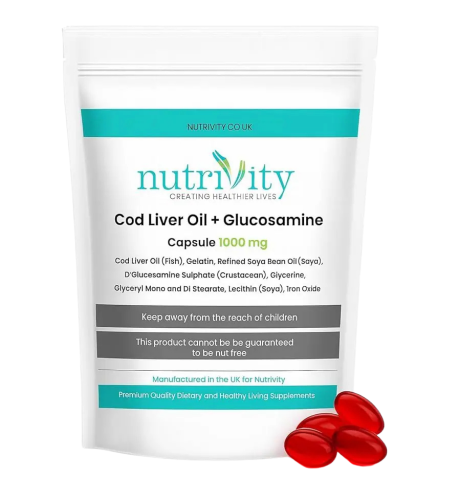
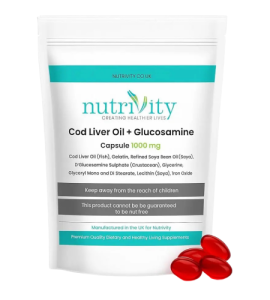
Halal-certified gelatine soft gels — halal-permissible. Some manufacturers use gelatine sourced from halal-permissible animals, typically bovine gelatine from halal-certified sources or fish gelatine. These are halal-suitable where the gelatine source is verified and the product is explicitly certified or disclosed. Nutrivity’s soft gel products, including our Cod Liver Oil & Glucosamine, use halal-permissible gelatine — not pork-derived.
Plant-based alternatives — halal-suitable and vegan. HPMC (hydroxypropyl methylcellulose) vegetable capsules are used for hard capsule formats, but standard soft gel production requires gelatine — plant-based soft gels are technically challenging and rare. Algae-based omega-3 supplements packaged in HPMC hard capsules are available as a fully plant-based, halal-suitable alternative.
Halal Omega-3 Options Available in the UK
 Fish-Derived Omega-3 in Halal-Certified Soft Gels
The most practical halal-suitable option for consumers who want fish-derived omega-3 is a product that explicitly uses halal-permissible gelatine and discloses this on the product page or packaging. This is not common — most brands do not address gelatine source at all — but it does exist.
Nutrivity’s Cod Liver Oil & Glucosamine 1000mg uses halal-permissible gelatine in its soft gel capsule, not pork-derived. Cod liver oil provides omega-3 fatty acids (EPA and DHA) alongside vitamins A and D, and the addition of glucosamine makes it a dual-purpose product for cardiovascular and joint health. Full ingredients are published on the product page.
Algae-Based Omega-3 — The Fully Plant-Based Alternative
Algae-derived omega-3 provides EPA and DHA from the same original source that fish obtain their omega-3 from — marine algae. Because it bypasses the fish entirely, it contains no animal-derived ingredients beyond the algae itself, making it halal-suitable and vegan without any gelatine concerns.
Algae omega-3 is the recommended option for consumers who want full certainty about halal compliance without relying on gelatine source verification. It is also the only omega-3 option fully suitable for both halal and vegan consumers simultaneously.
ALA from Plant Sources — Flaxseed, Hemp, and Chia
Plant-based omega-3 from flaxseed oil, hemp seed oil, and chia provides ALA (alpha-linolenic acid), which the body can partially convert to EPA and DHA. The conversion rate is low — typically under 15% for EPA and under 5% for DHA — so plant-based ALA sources are not equivalent to direct EPA and DHA supplementation for cardiovascular and inflammatory support.
These are halal-suitable without qualification and are a useful addition to diet, but should not be treated as a direct replacement for EPA and DHA supplementation where those are the specific health goals.
What to Look for When Buying Halal Omega-3 in the UK
Check the gelatine source explicitly. If a brand lists “gelatine” in the ingredients and does not state the source, do not assume it is halal-suitable. Contact the brand directly or choose a product that discloses gelatine origin on the product page. Silence on gelatine source is a red flag, not a green light.
Halal certification on the packaging is the clearest signal. A recognised halal certification body — such as HFA (Halal Food Authority) or HMC (Halal Monitoring Committee) — provides third-party verification of both the gelatine source and the manufacturing process. Not all halal-suitable products are certified (Nutrivity’s products are halal-suitable based on ingredient and manufacturing transparency, not third-party certification), but certification removes all ambiguity.
Vegan does not automatically mean halal for omega-3. A vegan omega-3 product in algae or plant form avoids all animal-derived ingredients and is halal-suitable. However, a fish oil product labelled vegan is a contradiction — fish oil is not vegan. Some products labelled “vegetarian” use fish gelatine rather than pork gelatine, but this still requires verification of which fish species the gelatine is derived from.
Look beyond the front label. The halal status of an omega-3 product cannot be determined from the front of pack. Always read the full ingredient list, check the brand’s product page for gelatine source disclosure, and if in doubt, contact the manufacturer before purchasing.
Summary — Choosing Halal Omega-3 in the UK
Omega-3 supplementation is well-supported by evidence for cardiovascular health, inflammation, and joint function — but for Muslim consumers in the UK, the standard soft gel format creates a halal compliance problem that most mainstream brands have not addressed. Pork-derived gelatine is the industry default for soft gel capsules, and the majority of fish oil products sold in UK supermarkets and pharmacies do not disclose their gelatine source.
The practical solution is straightforward: choose a brand that explicitly discloses its gelatine source, or choose an algae-based omega-3 product in HPMC capsules that avoids the gelatine question entirely. Do not assume that “gelatine” on a label without a stated source is halal-suitable — in the UK market, it is not a safe assumption.
Browse Nutrivity’s complete halal supplements range, with full ingredient transparency on every product page and UK GMP-certified manufacturing throughout.
Frequently Asked Questions
Is fish oil halal?
Fish oil from permissible fish species is halal-suitable — the oil itself is not the issue. The concern is the soft gel capsule, which in most mainstream UK products is made from pork-derived gelatine. Always verify the gelatine source, not just the oil source, when assessing whether a fish oil supplement is halal.
Is omega-3 halal?
Omega-3 fatty acids are not inherently haram. The halal compliance question for omega-3 supplements depends on the capsule material and the gelatine source. Fish-derived omega-3 in pork gelatine soft gels is not halal. Fish-derived omega-3 in halal-certified gelatine soft gels is halal-permissible. Algae-derived omega-3 in HPMC capsules is halal-suitable without qualification.
What is the difference between EPA, DHA, and ALA?
EPA (eicosapentaenoic acid) and DHA (docosahexaenoic acid) are the long-chain omega-3 fatty acids directly used by the body for cardiovascular, inflammatory, and neurological health. They are found in fish and algae. ALA (alpha-linolenic acid) is a short-chain omega-3 found in plant sources such as flaxseed and hemp. The body can convert ALA to EPA and DHA, but the conversion rate is low and unreliable. For specific cardiovascular or inflammatory health goals, direct EPA and DHA supplementation is more effective than ALA alone.
Is Nutrivity's Cod Liver Oil halal?
Yes. Nutrivity’s Cod Liver Oil & Glucosamine 1000mg uses halal-permissible gelatine in its soft gel capsule — not pork-derived. Full ingredients are published on the product page at nutrivity.co.uk.
Can I get enough omega-3 from diet alone?
It depends on how much oily fish you eat. The NHS recommends at least two portions of fish per week, including one portion of oily fish, to maintain adequate omega-3 intake. For those who eat oily fish regularly, supplementation may not be necessary. For those who eat little or no fish — including many people following halal dietary patterns who avoid non-halal fish products — omega-3 supplementation provides a practical way to maintain adequate EPA and DHA levels.
Are soft gel capsules always gelatine-based?
Standard soft gel capsule production uses gelatine. Plant-based soft gel technology exists but is significantly less common and more expensive to produce, which is why it remains rare in the UK supplement market. For consumers who need to avoid gelatine entirely, algae-based omega-3 in hard HPMC capsules is currently the most practical fully plant-based and halal-suitable alternative.